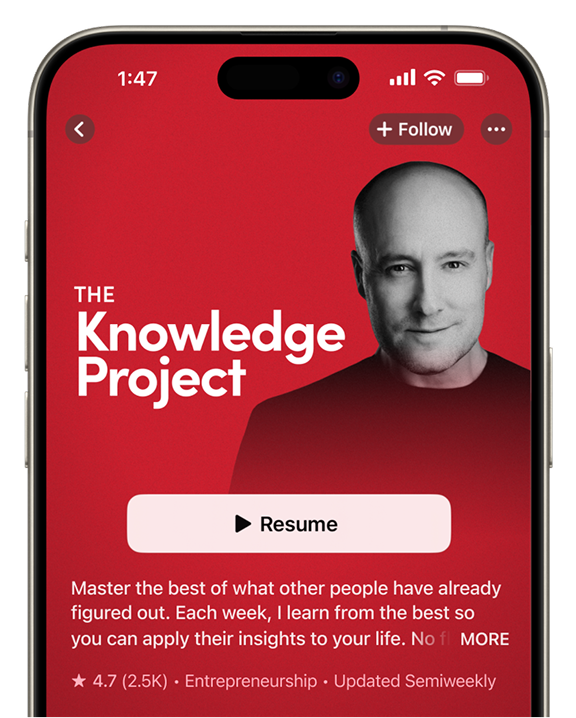
My guest today is Shopify co-founder and CEO Tobi Lütke. We discuss the differences between founders and professional managers, how he has scaled with Shopify, the continuous fight against bureaucracy, how he thinks about innovation in a large company, and how he manages to keep his head when everyone else is losing theirs.
Listen and Learn on: YouTube | Apple Podcasts | Spotify | Transcript
A coder at heart who emigrated from Germany to Canada two decades ago, Lütke co-founded the e-commerce giant Shopify in Ottawa in 2006.
Transcript
Shane: How do you lead through such a period of volatility?
Tobi: I don’t know if I did a very good job of it, but I certainly did it. I certainly had to deal with volatility, that’s true. Shopify has captured the imagination of everyone in this massive swing towards digital services. Market beta caused Shopify to be extremely exposed and just on everyone’s mind. And then the pullback was equally drastic, which was a fascinating experience internally. It’s lots of discussions you get always.
Everyone’s getting messages from their parents about, like, hey, what’s going on? I mean, I’ve never thought that companies and their stock have that much to do with each other. It’s related, but no one in a company works on the stock if things are going well. I think if people start working on stock, that should be a sign that things have gone pretty poorly in the company.
So it’s been a challenging time for leadership because you never knew what kind of puzzle box would drop onto your desk in the morning. And things are very important during that time, but things that are important during all times, which is the most important thing, is to keep the most important thing, the most important thing. And the most important thing in our case is make a product that’s really appreciated by entrepreneurs and can deal with, not just the current, but also the next sets of problems. We adjusted quickly. We shipped a lot of products that had, in the early days, curbside pickup and so on. And then we just took it from there.
Shane: How do you keep the most important thing, the most important thing, when the world around you is going crazy?
Tobi: Yeah. I would say when you dig into the nuances of what the most important thing is, it’s usually not the current tactic, but it’s actually the overall strategy. And the North Star is the thing that you need to protect. Right? The end result, the reason why the company exists is the thing that needs to be protected. And in our case, it’s very much like, we love entrepreneurship, we think entrepreneurship should be simpler. We think entrepreneurship should be simpler on internet than it has been in the past, in a physical world. We want to build software to make entrepreneurship just easier. At least make it so that the technology side and internet side so that these things are not something you have to worry about.
We take care of all of them and you make great products. To a degree that we can have, we have a voice as well, but basically, sure, there’s something people want and we will do whatever we can to make you reach your audience, because if that is your North star, just because suddenly no one can reach stores and these things. That’s an obstacle which no one could see coming. But if you know in which direction you want to go, then you just know, okay, well, clearly, we have to get around this obstacle. So as long as we keep going the same direction, it’s all fine.
Right now, no one can reach retail stores, so make sure that we have retail stores, get the catalogue online and curbside pick-up, these kinds of things. I actually think, even concepts like roadmaps and generally, plans are actually overrated. The best possible roadmap is have a very clear guide view of what matters to your merchant, have a super strong model of your own capabilities as a company. And then we run the function of deciding what is the very best thing you can work on. Every moment, you have teams ready to pick the next task instead of everyone of doggedly working off a thing that, of course, gets interrupted by reality.
How this looks in actual practice is you look at everything that is being done in your company and you put things into categories, helpful, not helpful right now, because reality changed. And I think we ended up stopping to vote on canceling or not getting 60% of our things we were working on, which I think everyone was ready for because it was very obvious in first half of 2022 that we are going into very different times. So everyone was looking to see, how can we be most helpful?
All of us made life decisions. We were not doctors, we were not frontline workers. We were not essential workers, but we worked in the technology industry. The technology industry was probably among the least affected from a productivity perspective. We had home setups. And given, us not being able to be helpful with the primary objective that everyone had, which is health-related, we could at least nail it on what we could do. So everyone rallied around this and we got cracking on that.
Shane: I imagine it pulled you altogether too because all of a sudden there’s a lot of meaning and urgency to what you’re doing.
Tobi: I mean, it clarified the mission for everyone. And mission, everyone talks about mission. It’s almost like one of those things you go like, “Well, what’s your mission statement and whatnot?” But it matters. It’s a reason. Some companies might have mission statements that are dissonant with what they actually want, and that’s unfortunate. I think that’s rare in founder-led companies. They tend to be coming from a particular observation or particular reason why they needed to exist.
In some cases, that is a limited goal. At some point, you might accomplish this goal and then you’re looking for something else. In our case, I don’t think be threatened by this, but this is a forever mission, an infinite game if you want. So it’s really clarifying for us.
Now it was very difficult times. I mean, man, so many people were holed up in tiny, little apartments and didn’t step outside for a year or more. There are a lot of mental health issues. They had so much energy to want to do something. People were upset with what they were seeing in so many different ways. Not just COVID, but also other conversations. There are a lot of racial unrest for very good reasons and there was a lot of energy that couldn’t be converted into productive means during this time, which made things challenging as well. And it was a fascinating time. It was a challenging time. I think it was a clarifying time. I think a lot of companies, are connected really with why they are there and how they think about their own principles, how they think about organizing, how they think about talking, how they think about contributing, not just as a company, but also as a community. We had to go through this all in a hurry and all at the same time. Leadership for this was tricky. Yes.
Shane: Are there different roles that you see for founders and CEOs?
Tobi: Yes. I have complex thoughts on this because, I mean, it’s a recurring conversation. I don’t have a good word for non-founder-led companies. I used to refer to them as professionally managed companies, but it’s the implication that the founder-led companies are amateurishly managed, which is actually not true. So I’m lacking a great moniker for non founder-led companies. But if you’ve worked for both these types, they are very different internally, completely.
Professionally managed companies are often like a river stone, right? Something that’s really smooth around all the edges. It’s a very similar skill level on everything. If they have significant competencies, they’re often about just operational excellence and very, very quantifiable things. Everything that can be measured, they tend to be very good at.
The core competency of a CEO or leadership team is management, I guess. I say it with great respect because it’s a very, very hard thing to do. It’s extraordinarily hard to align the interests of very, very different groups and bring them all to the same side of a table. You have a shareholder community, sometimes society, definitely your local economies, your employees, your customers, of course, and the board of directors.
Taking everyone for a journey is a tricky thing to do. The way you do this in a professionally run company is by planning. What you’re trying to do is literally everything a company does, is try to beat reversion to the mean. Your options there are like usually, you have a strategy. That’s the plan. But plan by the people, the stakeholder management who will bring all the stakeholders on site.
Have a plan with a ton of legitimacy. And then the legitimacy that the plan has ends up being the thing that beats revision to the mean, because you can now go around saying, “Hey, you have an engineering team. You’re implementing the things on the plan. You, UX, you’re going to build the user interface for us.” Sales learns what’s going to happen when. We have rich competency and how to explain the product. This is the mechanism.
Now all this to say the founder of a company doesn’t need this, right? Because there’s another thing of legitimacy, which is the founder. I’m not saying this is a person. It’s actually the fact that the founder is in the company.
I think legitimacy is one of the most underappreciated resources that exist. I think that the only really good piece of writing I found, and you probably might know 10 others, is Vitalik Road essay on the topic of legitimacy. More investment blockchain world, but I think it brings true across.
So where does this come from?
In every company, there’s a founding story. Everyone gets this clear sense that, hey, the reason why we have this job, the reason why we’re on this mission, the reason why we’re doing this thing is because at some point someone took the first step, wrote the first line of code. That story is imbued in the company. It’s in onboarding. It’s like, even if no one would actively talk about, it’s something people eventually encounter.
What happens when a story is told is that there is some little bit of legitimacy almost deposited into a bank account. You can almost think about it as social credit of some kind. This happens in all companies. But if the founders are still there, they can still draw on this account of legitimacy.
So my role, I see, very often is that I have a pretty humbling ability to use resources deposited into this bank account of legitimacy. The company made changes because I can speak for the entire story of the place. Now if I would leave Shopify, this bank account would only increase, but no one could draw on it. Therefore, it can’t be an active ingredient in the company. Okay. What does all this mean?
The best thing founders can do is subtraction. It’s much, much, much easier to add things than it is to remove things. Adding things is a lot more expensive than removing things. However, it requires some measure of bravery and risk-taking.
If you say no to a thing, you say no to one thing. If you say yes to a thing, you actually say no to every other thing you could have done for this period of time.
So as people add things, the set of things that can be done becomes smaller and smaller, and smaller. And the set of things that has to be maintained gets larger and larger, and larger, and you end up with more and more people actually working on just maintaining of status quo, or maintaining code bases and so on.
So where does subtraction come in? Every individual edition was a very good idea, but where it builds to is actually sediment layers of something that actually doesn’t make sense and that you have to walk away from. Sometimes you’re building for really, really good reasons, a product that will not make a difference for the company. Or when reality changes, like I just said earlier, I had to subtract 60% of everything the entire team was working on.
The reason why I could do this is because I could draw on the legitimacy of, hey, I have seen every single version of this company. I’ve seen recessions, I have seen downturns. I’ve seen chaotic times and I’ve seen calm times. I know what to do. So why this might affect you negatively because your day-to-day job is changing, the thing you’re going to be working on, you’re going to be prouder because it’s going to help the company’s mission in a better way. That is a form of subtraction. And then there are many, many others that we could go into.
The very best non-founder CEOs can subtract. It does help. Nadella has done it at Microsoft in a phenomenal way, potentially better than many founder CEOs can, but it’s probably 10 times harder to do or 100 times harder. So that’s almost a service rendered for the business. So in a way, where you have river stone on one side, you really have volcanic ash, spiky object thing of a rock on the other side. Sometimes very, very strong aptitudes, spiky objects. Sometimes surprising weaknesses. It’s not a well-rounded thing, but it’s usually perfectly appropriate in terms of its aptitudes for the particular set of problems that the company solves. I think this is why they end up feeling so different internally.
Shane: You mentioned risk-taking. How do you think about risk-taking in a professionally managed versus a founder-led company?
Tobi: There’s exactly one thing that doesn’t take risk, which is do the same thing everyone else does. I just don’t see value in doing the same thing as everyone else does.
Who grows up to say, “I’m going to go into UX. Let’s go to design UX, and then I’m going to do work that corresponds to what, generally, everyone else launches around me.”
I see why you might want to because it gives you more common ground with your peers in other places. It’s easier to appreciate making a slightly different version of something else that someone does because then if you encounter those people who are behind that, you can now have a conversation about the slight changes you made. If everyone does this, that makes this planet simply spin too slowly.
I think sometimes there’s significant wisdom encoded in what everyone’s doing. In most cases, go all in on it. But in many cases, just put everything you’ve ever learned together to make something that’s just as good as possible because, otherwise, I think you’re holding yourself back. And I think the company needs to de-risk this for people.
Now it’s no one’s intuition. Every single time you do anything that is different from best practices … We have so many euphemisms for just basically doing undifferentiated work. So strong statement I’m making here, but best practices actually just simply means don’t take risk and do what everyone else is saying you should be doing.
Best practices are not that good. I have no time for average. I think we can do much better on everything. There’s no chance that in 100 years, people are looking back and saying, “Wow, back then, we just nailed everything.” I mean, you look go back three years and you’re like “Wow, we just had no idea how to do all these things.”
Everything depends on innovation. To be innovative, you have to do things that are different. And if you do something different, you can either overperform or underperform the status quo. But again, if you can subtract, you can remove afterwards the things that underperformed and give another go at it. And if you do that effectively, over and over, then you are a company that’s out-competing what other people are doing.
Shane: So, is that the role of the company then, to provide safety for that failure internally?
Tobi: I think so. I don’t think anyone’s cracked the code on how to do this. I mean, school conspires to tell people, “Here’s how to solve problems. Ideally, don’t deviate. And you probably don’t have to learn anything new after this.” It’s just a joke, right? I mean, I don’t know how you steelman those arguments, but this is definitely what school is saying. … Some people will have vastly different career outcomes because they are just walking away. They’re using orthodoxy as a major input. They learn everything they can out of it. They use it as a starting point where they’re not hamstrung by it. They will do things that could be described as risky, but I have to say, this is very, very hard to get people to believe. But it’s actually risky to not try higher.
Shane: It’s not risky in the moment though, right? To follow best practices. It’s only risky as you fast-forward time.
Tobi: Yeah. I mean, they should acknowledge why. If you do what everyone else does, you are like, say, “Well, that’s what industry does.” If you make an edit to it, you will have a responsibility, good or bad, for that change. If you’re risk-avoidant, this is something you don’t want.
Now, of course, if it works, it’s great. At Shopify, it’s very clear, it’s very important that we explain to people, it’s the successful discovery of something that did not work if you underperform. You now actually have more data and will try again. People actually are performance-managed out if they don’t take risks.
So it’s actually for your career. At Shopify, it is actually riskier to not aim high. I think that environment, and with psychological safety to take this risk, is very hard to produce. And I imagine 20 years from now, there’s going to be fantastic books on how to create these environments. I think there might be a few, but it’s a very, very hard thing to maintain, in my experience.
Shane: Typically what seems to happen in this case is risk can be taken outside of companies, not inside. So you leave your job, you have an idea, you can’t do it internally, or you fear doing it internally, or you don’t perceive enough upside to doing it internally and only downside. So you go start a company. That is the risk. The company succeeds, gets acquired. How do you think about innovating internally at Shopify versus acquiring to bring that in?
Tobi: I mean. It’s ergonomic for a lot of companies in the end state is to become companies that maintain what they’ve got and then acquire all innovation. I would not be proud of overseeing a company like this. If Shopify were turned under my watch into that, I think someone else could do my job better. Innovation’s a lifeline. I think you want to innovate everywhere. And I think every group in a company should be able to go to a conference and talk about how we’re doing, how our group is better than the general implementation of this discipline or idea by us doing things differently and how we’re thinking about the first principles. It can be applied to any area and can yield huge upside. The way I would like to see this is actually, for our own purposes, to build the best company that’s parts being extremely innovative for entrepreneurs and the retail space.
We’re innovating across all the disciplines. We’ve recently done, and completed new comp system in HR, which is not usually an area that sees innovation. But it’s been very, very successful internally, generating a lot of interest externally as well. This is just Shopify applied to a place that usually just simply doesn’t see a lot of innovation, and therefore it’s notable. But we want to have the same thing everywhere. Entrepreneurship is actually be innovative inside of Shopify, which has the balance sheet to support this kind of thing. Failure is just not that fatal. Upside is massive because anything can be brought to market very quickly. Shopify, if it’s focused on entrepreneurs, says, “Well, this idea placed more value in this,” is if it’s brought to another segment, or maybe this comp system might be prioritizable. Well, but that’s not our main thing.
We’re perfectly happy to yield this to others, and maybe people go and prioritize it, and then make this a sellable product for other companies which would like to take part in some of these innovation take. Actually, I think that’s probably a better way for entrepreneurship in the phase we’re going in.
The stories around entrepreneurship very much come from the same period of time. You know what? It’s a fairly new idea that you have to innovate at a pace and talk about it, right? Actually, it fits into the times because we’re in times where everything changes so quickly all the time. Every time new infrastructure comes online, every time transformer models, we’ve figured out how to get an unreasonable value out of machine learning now. It’s a perfect midpoint between the academic ideas and the vocational, get it done. But now that’s a huge, huge space for innovation, and now it’s time for companies to apply this to their own problems and potentially for new companies being formed around this. It’s amazing that it exists. It’s a great example which I’m giving. These examples are not coming along at the pace anymore as early 2000s. Right? A lot of multibillion-dollar companies in technologies come from a three, four, five year period of startup creation, which was this extreme Goldilocks zone of everything was changing. The mobile, SaaS, internet, broadband, all these things happened at the same time. It was just like you could take, like I did, massive risk, career risk to just go all in on an idea because the batting average of just having a good idea, given all the technology changes.
They’re building an internet native, in my case, software as a service eCommerce system rather than software that could supply online stores, then that was just so categorically different from what everyone else was going for. That was just a clear obvious business opportunity in there. Basically, what I’m saying is I think great entrepreneurship is actually about extracting amazing innovative ideas out of now much, much, much more innovative, larger companies than existed previously, and bringing them to other fields. And I think that’s a good form factor for entrepreneurship.
Shane: Going back to the revision to the mean, one of the other ways … So best practices is a way to start the path towards revision to the mean. Another way would be bureaucracy. How do you fight against your 8,000 employees now?
Tobi: Yeah. I mean, subtraction helps a lot. Sometimes, again, bureaucracy happens because people put sediment layers of bureaucracy on top of each other. I have found people don’t actually describe things that work really well as bureaucracy. I think bureaucracy and process are almost terms that are exclusive to the things that did not work. So if top people talk about some area having a lot of bureaucracy, it’s actually usually an area that, if you apply some first principle thinking, you might actually find a way of just streamlining this enormously. It’s not all bad. It is fundamentally extremely hard to build things in groups of people. There are very few, very, very important things that can be done by individuals anymore. We’ve almost mined the entire value space. Basically, all the minerals that were on the surface have been mined out. So valuable minerals are now fairly deep underground.
For that, you need organized groups of people to build the infrastructure, the support, the safety. You have to, like automatization, you have to build high-tech mining operations now. That requires coordination, that requires incentive systems, that requires mission, that requires culture, that requires every trick in a book to say, “Hey, we are going to do things that can only be done in teams.”
Very often there is conflict between dissonant infinite games. In fact, Shopify is causing this. Getting towards the horizon behind which there’s a lot of value for entrepreneurship and entrepreneurs, that’s the journey Shopify is on.
What you need to do is get as many groups and as many things, like parts of the company, to all be in alignment with this overall overarching goal. It’s very easy for a group to end up with an additional own goal. But sometimes … I don’t know if it’s a good example. I remember when I started to look into it, how to do charity. Right? That’s something I want to do. I’m very interested in, how can I be as beneficial to all the communities around me as I can? So the first thing you realize when you talk to people is you have to make a choice between individual level and society level impact. And individual level is like, you can do something for a person and that’s deeply gratifying because it’s very immediate, and frankly, it’s deeply popular with people.
It’s very easy to point out. Almost all of our hero stories are around a charity of individual level. But for data, if anything, it actually causes problems because, usually then create dependence on charity for things, which is actually opposite of, I think, the goals you’re having. So you end up having to look a lot at society level things, like what’s the upstream problems for the thing that you’re trying to solve?
Anyway, companies are just the same. You have the society level and the individual level experience. And company design only allows you to get to the large outcomes of a company, get to alignment, and try to avoid bad individual-level experiences to the best degree possible. Ideally, to uptime on service, you want to get to a 99.99% SLA on people having good one-on-ones.
Usually, that step would be great. But of course, there’s going to be bad ones. Maybe the same person that usually has good one-on-ones, at some point has just a disastrous one. One of the problems is in terms of criticism, a lot of people then describe all of a company through the lens of one individually bad experience, which actually was an exceptional case and so on. So you end up with the story becoming a description of an exception, which was actually rather expected, although unfortunate. Anyway, with all that being said, bureaucracy is very, very real and absolutely soul-crushing, horrible, and mind-numbing if it happens. I do not want to build a company that causes people to have to go Kafkaesque experience.
However, there are instances, where what people describe as bureaucracy is actually good checks and balances, which are the way you’re trying to solve a problem. You see a hole in the wall and what you will try to do is paper over it. It might make perfect sense in the local context that you have, but actually, the next person with a larger perspective says, “Actually, we use driver patches because that doesn’t cost props of rodents.” And the person, if they talk to the next person, they say, “You know what? That wall where the hole is, is actually a bad wall. It shouldn’t be there. Let’s actually get rid of the entire wall.
Someone with more perspective might say I’d say we’re actually going to remodel this entire floor in this hypothetical office that I’m just spinning up for the purposes of this conversation. The entire floor is being redesigned so that wall doesn’t matter. No one has to fix this right now and this is unnecessary work. And the next person might actually say, “Hey, we’re going digital by design and we don’t even have offices anymore.”
So the culture you need is that ideas and action, and proposals come from absolutely everywhere. Ideas must be omnipresent, but decisions on the strategy should be coming from the place of right perspective, which sometimes is for people close to frontline, and sometimes actually other people will have a really intuitive understanding of the long-term goals of the business.
So when things get marked up there and not explained right, I have found that people reach over bureaucracy in these cases, but I don’t think that is bureaucracy. I don’t know if this is a useful conversation, but I’m not a bureaucracy apologist. If you ask anyone at Shopify, they’ll be able to cite many, many instances of me using my legitimacy to subtract bureaucracy in every instance I can. However, it’s not all that, I guess.
Shane: I like the visual of sediment layers and how it builds up over time. You end up with this outcome that nobody intended, but you fast forward time, and nobody would’ve chosen this, but it happens, and it happens so incrementally that nobody notices.
Tobi: I think that’s a road to evil in businesses. Very, very, very smart people in groups sometimes do extremely entertainingly dumb things. It’s like every individual killed it along the way. However, result is something that absolutely no one can steelman about why it should be done this way. And if you don’t have some kind of system of removing those things, and I mean, humor is by way very good. This is why one of the books I give to my executives is Parkinson’s Law, which is a wonderful 80 page read on how silly companies end up being, and very often. So being able to make fun of these things and just then like, “Hey, let’s replace it with something better,” is a good way of doing it.
Shane: How has your thinking on compensation changed?
Tobi: A lot. I mean, I’m very much in this because I looked on this quite a lot in the last little while and I actually don’t know if it’s a super interesting topic. It’s just a problem we had. This is the other thing.
A lot of solutions are multi-variant. They solve five things. I’m usually a believer that if there’s smoke somewhere, there’s probably a fire. But it’s often one of our smouldering fires that’s been going on for 2000 years in the root system …. these things exist. They’re in real life as well, therefore, they exist in companies. I think the way technology industry ended up doing compensation is one of those many, many, many sediment layers of I think individually good decisions, which amount to a place that’s just strange. For something as important as compensation, I think we should not press into service reflexively such highly financialized instruments of enormous complexity and huge variance of outcome without there being an agreement between both sides that that’s something that they want.
Now, a lot of stock options and RSUs, these things exist because it’s a tax optimization system. Very often, it’s not actually true anymore in many places. Canada has a different tax system. Europe never had really stock options in most places. Actually, in some instances, it’s now coming, which is sort of interesting. I think Germany is creating some tax availability for stock options.
So the world is very different. I think these things should be available, but not prescribed. We switched to a very simple system where everyone gets a number, this is what you make every year, so everyone agrees on what the ground truth is of compensation. And then you can say, “Do you want this in cash? Do you want this as stock options?”
We have quarterly, I think, two or three sliders that you can choose how you want your compensation. And then hopefully, there will be 10 or so to give options. As you build more capacity for different options. A charity bucket would be great. Maybe even a charity bucket for individual-level action, society level action, maybe make that decision at this level would be wonderful.
So we now have a system that we control that they can say, “Hey, we are making our compensation system and implementation of our belief in what’s actually the fairest best and most flexible, and treat people like adults where they can make choices. And then if you want stock, you just simply get those. If the stock market value of Shopify is very low at this point, you get more shares. And if it’s very high, you get fewer shares. But presumably, the ones you’ve got previously have appreciated in value; therefore, you’re kind of ahead in both ways.
This sort of gets into the weeds of previous compensation models. The weirdest thing about the previous systems is you make these big grants four or three years. At some point, there’s a grant date, all these grants are created. Every single time before this grant moment, you actually have to look at the stock… And because I’m like, “Man, the individual outcomes of the people for getting this next set of grants is so different based on what’s happening that week.”
Because again, this is nothing to do with the company. Shopify’s real market value is going up fairly rapidly via all the amazing things we are building. That’s what I’m working on. Shopify’s stock price is this crazy function over time based on, again, sentiment, and market value. So tying everyone’s lifetime earnings really to this other thing which is, why are we swinging compared to the thing that we are working on? Feels like just such a pattern violation. It’s just steelman me argument. If a Shopify employee makes a lifetime earnings whether or not Russia invaded the Ukraine the week before for a grant or not. If someone wants to steelman then this, let’s do it over beers in a bar and I’m like all ears because that would be a fascinating conversation, but it’s a silly thing to have to even discuss. The answer should be no, and therefore you should design systems where that’s not that big of a factor.
Shane: What do you think businesses can learn from programming?
Tobi: I think all business has to be re-derived from programming principles. I had this intuition, I think we even had this intuition on previous episodes, we talked about this. Wherever I tried it it worked better, then all of our approaches and I think people need to understand it. Why is this? Because it sounds random. I know especially in the technology industry, we are sort of used to treating technology with deference. If you go into oil and gas or into finance, where engineering and technology is almost like a cost center, it would be about as random to them to say, “Hey, we have to derive all of the business from engineering principles,” as it would be to come to a technology industry and saying, “Hey, you have to derive all your HR systems from server culture.” It’s like it’s a total random idea but I think it’s proving out and so we should just discuss and analyze why this is the case.
I think we ended up in a quite path-dependent but very unideal treatment of what technology is and how people think of technology. Actually, I think it’s causal from the way campuses of universities are organized in the fifties. Turing came up with the Turing Machine, and reading executions from tape, and writing back to it, and Von Neumann formalized the architecture that we are using. This sort of created this conceptual Cambrian explosion around this time. It took till the sixties for having reasonable implementations of these things. Of course, there were some examples before, but where did everyone put them? I’m well through books that chronicle the history, even books that are obscure, books that more people have to read. It’s always a basement of some building or a rental off campus across the street from MIT or Harvard or something like this, where they put people because they didn’t fit into anything, right?
It’s like, what is this thing? It has a lot to do with language really, because I mean what’s great about language? Language is a concept of taking very complex concepts, and abstracting them behind new roads. It’s the concept of abstraction, which is like what is it, mathematics? Well, mathematics, it’s goal is probability. Its goal is its theoretical cohesion, the equivalency sign is both two sites are exactly the same thing, not just reasonably similar. It acts on a very limited syntax. It’s sort of a language but it doesn’t have a concept of abstraction. It’s like everything is just these formulas. And so you end up with this new world of a Turing machine, which is actually the midpoint between human language and mathematics. It has none of the theoretical parts of mathematics. It’s all only the practical things. There is no such thing as a pi that is an infinite number that you can’t cover to the end of a universe.
You can make a function called pi. In this function you have to make a decision for how much compute you need to invest into it. At some point you should stop because otherwise you end up with an endless loop. So therefore what computation actually is the practical parts of mathematics and much more definable parts of linguistics. Basically, what Wittgenstein was trying to do in the Tractatus exactly a hundred years ago, I think Wittgenstein was actually probably the first hacker and so you have a completely new field. What did we do? We called it, what computer science, engineering? We are still not sure what to put up on it, but it’s much larger. Actually, I think we’ve taken a significant chunk out of all the fields and figured “Hey, there’s actually a unification out of it.” And all the practical people (laughs) for the next 50 years gravitated towards the whatever the department was called. Computer science if you will. Leaving behind of theoreticists, this is why we and the philosophy group was only doing weirder physics, and physics basically only does string theory.
The topics that are going on in academia are basically the disciplined versions of a nerd snipe. Tehy are the things such are like, yes, let’s discuss them, but it’s not clear that it will have real practical value. I’m being somewhat critical of these groups here because frankly, I am. I think we are just not thinking about all the stuff.
With all this being said, where does this leave us? I think what this field is probably some kind of applied computational philosophy, is the correct way of thinking about it. A little bit like game theory and economics ended up being sort of an extraction from people playing poker. You found a practice where game theory was applied and then a lot of ideas from game theory were sort of informed to this.
Computer science is a bad term because it’s actually all applied and therefore it’s the most applied field of systems design. It’s the most applied field of architecture, it’s the most applied field of control theory, or it’s the most applied field of almost all these things. And it’s sort a practical, almost vocational side of academia, extracting all the good bits. (laughs) But we left it to the nerds and said, “Hey, for most industries you’re a cost center. You just sort of enable the things that others do, and the revenge of the nerds is actually where we now build all these companies which are kind of outperforming everyone else, and frankly, everyone has to understand. But that isn’t because we got technical skills, but actually because we, and I’m including myself here in sort of an engineering discipline by being very loose with it, because I clearly don’t have an engineering degree.
We spent our formative years designing systems that have to be resilient to weird non-deterministic kind of things that you can’t even really put into a mathematical formula like packet loss. Our world actually is one of chaos in which we are trying to pretend that it isn’t, and then we have to put abstract systems almost in the heritage of linguistics as an eCommerce system. That world has, right now at Shopify alone, few and a half thousand, 4,000 people in R&D working on, like every single day and has had so ever slightly fewer for years and years and years, 18 years of my life invested into it.
Business is unbelievably complicated. Your departments are trying to serve the old way of old inputs to try to make the most of it, in most places. Like old inputs are processes, bureaucracy, and story, and all of those leading to a culture. That’s your compensation team, for instance, had those mechanisms and by which they went through a process to look up, “Okay, there’s a new job, new sub, what’s the cost center? What’s the comparables? What does the Radford or Compensia data say? Is it comparable? What’s our percentile? Here’s the salary, let’s use this as an input.” Well all this is data processing and engineering discipline has a lot to say about how to build very resilient systems that can roam across a lot more than just a few inputs like this, and actually implement a function that spits out the right results based on way more imports than this.
And a function is auditable and can run every moment and if you are thinking about making a change to your business, like what would it look like when a certain discipline or job moves into a different part or department of a company? Well now if I made all of this executable, I now go and just edit one file and then it rebuilds the model of a business and then if you like it, in engineering, that sort of engineering thinking company, that becomes the new desired model, and the goal of the HR discipline is actually not to make all these arbitrary decisions, but actually to look at what is the model of a company, what is the actual state of a company, whatever moves that gets the actual state as close to the model as possible. Where are those big discrepancies? A company like that retains its ability to evolve an ever-changing landscape because it’s extremely hard to change bureaucracy.
The stories in good business is extremely hard to figure out obvious little arbitrary exceptions that have been created, and can still move fast but also just leads to much more fair and observable outcomes. You can use all the systems building advantages of unit tests, of linters, of where are things weird? Data processing, observability, dashboarding. So, these are the ambitions I think amongst most technically run engineering companies, and it allows you to think about what we have done but it gives you a new tool because at the end of the day, I think what Turing invented is not as separate as people make it out to be. If you look at the cells that make all life, this is kind of what DNA is like, it’s a read hat and a write hat and it creates more DNA, it creates more cells. It’s not equal sign in terms of mathematics, but by analogy I think it’s a lot more fundamental than what we give it credit for.
I think in a 100 or 200 years from now, when we talk about human history, these books spelled like Hacker by Stephen Levy, Dream Machine, Code, and all these kinds of books are actually going to be referenced works that show the actual mainline history of our species.
The newspapers talk about, I mean current affairs, which we should, they are also important. But it feels like we are living in this weird world, that actually has not integrated its own mainline history track into the public consciousness, and I think this is why the world is so weird to so many people. Why are things the way they are? Well, because we have a model in our minds, propagate a model through I don’t know, school, media, books. That’s deeply rooted in the physical which is easier for us to reason about to be fair, but it’s an extraordinarily lossy model if you actually hold it up to what is happening in the world.
Anyway, this is a topic I could talk about for hours. I never know if it’s an interesting topic because I have no answers.
The TL;DR here is: just like poker taught economics a lot, because it was applied game theory and people play many hands in an evening, and therefore develop a more intuitive understanding of the part that’s important to economics, and the various part of mathematics. Engineering involves applied systems design. It has a discipline of systems design that is just vastly ahead. We are not talking about slightly ahead, you’re talking about a hundred years ahead to everything else. It is not a contest when you hold it up to a sort of industry orthodox thinking on these things. If a book is basically from the eighties, it will have interesting things to say because the sort of how to implement things with humans is going to be more better developed, and potentially harder to craft a story and process. But it was a fairly minor support roles, now to a larger side.
Shane: I think what makes it interesting is the fact that there’s no answer. If there was an answer or a definitive answer, it’d be a little bit less interesting.
Tobi: Yeah, I wouldn’t do this. I’m interested in ideal, and I’m actually uninterested in fields where ideal is figured out. Because I have nothing to contribute there. I love and understand technology. I love and understand design and UX. Why? Because I really, really care about people. I know it’s a weird thing to say, but I have sort of built my life around giving people superpowers due to technology. This is what I love delivering. So these are the three pieces. Technology is for enablement, people are the point of it all, and people are awesome, and people are creative, and people need to be augmented with technology, and I think that’s obligation of the technology industry to cause this, to help instead of replacing our people. What we should replace is toil and drudgery and bullshit.
Shane: Yes.
Tobi: And bullshit. Those are things we replace. Sometimes there are jobs because we are mean or because we didn’t know better or we couldn’t do better that are only toil, drudgery, bullshit. Let’s replace all these jobs. Everyone locked into these jobs is a creative person, can contribute significantly more if enabled with proper tools. And so of course UX is in the very middle. It’s like UX makes all the world of technology and everything we have accomplished available and approachable by everyone. It’s a fundamental equalizer. This might be surprising to people. I don’t think that has been attempted many times before. There are companies who can describe as being highly innovative that are hundreds of thousands of people because I think you’re going to always get sort of a residue of innovation out of it, and if you have a lot of people that ends up being still significant in terms of innovation.
Of course, they are phenomenal companies that have succeeded at this, but think it’s not unique, but it’s probably single, maybe low double digits of companies that have ever attempted it. Most companies are just trying to find their market fit and core competency and then play a defensive game around this, which is a very, very different thing to do.
Everyone pays lip service to innovation, but innovation costs you a lot. If you want this, solving any single problem in a company is 10x as hard as it is if you don’t. So I don’t think that many people have synapses for this kind of headache, but I think it’s intoxicating.
Shane: One of the things you sort of said was unleashing people with technology, which is fascinating to me because small differences in skill, technology can amplify or leverage that ability to massively different results. You and I have the same iPhone. The same technology is available to us, but you can do a lot more with that than I can.
Tobi: Yeah, I mean, again, I think the computer is the most powerful tool in the world, but it’s probably a slight world. Let’s say you would go back to pre-desk-calculator times. The way they had to do the Manhattan project was rooms and rooms and rooms of people. A lot of what they did is was actually calculating calculus, doing the trajectories for artilleries. We had rooms and rooms and rooms full of people doing this manually. And so all these people’s brains, like bad mathematics than I will ever be and most of us will ever be, but we’re locked behind writing tables for every particular artillery. Every one of them was different. So you had to re-derive all the calculus, and look up tables basically for different distances. But I think that sucks. So now, you’re living in a world where one of them could probably go on YouTube and learn enough programming in maybe a week from scratch because, again, people massively overestimate how complicated it is to learn programming.
It’s like you fire up Khan Academy, you sit down, clear your calendar, and by the next weekend you’re programming some useful stuff like this example. And you will write a function that you input some calibration numbers from artillery, whether you care about and the distance and maybe an elevation difference, and will spit out very quickly to where to point it. Or you do it with a desk calculator. So after you do this function, this thing will always be correct. Maybe you need to add wind at some point because you forgot about it. But that’s just one option of a parameter you add to the function. That function will solve forever. The amount of productivity added to the world is not the utility value of a function. It is freeing all the best people at calculus on planet Earth to do productive work and actually write these functions. It’s flabbergasting in terms of a planetary productivity number.
Shane: So, are we more productive now? Because based on that we should be massively, but it doesn’t seem that way.
Tobi: I’m curious why it doesn’t seem that way. There’s a funny list I’ve seen recently about all the movies you love that could not exist in a world that has cell phones. So there was just like Die Hard, and obviously, it’s just all the movies you watched in those days, it’s like that Earth has changed a lot. We are all the frogs sitting in the slowly boiling water.
Shane: We’re the sentiment.
Tobi: The sentiment is one of the most important things that I think everyone’s overseeing. It’s where “I’m great, but everything is fucked” effect. So this is actually a metric you can look at per country. Basically, people have to answer the question, “How are you doing, and how do you think everyone else is doing around you?” What do you get back? Everyone in the world it’s like, “I’m doing great.” I think in the US, 80% of people say doing I’m great, and 30 or 20% of people, I don’t know what the exact numbers are, but it’s ratios like this, say everyone else is doing terrible.
Everyone’s anxiety is based on their understanding of everyone else, which everyone else disagrees with. So we all think everyone else is doing bad and everything else is getting worse but it isn’t. The numbers don’t bear it out. There are countries, I think South Korea was like 90/10. 90% of people are doing fine, and they only think, 10% think anyone else is okay. So our sentiment is an important thing. The sentiment tracks the actual experience of planet Earth in the same way a stock tracks the fair market value of company. It’s maybe eventually convergent but sometimes vastly swinging up and down.
Shane: And driven a lot by media and what you’re exposed to and the messages you’re getting.
Tobi: Yeah, because I mean why? Because the media has a grudge against technology for understandable reasons. Everyone in media works for an institution that probably was negatively affected by tech. Now I think media itself, if you shoot some art is actually doing great.
Podcasts are doing great. A builder-operated, founder-operated media is killing it. You’re a founder-operated media. It is the Golden Age of media along those lines. I am a delighted customer for the product of The Knowledge Project, but I don’t think I would’ve been serviced in any other period.
So founder/builder operated media is doing amazing. Institution, legacy institution operated media, some of them actually doing great. I mean titles at Higher Inference great than they ever have been, but there is a prestige change to these jobs and so I understand that people are fundamentally in this space are colored and pessimistic about the changes that technology wield.
But what is technology? Technology is progress. Everyone becomes the average of five people they spend the most time with. That’s just sort of a really well-documented or however it’s fundamentally true, but it’s super useful as a mental model. And I think that one of those people is the media, for most people and so you’re adopting a set of beliefs which are I think extremely colored and in this particular case I think somewhat unfortunate because you just recast the applied field of human progress as something that is causing detrimental outcomes, which again, in the individual case can happen.
But clearly, on a societal level it isn’t. We lost our ability to be optimistic and love the future and love progress and I think it’s extraordinarily unfortunate, and this is somewhere in the top five things that we really ought to edit, because people actually think they are doing okay. No, not so perfect. Everyone has problems, would be great to get rid of all of those too. But overall things are going in a really, really neat direction and books like Enlightenment Now and so on. Everyone chronicles, “Hey, what was the past like?” Overwhelm you with evidence for how good we have it.
Shane: Well, if you can go back in time, you’d definitely choose today.
Tobi: I have an incredible birth year, I was born in 1980, probably one of the better times to be born. We saw perfectly digital-physical like a handover and digital nativeness and all these kinds of things. But man, wow has that got to be diminished compared to what our children will see.
Shane: You hit on something interesting there, which is the search for accuracy over utility. A lot of people dismiss ideas because they’re not a hundred percent accurate even though they’re useful. How do you think about that?
Tobi: Oh man, I mean this is a reoccurring topic that you, I think, teach extremely well. All models I use are wrong but some are useful. It’s the right way to think. I think this is another one of those things that you learn in engineering adjacency like electrical engineer has this really well down. The sciences don’t sadly, but computer engineering is like you’re carving a system that works out of with what you got. Sometimes bits in your memory flip. Cosmic rays cause problems of hardware. Everything has to be self-healing with this kind of stuff. Now that’s good engineering, but actually if you expose yourself to this, this is actually good thinking. You have to think in bets. You have to make choices earlier. You can’t wait for having a hundred percent of the inputs because you will never have it.
So heuristics are useful and I think sometimes after the fact you get to go back and give yourself a scorecard for how important a job did you make, when you had to make an important choice, how good of a job did you do finding all the relevant inputs to connect to make a choice with. That’s something you can really sort review after the fact, like, “Hey, I made this choice this way. It was the wrong choice. Was it the wrong choice for chance?” In which case you made no mistake. “Was it a choice for a certain chance that could have been known and wasn’t considered? Was it invalidated because you didn’t see the bigger picture?”
That’s totally your fault on making choice, as long as the bigger picture would’ve been available easily. My test is always wherever any 20 minutes I could have spent to pull this piece of information that I didn’t consider right, into the set of things I used as inputs to make a decision. If so, I wasn’t equal to the task of making the choice at the time and I need to understand this better in the future and improve form.
Shane: Let’s talk about decision-making a little. I mean we sort of highlight the last two and a half years and all the ups and downs in that. How do you keep your cool when everybody around you is sort of losing theirs?
Tobi: I mean the reason why people lose their cool is becasue they need to do something. I mean they have anxiety about change in general. People have different opinions on what makes them valuable. Let’s talk about the world of companies. A lot of people end up getting really invested in their sort of job title as an identity. They think they’re valuable because the job’s valuable.
Unfortunately, so much of the word is a second-order effect of self-confidence issues. People seem to have a fairly low opinion of themselves fundamentally, which I think it’s just so sad because we should have a vastly higher opinion of people’s capabilities in general. I have a very, very high opinion sadly, actually, that makes me sometimes disappointed in people.
I had this funny exchange with a person whom I had worked with for 12 years and who had recently retired and joined the board. He told me, “Hey Tobi, one of the biggest differences between you and me is: you have an extremely high opinion of people’s ability and therefore you’re constantly disappointed in people and I have a really low opinion of people, therefore I’m just utterly delighted when they do anything useful.”
Like he was offering this as advice for me to change my mind. I think I’m less confused about people’s potential than I think they sometimes are themselves. In many cases, I see it as one of my major contributions for my career to help people actually reach their potential and have a more clear idea about their capacity. One of the ways how this low opinion reflects itself is that people think that how valuable due to more legitimate sources of external validation.
Shane: External validation.
Tobi: External validation, like having a degree. “I’m valued because I have this degree,” and most things are fundamentally incorrect. I mean you are valuable because of the brain you’ve got. It’s your experience, it’s your skill, it’s your actual life story rolled up, it’s your intuition, it’s your ability to make great decisions quickly. So often this anxiety that we are talking about problem popping up the stack to your actual question, it’s that people confuse their own self-worth and their role in the world and their ability to, well feed your family frankly, with the continuation of jobs and the continuation of a role that they have.
But the question you should have is how can I be valuable? Shopify hired you as a person. The only reason why we create roles and responsibilities is that they are lures to great people.
The interview process is not a process of can you do this role? Can we slot you into this role? It is, “Will Shopify be better for you being here?” So people shouldn’t have those anxieties. People should figure out how to be valuable and show great flexibility in this. Ideally, develop range, or you should make a fundamental choice of whether you going all in on specialization? And for range, most people should opt for range. Everyone who knows that there should be a specialist knows they should.
This is a very particular set of character traits which wants to dedicate itself to a very narrow kind of thing and go unbelievably deep, to a degree that’s absolutely impossible to appreciate for the non-specialists. But true depth of true specialists is incredible. What specialists don’t understand is how incredibly good journalists can be at 50 things. Many people figure journalists as sort of like a jack of or trades and masters of none. This is one of the dumbest sentences I’ve ever heard. That’s just usually someone who hasn’t made a choice and it’s not good at developing any kind of skill set. They’re fairly rare people. You’re like Pareto principle and no one tells you. But the first 80% of every field can be done 20% of time. So you can develop easily five fields to a degree of eight or 10, while the specialist is just looking at primary topic.
And frankly this is even incorrect because learning the next thing is significantly faster than learning previous thing because a skill set of learning is itself a skill set and it’s actually your skill set of how quickly you are learning which determines how long it takes you to pick up any kind of new field to a certain 8 of 10 out of 10.
Okay, how do you keep your cool?
No one matters and humans are awesome and every individual human has more computing than all the computers we’ve ever built in network together. So there’s a lot of roles for us to play. Especially when a millions of variables change. Software, technology gets worse.
Right now the way engineering works or systems work, as great as they are and as flexible as they are these days, they are still a little bit more… You pour a little bit of cement into your current approach. Refactoring and technology is tricky. So if a word changes, it’s time for humans to shine. And so it should actually be very safe gotten into our role. Again, you make decisions.
I think decision-making is mis-studied. I think decision-making is the easiest thing in the world. It is blindingly obvious how to make a decision or any decision. What isn’t is finding the inputs. What is the context? What are all the things that affect the decision? Developing that is hard. Knowing all things you should look at. Knowing what to ignore such as what everyone else is doing. What everything else is doing is actually a second-order input. It’s an input, you should look at it, make a judgment on how much value there is and use your judgment on that as an input into your decision-making. So you already twice removed and then you build up a picture and then honestly everyone who looks at the inputs will kind of come to the same conclusion. I’ve actually never really seen this situation where people are truly making different choices.
If there are people on different sides, you just have to like, okay, let’s take it from the top and state all the unstated assumptions that are actually inputs into decision making and once flushed out it becomes pretty obvious, I find. After you make this decision, if it’s an important decision, strategy or something, you don’t throw away this entire work, you actually capture it and you revisit it because, again, the world keeps changing. And by the way your appreciation of the inputs that you considered end up evolving as well. And so you should actually at any moment, rerun function over the inputs and be fairly neutral to what that says.
We decided to build a lot of offices, we did them extremely well. I think we got very good at building offices. But then a change happened in a world and one of the variables were are people allowed to go to offices? There was an unstated input, it wasn’t stated input but it was one, one that flipped. They decided okay, no offices anymore. And then another input was like where are our current staff? Are they all close to the offices? And our decision should we hire now outside of these places. And after we made that decision, the variable on where people lived changed. Not everyone was close to the offices and I think it just said, okay, well you’re going to go digital by design and these decisions actually went very quickly because you could see how one leads to the other and then we just caught it early for instance. The stuff we did very 2000, I think in May or so. I did, okay, we are done with offices, we are going to be probably the biggest reward company.
Shane: And you were the first to come out basically.
Tobi: And we thought it was valuable to people first because again, removing bad ambiguity is a very important thing and I think a lot of people want to know. Some people were just waiting to get back to office, which I appreciate. But many people were saying and people at Shopify in this stage should know that that’s not something Shopify could provide in the future or would not. And people in other places which were clear that they would go back to offices but actually liked the ability to move wherever they want to live, and engage in more lifestyle design than what you can do when you have a desk job. For them, it was important for me for them to understand that Shopify would be a fantastic company to join and I think that was very good for us.
Shane: So, I think it’s fair to summarize what you sort of said about decision-making as being easy in the sense that the source of all errors in decision-making are blind spots — you’re blind to inputs or you’re blind to the effects of your decision. How do you think through the primary secondary consequences of your decisions and then the broader impacts?
Tobi: I mean, I think you develop a little bit of an intution for the second, for the third order effects but I don’t think you can’t plan for them. You tend to make decisions on primary effects and you communicate them on primary effects. I think in a smaller team you might talk about, okay, this by the way will actually cause this other thing, the trend will cause this other thing. And I think that’s sort of expert-level decision making is being able to have a fairly high batting average idea of how this is going to continue because you’re saving future headaches by being aware of them.
But I would say this is where things get really hard. Most people are really only concern themselves with the primary effects. Secondary effects, very, very often the secondary effects and tertiary effects are vastly more societal impact than the primary effects.
The primary effects were people didn’t like nuclear power, we could have a different conversation about how that might have happened. But I think if you look at the causal requirement, it’s probably caused all the Green parties in the world which are actually appreciate for what they do, somehow ended up embedding nuclear power being bad as one of their founding myths and organized around this and therefore it was possible to get out of their platforms later on when this became sort of silly.
So there’s an input which may, to the best of my knowledge and these parties were created in countries like Germany, maybe that was thought to be true. I mean, I think sustainability and environmentalism meant something different back then.
We didn’t really understand fully the raw carbon plate in there. It became an acute problem. And so anyway what later they didn’t do is after they got more data, they reran the function of their position on nuclear power. They just kept with it because it was convenient, I think.
Shane: Or you don’t rerun it; you just dismissed the change in variables.
Tobi: I think that’s actually more accurate sadly. It’s probably just it’s written into the set of, again, it’s a founding myth. Founding myths can’t be revisited. I mean it’s just like, this is why you better end up with a really good set of initial rules because once the people who write initial rules are gone, very often there’s going to be great deference to them because again, no one will ever reach for legitimacy. Think about how few founding fathers there were and how many constitutional lawyers there are now interpreting, have this crazy discrepancy between us.
Shane: But this is one where it’s super important that we find a way to rerun or get rid of or change. How do we do that?
Tobi: Talking about secondary effects. Very often secondary effects are really the opposite of primary effects. A lot of our carbon issue, in a word, comes from the environmentalists convincing the world that we’re building an economy that required nuclear power, we could somehow do it with coal instead. And now I think we got the support card for that. This really worked very poorly and I don’t necessarily think it’s an expense that we kind of needed to run, but we did.
And until maybe a year ago, it seemed like we actually were really not looking at this — I should make this explicit. The secondary effect of us not building nuclear power plants is now we have climate change. So primary effect is environmental movement, secondary effect is climate change. Chew on this for a bit. Again everyone in the first movement wanted to do what was best with the best of their information but the secondary matter.
Now take another one. Russia invades Ukraine which seems to be a recurring topic here. Everything in primary is bad. Secondary effects, many, many, many of them are bad. There’s a secondary effect of everyone having to look at the energy policies and realizing holy hell, we probably need these nuclear-powered plants back. So we actually in a really odd way, Europe’s dependence on Russia for national gas pipelines plus the act of aggression by Russia may actually cause climate change to be solved. Which is an unbelievable story when you are looking at this and honestly this is the danger of secondary, for tertiary effect thinking is it really lends itself to cynicism because sometimes you see these connections which feel extraordinarily inconvenient for the main story we tell ourselves. But I think facts are friendly and also those are not facts they effects. They are compounding systems that feed in into each other in loops and cycles.
All of this is just like yes and then a hundred things besides but it’s really good to fake a partner. So you do the same thing, I hope, in a micro way in the company.
In a company, everyone is allowed and actually encouraged to be an intelligent actor in their own sort of local and center system. The system should be designed so that people’s individualistic efforts level out to the society level benefits. For roadmap, for mission.
Bureaucracy very often ends up being the grinding between those things. Like local incentive system and the needs of a company or for needs of another group. So designing things is such a way that they’re in alignment is really important and for that you will have to go analyze these things.
So I think to me those are interesting challenges. And again it’s interesting again because there are no right answers. No one has figured this stuff out properly. I think partly because we had to build every company before computation really from very basic building blocks. Which is policy, rules, process and story and those are software for humans. Now with computation and actual computing, I think we can implement more complex systems that are more auditable. They’ll be able to provide some analysis that things are going in the right direction in a more macro sense and they’ll actually make it much easier to implement in a more complex incentive system. They’ll make it easier for everyone to know if they’re doing work that’s actually helpful to all the company and the mission.
I think that’s completely underappreciated right now as a source of business thinking value. And I find this very, very, very interesting. This is really what I mean by applied computational thinking and applied computation of philosophy. Being almost the academic department that should exist on campus. By the way, it should probably have the nicest building. And then this sort of computer science hacking, tech, engineering are sort the super applied versions of this. But I think a lot of other fields should have moved into this particular faculty as well.
Now I’m not engaged in redesigning academia. It’s not something I’m interested in any shape or form. I’ve never been in a university outside of giving talks there. I’m a little bit outside observer there, although I am looking at what’s going on with a little bit of exasperation. Because I think academia fundamentally is one of the areas where all the incentive systems are incorrectly designed with society’s interests.
I wish … would have more founder academic institutions that could engage in some redesigns into subtractions. Or figure out some different means by which we could enable some good thinkers with the legitimacy needed to make some changes there. because otherwise, we are just going to get papers and rings. And I think progress from academia has slowed down too much.
If you believe in IQ as a heuristic for potential, it’s just not necessarily a discussion I put my signature under. But for simplicity’s sake, man we are diverting a lot of people into academia. Thinking about the string theory. Man, there are a lot of practical things we need to solve here and I think we should go and solve those.
Shane: You did some of that during COVID with the RAPID grants?
Tobi: Yeah. I mean, RAPID grants was great. I invested in an entire sort of emergent fields led by a bunch of non-academics or sort of academic adjacent, sometimes founder builder types, called progress studies. Which says a very basic thing about, hey, we should probably study how progress happens. It’s probably slowing down a lot right now and we should have a theoretical framework by which… Meter academics is probably almost a better term there. Who watches the watchmen so to speak. And I think that’s pretty nascent and probably not university loved and potentially I don’t know if it can get off the ground but we did some experiments with fast brands and some other things. But we just said, hey with enormous time pressure, give us a proposal and we’ll tell you if you’re going to get money for it in a couple days because that was really needed the beginning of COVID because the granting process is to Byzantine and Kafkaesque and bureaucratic.
Shane: What have you learned so far about how progress does happen?
Tobi: I mean fast grants was incredibly successful. It was unbelievable. The amount of times that things had made a real difference ended up being the recipient. It was a clear mark of how people really would try to make the system work but we’re stuck behind barriers and I think that was good. I don’t know how reproducible it is and because it was a unique moment, it was also unexpected. Springing these ideas on people is very important sometimes because the problem is… In any other case you reward the most prepared and the most prepared are usually people with the most time and people with most time are not usually people working on important things. It’s sadly true. It’s very hard to build academic environments or even processes but people who can make the biggest difference, that’s a very complex problem in incentive system design and again systems design, especially once humans are part of it. The people who are the most capable tend to be the busiest.
Shane: You said in the past that, I want to read this so I get it right. People should make decisions based on the decision they assume the company in 10 years from now wishes they would’ve done. Can you expand on that?
Tobi: It’s very easy to do what’s popular right now and commit yourself to more pained future. It’s almost every important decision that just doesn’t have automatic ends up being a little bit of a, do we do what’s right or do we do what’s easy?
Those are the only real decisions that people get hung up on outside of heavy seeing no path forward. We will have to eat shit. Which is what pie we should start nibbling on. It’s like that exists too. I mean especially in times of crisis or sort of wartime. Both will also end up becoming discussions. But usually, it’s in the form of are we allowing ourselves to do what’s expedient or easy.
And I want to have good heuristics for skewing towards the best decision overall in the long term, ideally, especially at a strategy level and people systems levels these things should be along the lines of a long-term benefits, inclusive of some of the secondary and tertiary effects that are predictable. A lot of our team core strategy is actually go to market. And a lot of go-to-market involves trying to figure out if you want to pull future profits forward at a discount.
Shane: And how big that discount is.
Tobi: And sometimes these discounts are enormous. Absolutely crazy. Like 90% discount. But you can finish a quarter. I’m not talking about here’s a Shopify card for 90% off. I’m talking about we have a product called Shop Pay, which I think a lot of people are familiar with because, I mean, it’s the kind of thing that makes checkouts good. Makes it so you don’t have to type your address of your funds. And it’s hard to choose amongst all the things we do, but that thing is increasing conversion rates to a degree, but not having it is simply makes it a mistake.
You’re basically committing… Like right now, you make a strategic mistake by not using Shopify if you go list to sell products on the internet. Because that’s how high the number is. I’m super gratified to me that we got to this point.
The attachment rate is massive, the value is insanely high of this. There exists a lever inside of the company, physically, it does. I don’t think really, really anything with this. Basically, when you build products that are fairly valuable, you have a dial, which is your monetization dial. It’s set to zero. That exists in a room full of monetization dials or dials like that exists. But as your roadmap tries to build more dials for that room, your long-term strategy ought to be to use as few of them possible because I could walk up to one attached to Shop Pay and just say, you know what? We should charge for Shop Pay.
We should say, hey, costs an extra percent. It’s, again, conversion is like 20% better. Everyone in the world would probably pay this. Yet, I think that would mean it could create these incentives for dis-intermediating the product. It would create comparative landscape things.
It’s just I think Shopify all in over the next 10 years, we would be a very diminished company for not giving our best feature to everyone. To make it a fundamental flag in the ground about hey you come to Shopify because we work on things like this and then we have them, they become available to you. For the period of time that involves us.
The web doesn’t have identity built in a good way. There’s auto-complete but that’s a really hacky solution to the problem. Even pre-internet like VTX and other things had your identity as part of what the platform to support it. It’s like your name and how transactions fit in and AOL had all this.
So it’s kind of surprising that the internet doesn’t but it doesn’t. And therefore a certain period, which is still ongoing, requires us to sometimes enter, just with our thumbs and Shop Pay is the poorly missing internet platform feature in a way. So this is valuable for this period of time and it’ll be something else more valuable if this is solved at some point. But we want to play the role of democratizing the best features to as many managements or small businesses because we approve this.
We want the small business to compete on even ground of the biggest companies. And all this to say, this dial is not just a dial of monetization, this style is a dial of how much the observable difference to the mission, how much we invested into this and I think it’s more valuable for us to build a reputation of doing this way than it would be for us to absolutely kill it for hundred quarters. So that’s an example of that.
Shane: I want to talk with you about two ideas that have left an impression on you. The first one is Paul Graham’s essay on conformism. Can you talk to me about what insights you drew from that?
Tobi: I have to say Paul’s essays, I find they’re always insightful, they’re always gems. And so in this he draws, if I remember this right, one of those four-panel grids where one axis is how independent minded that you are or how conformist you are on the other side and then a passive aggressive standard separation. And I think it’s valuable because I think you can put a relation density quote over this and you would… I think he makes the argument most people are probably passive to begin with. And I mean I think society would fall apart if that’s potentially not true. More people would be on the conformist side, which I mean, one thing to acknowledge conformist is a really… I mean maybe it’s only to me, but it seems like a negative connotation there. This just means people were willing to work on great ideas, really.
Especially passive conformist. Some of the greatest people probably can be as described this way. People who are also the specialists. People who are making a choice on, I’m going to really go super deep into this one topic and I’m okay working based on what I know, on a company goal. This on the aggressive side of the picture kind of changes. And those are people were trying to get everyone else to go to their sides. And I think the aggressive independents are clearly entrepreneurs. They’re sort of a little bit different. And the aggressive conformist, that is what the essay gets at. I think it’s important that they sort talk about them with a little bit of, hey, there’s probably a lot of good in there, but we should so really understand the downside effects on here. Because aggressive conformism is a thing that is going to make it very, very, very hard to innovate. It’s going to be a thing that certainly makes a lot of notable people’s life a living hell on places like Twitter. And there are a good deal of industries that are deeply invested in this as an archetype.
Again, I would say generally, bureaucracy, especially of the sort of bad part of bureaucracy, the Kafkaesque part of bureaucracy, usually involves aggressive conformists. They are very often the comic book villains, but they blend in really well. So I don’t know if one person is one of those things always or in different contexts. But what I like is, hey, this is useful. This feels like what’s going on? Why are people having such different opinions looking at the same thing? Here’s something that changes things and some people automatically say, to quote some people, say, that’s clearly something I’m going to fight.
And I think it’s important that companies kind of state what kind of groups they want. A company that makes no choices about people they want, again, you end up a full on bell curve and therefore, you’re going to end up full-on-average results. Because the potential for agreement is extremely tiny if you are fully in a limitation of every set of ideas. Because if you combine everyone’s favorite color, you end up with mud brown, which no one likes and that’s the sort of thing you’re going to end up with.
So if you want to build an innovative company, you should be very deliberate with where you put your conformists or aggressive conformists. They play a very important role in some groups, but you have to be clear about which role because the consequences of that kind of thing are, they will cause a thing to happen that you need to want to happen because they will definitely make it happen. If not about the output you want then you should treat carefully.
Shane: The other idea is the infinite game, which we’ve talked about a little bit earlier.
Tobi: That’s a big topic I find James Carse’s book, Infinite Games to be really profound and underestimated. I think what could do us all the service by making every single essay free page repackaging of idea because he seems to be able to uniquely be able to simplify complex ideas to this point. For everyone else, you have to read James Carse’s book, which is somewhat dense but actually I think is wonderful.
It is important to delineate finite and infinite games. What’s the difference? Finite games are things that have a goal. Anything that a goal can’t be an infinite game anymore. They have a winning condition, and the winning condition is usually met, when, basically, participants agree at the winning condition is met. This is a sort of convoluted way of saying tennis is a very finite game. Tennis exists in a world of rules. It’s been defined, it’s probably a governing body of aggressive conformists that keep tennis the way tennis is. The match goes to a couple of sets and there’s a referee with a participant in the game that people forget about. But it’s actually, the game is won. Because all the players participants agree that the winning condition has been met, which is what someone won three or two sets. And then the same game of tennis that’s played over and over and over and over again. So that’s a finite game.
An infinite game is something that has no goal. An infinite game is actually, let’s say, fitness. There is no defined thing that happens there. The only goal of the game is to keep playing. You are trying to say, I’m going to go into some direction, the direction of fitness. But you can make the opposite to say the decision, but you could make a decision to go towards sloth if you want it, I guess. But you made that decision and you have to compromise on this. Every single step along this way is going to be different. What you are allowed to do, though along the way is play finite games. And this is where things get really, really interesting because everyone should think about their infinite games.
What is the infinite game they do? And maybe you have multiple ones that happen to be in reasonable alignment, and you should make your life decisions largely based on your infinite game. Again, I talked about my infinite game as my goal is for everything I do is try to get people as much power from technology.
So Shopify is awesome for me because it’s that, and it costs resources. It’s like my infinite game is in hundred percent alignment with all the finite games I play within the company of doing financial calls, build a company worth working for, and filling the role of CFO. It is the game …
And so that’s I think important. I think the word very often confuses this because for instance, school is such a great example. I’m really down on academics and school here in this conversation, it’s funny. We all have I think an infinite goal for being educated. We want to be educated, we want to acquire knowledge so that we can turn it into wisdom. That’s sort of like a pursuit I think everyone’s on. But then when we explain this to kids, the way we tell them to do this is like, you play the game of grade one, and there’s a test in the end, and you are passing or not passing in the end. At least sort of in a grading system, you repeat the entire class. And your first prize is you play a grade again and this time it’s called two. And then you do this again, the two. And underneath, math is like we start on page one and we do a page of a book and we solve the current topic, and then there’s a test and you solve for test.
And it’s like it’s a fractal of finite games. And everyone’s forgetting about education. Because if you remember education being the infinite game, I think there are a whole lot of finite games you were playing even in school but are not leveling up to the infinite game. We end up obsessed with testing, over-testing, rote memorization, and random things that are just kind of so beside the point. And I think very often my criticism of school in my observation, my biases before having kids and my observation with having kids is that some of it is really, really good and some of it is totally random and it’s something we’re doing because we’re doing it and we are falling out of alignment.
Okay, so what does all this mean? The biggest difference if a rubber hits the road, the biggest difference is the attitude to change in between those two games. If you pull a lever somewhere and you change gravity down to .7G on planet Earth, if that would be a thing. Tennis depends on gravity being 1G. No, it’s not something that’s got to be edited, hopefully. But it is not possible to have a game of tennis ever again if planet earth just doesn’t have 1G of gravity. You can potentially invent a new game, maybe even one which is more fun than tennis, frankly. But you have to end forever this game and you have to invent a new game. It seems to me that the only people who seem to have ability to reinvent a game based on changed information, are the people who were actually the infinite players along some other journey. Maybe the infinite… Just again, fitness or self-mastery or something or just actually a need for physical entertainment. It’s whatever it is, but if you are on an infinite journey, change is actually welcome. Change is clarifying. Change is a new bit of information. Because you actually have no opinion, you want to try to get a horizon, but you’re not because this is a goal. There is no goal in the infinite game. The only reason why you have this vision of wanting to get towards your horizon, is to gain more vision from the horizon for something else. And I think that’s poetic, that’s beautiful.
I read this book twice now, once when it roughly came out and once 20 years later almost. And I realized maybe it first helped me in this way myself, but I feel I just always had more to do with the infinite games. And I’ve learned to translate the tasks that need to be done along an infinite game into finite, winnable, quantifiable, more fast-paced games because a lot of people ask me to. Most people are just not okay on the full, raw… You never know how you’re doing.
Shane: It’s a lot of ambiguity.
Tobi: It’s not satisfying because there is nothing you’re working towards. It’s just trying to, it’s progress for its own sake. It’s not even progress for the outcome that you’re hoping for. It’s almost a little bit spiritual, the pursuit of this. It’s like you’re doing this for your own purposes. And nothing in society tells people that this is anything worth doing.
You can’t have a career unless you climb some kind of ladder, one rung, and one job up, and one title change. And therefore people’s identity gets tied to the finite. Like, I’m currently crushing the finite game of being a senior UX developer or something like that. You think that’s your self worth. And if someone comes to you and says “Hey, we don’t do UX developer because we just moved UX to an engineering job because it’s part of engineering discipline. We’ll move you over there.” That’s crushing to some people and delightful to others.
I was always wondering, I tried to figure out how to separate people. And I find you can spot it in the language people use talking about their career. And Shopify hires through, we talk about just your life story a lot. And I feel like we can find a lot of predictive artifacts in the life story about which type of pursuit you are on.
But I think the key is just to invite people. I actually think this is one of those, a lot more people would say, “Holy hell, that sounds like a lot more reasonable as a way I’m going to structure my career and my life,” than this sort of mill, to doing the same thing over and over and just trying to hit the quarter close slightly better, with a slightly higher number. You do that if you actually want to become the most … person on planet earth, if that’s a thing you want to build. Or if this is your craft through which you make commerce better for everyone and make entrepreneurship more valuable through our products.
If you can’t find the alignment between the infinite codes of the company and your infinite codes of the fix that you really want to acquire for yourselves, and then you pick your finite games as things that have a second-order effect to help you along your actual journey, there’s a harmony that’s unbeatable. And I think when you study really, really successful people, you invariably find people who are on some kind of intrinsic, sometimes unacknowledged to our third world, a journey of their own. And they structured their time management in such a way that they spent most of their time doing things that are hyper-valued by society, potentially for the purpose of a job, but actually played dual duty towards their own goals.
Shane: We’ll switch gears, talk about a couple personal questions. One of which is you recently tweeted that you had fixed your sleep. I’m curious, what did you do to fix your sleep?
Tobi: Yeah. Actually, I’d love to make a PSA of this. Because this is one of those, sometimes there’s just really unreasonably effective ideas. And I have to admit, one compromise I made when Covid started is I had a prescription for sleeping pills, which I had just for some international travel. I was really worried about it initially because it’s like, that’s a pretty slippery slope. It’s easy to create a dependence on. But the other side was if I can’t do red eyes, then I lose one day with my family on each side of international travel. And I just, that felt like an easy decision to make. So, I had this.
When Covid started, Covid for me meant 14, 16-hour days every day, seven days a week for probably a year and a half, actually two years, probably almost. I think I started taking weekends after about a year and a half again. Lots of my executives turned over who ended up just like, it wasn’t for them to go into those times. For obvious reasons, anyway, this is not making excuses. It’s like, I can work two or three jobs with my time management skills and background if I’m reliably sleeping six and a half hours precisely. So I took sleeping pills, all of this to say I took sleeping pills.
And I was like okay, I got to get off this, because I’m not going to stay dependent on sleeping pills. So I imagined this is going to take me a very long time, but I’m saying one of the first questions I ask is, who in the world is good at this, and what can I learn from them?
Clearly, a lot of people are good at sleeping. This feels like a course skill for a lot of people. Because when you go to sleep hacking, and you’re like okay, melatonin plus red shift on your screens, and routine, and always the same and temperature. When you talk about people who are good at sleeping, they don’t know of any of these things, they just sleep. It’s actually almost annoying, the simplicity there.
I’m like okay, man, what’s the theory here? So I eventually found at best, CBT is the modern packaged stoicism, like cognitive behavior therapy that is. … It’s exactly what we need. So, good stuff. Unreasonably effective as a form of therapy, has a lot of sub-theories. One of them is CBT-I.
CBT-I is the subpart of that, called insomnia. It’s actually, it’s awkwardly named, but actually it’s correct. I think the taxonomy is correct.
So finding out how to fix this, I tried finding a doctor for it. I couldn’t, because there’s only, I think all of United States is a hundred certified people that have been doing it since the nineties. Effectiveness is 90%, it’s better than sleeping pills. They reliably fix everyone’s insomnia in a bunch of sessions, and somehow we don’t talk about it.
I found a book to read, I think I’ve read two books on it. They were pretty pop-psych, and I think you can pick any book because it’s actually pretty basic. Actually found some apps that have, which I think is actually really great entry point for app-based healthcare. Because I think what the practitioners do is very similar. They just put you on a program, they hold you rigorously to it. But these apps actually do a very good job, and actually have more data because I’m wearing an Oura ring which was very useful to have data before I even started with this already, highly recommend your Oura rings or Apple Watches or these trackers. Because having some data about your sleep is important. And then the apps can just help you to create this.
Okay, what have I learned? I thought this was going to take me a month of a grind. I actually pre-registered for Shopify, may have to take full time off to do this. By day three, I slept for a night, I have been sleeping perfectly.
Shane: Walk me through this. What are the steps to do that? What app do you use?
Tobi: Honestly, it’s mental, unfortunately, or annoyingly. It’s like I thought poorly about sleep. I have had bad stories that I told myself. Such as if I wake up in the morning and I feel drowsy, I had a bad night’s sleep. That’s incorrect. That just means you woke up in a different part of a sleep cycle. You cannot just use sleep. It’s also, I had stories like I need eight hours of sleep. I don’t. In fact, if you spend enough time forgetting to charge your Apple Watch, you probably have enough data to figure this out. You go into the sleep app, you look at all of history, and you get it to pull the average of your sleep.
Sleep is like hunger, there is no need to train for it. Sleep will come, your body takes it. You probably will tell you when you’re hungry. And your body will tell you when you’re sleepy.
If you’re not sleepy, that means just exactly one fact. You are not sleepy. There’s a difference between sleepiness and fatigued-ness. Fatigued-ness is you are running on too low sleep, fatigued-ness can lead to sleepiness. They are often correlated, they’re very different things. You cannot sleep and you’re just fatigued and not sleepy, but you can always sleep when you’re sleepy. So what you do from it on an effective basis, is you do create this routine.
A lot of these tools are useful. But, and this is the hardest part, you do not do basically with some minor allowances, anything in your bed that isn’t sleeping. Your bed is for sleeping. You have a chair close by, you take your book there. You read there. You do not bring your phone to bed ever, even it’s in the afternoon, if it’s convenient and you’re just hiding from kids or whatever. To allow yourself to go into bed if you’re sleepy, you don’t go there until you’re sleepy. You learn how to figure out you’re sleepy, you will always get sleepy at the same time of the day. And if you’re not sleepy, you don’t need to go sleep. I read at 10 every evening basically, sometimes a little bit earlier depending on how good my book is, and then I will go to my bed when I’m sleepy, and I sleep immediately. I fall asleep, the sleep effectiveness rating on my sleep checkers is basically 95% now. That means on average it’s like five minutes in bed that I’m not sleeping. Some nights there’s more, next night it’s fewer, over a course of week it averages to exactly six and a half hours, which is exactly what my watch told me the average amount of sleep that my body takes … Maybe this can’t help everyone, but it seems to help everyone I’m sending in this direction.
Shane: Well, that’s why I wanted to talk to you about it. Because everybody has problems sleeping and it seems like the most common problem these days is you go to bed, you don’t have a problem falling asleep, but then you wake up at two or 3:00 AM, and you’re wide awake and wired.
Tobi: Yeah, exactly. What you do is you get up to your chair for 15 minutes, you read and your body feels sleepy, and then you go back and after a while your body just doesn’t do it anymore. I know it sounds crazy, but it takes two to tango. You need your brain and body for this. If one of us is super not in on the job or not aligned with the institution of sleep, then you will not sleep.
Shane: Two final questions. What did you used to spend time on, that you now see as a waste of time?
Tobi: A lot of travel. I think I’m hugely pro-spending time with people, and I think travel is a tax on doing this, which is totally easily worth it. But I think there was a lot of travel before the pandemic, I think, which was almost penance for meetings. It’s just like your sincerity had to be proven at some kind of altar of sincerity by you sacrificing days of travel, airports and cross-continent travel, and compromising your time with your children. It sounds insane now, but we did this, all of us. That shouldn’t come back. What should come back, is deliberate time spent for people that are important and then it nets out.
I fell a little bit into this work through the org chart, treat it as a trust fall, hire smart people and then get out of their way. I think that’s a waste of everyone’s time. It’s a nice story but it’s dumb. One of those would be nice if it would work, but doesn’t. Maybe again, if you’re going for middle of a bell curve outcomes, then I think probably it works. But in some industries, that’s all you need to do, but not in mine. I’ve enormous perspective and ability for, again, found legitimacy to make things happen faster. And it’s not that I want to make decisions, I want to be part of important decisions. Because that helps me for my metal model.
And so, now I work on the old idea of a trust battery that we talked about in previous types we talked about together. The trust battery builds, we work together, we work alongside, we make key decisions together as a team where everyone brings perspective. We listen to absolutely everyone, but the choice at some point has to be someones. It’s not a good place for faith. At the end of the day, if you’re trying to make a product, it’s all the details that matter. And for that, you need to have a team of people who are okay with going into all the details or at least can talk to the trade-offs that are being considered when we talk about the details.
It’s a way how I always worked on all technology. I understanding many layers below the level I’m working at. I don’t know why it took me almost a decade, but it took me almost a decade to allow the way I’ve been successful in working technology and software, to actually fully come to fruition in outside of work technology. Maybe this a thing you’re spotting in our conversation. I’m a lot more at ease with the integration of those two things. I think it’s not even integration; it’s actually a collision course. And I think maybe it’s already happened.
There’s a lot of good content in something like how Harvard Business Report, but sometimes I read these things, I’m like that is some kind of Weekend at Bernie’s party you guys are on. This is everything that you were talking and taking as statements and as the immutable truths, is utterly invalidated by things that we figured out in engineering system design 10 years ago. And just because that’s for nerds doing this kind of thing, we haven’t been pulling out the lessons in the way Nash pulled out the lessons from his poker evenings to then get a Nobel Prize in game theory.
It used to be that academia was better at pulling the lessons out of practitioners, and I don’t think that’s happening anymore. If academia are not doing it, we should at least the business leaders need to do it more.
And so, I’ve changed the way I work mostly around self-confidence in my intuitions. Again, I think your intuition is all of the mental models, all of your experience, the supercomputer in our brain that’s utterly unsurpassed by all Turing Machines combined, coming to work to do everything you’ve ever seen to make the best decision in the moment. Continuing just to build out, the situations I can fold up models to or can say I’ve seen this before, that’s how I become better at my job. I’m not putting engineering skills on speed dial anymore. They are now the core of how I make decisions.
And that’s been just fascinating. If I could travel back in time and just give this as a, hey, this will happen, I would be extraordinarily surprised by this. I really was almost in, these skills took me here, they will not take me there. I actually need to go for a change of identity and just embrace me working for strategy, and a bit more of the old-school things. I thought this was going to work. It’s blown up in my face. I think it can work in peacetime. I think it cannot in crunch time, where everything matters, where all the slack is gone, where it’s much more of a high-wire act of can you pull this off? There’s not enough slack in the system then, and everything has to be more precise.
And the feedback loop is much tighter. We are in a recession time potentially, it came out of Covid which was different, it’s crisis into crisis in a way. Although the weirdest crisises compared to previous ones, just bizarre shape to them. And therefore, even less predictive, you can’t even really look at previous ones because we just never had an economy that was also good, but inflation. But in these times where it’s no margin for error but very tight feedback loops, it’s actually better times for this kind of decision making. And again, even more valuable, very valuable, innovative and the new.
Shane: You seem a lot more comfortable.
Tobi: I hope so.
Shane: What technology are you most excited about right now?
Tobi: Look, I’ll say Metaverse and everyone’s rolling their eyes. I think for Metaverse is like the Hemingway implementation. It’s like nowhere and then suddenly everywhere, and it’s hard to predict where it will be. We definitely have our platform requirements around glasses. I think we know how to make lasers for the glasses now, minus maybe red. This is really where academia shines, and there’s a lot of practical industry-relevant work happening. So that is going to happen, and I’m excited about it. I think that it’ll just be clear when it’s all going to that world. It’s not as far away as people think.
Right now, you got to say machine learning; machine learning has been unreasonably effective already. But boy, do transformer models change everything. It’s another one of those, transformer models feel a little bit more of a vocational than academic. And they’re probably not as good an analogy to the brain as maybe some of the other approaches, or at least it’s not as pure play as some of them. But it’s crazy what’s happening, it’s crazy. And another thing that I love about what’s happening in machine learning, I have to say as a lapsed apprentice computer programmer slash hacker, I love that stable diffusion happens, and not even for what it can do, although that is stunning. Who knew that so much of a human creativity could fit into 4.2 gigabytes of binary floating point numbers?
That’s another thing to send back in a bottle for a time machine and really, really stun people with. But we all lived in that world where we know that’s true. Which is something that doesn’t feel re-integrated with our mainline human history. But what is so profound, I think stable diffusion is that it’s gotten released as open source. And now what’s happening with it is just like all acceleration has… This is already the probably, maybe minus crypto, the fastest progressing field in the world, has just found two or three more gears there. Because if you track, we started I think first versions on top of the line graphics cut on your own machine, you can execute this, this open source, you could make an image in 15 seconds. I think they’re down to three, and with no hyper changes.
The tooling behind machine learning, again, is a very academic field. It really feels academic. It’s janky as heck, it’s not really an outcrop of a soundest engineering that I’ve ever seen. Although it’s unbelievable what they’ve enabled. But it’s coming from, again, mathematic of purity rather than developer experience, this kind of stuff. But now you have a lot of people who can contribute, because we have an open source thing that we can all hack on. So suddenly you have people who are good at developer experience, suddenly you have people like John Carmack who are like, “Hey everyone, we can probably do this with less precision and here’s like 15 ways no one’s ever used a computer.” I don’t know if he was actually saying this, but he will say this because he’s that kind of person. He’s going to tell us how to make computers do this thing significantly easier. And a lot of people who grew up on Carmack’s contributions to video games, and have been inspired and want to do and bring the same thing to this field.
So everything changes every time there’s a significant breakthrough in terms of speed and computation. Because it is extraordinary how many things we can do with large language models, and diffusion models and transformers. And I just, in a more inspired word, yesterday’s breakthroughs in the world of stable diffusion would be every single day of the last couple months, front page news in the newspapers. We are spending our time thinking about very relevant and very important, but although there’s more important things going on in the world that are a lot more crazy, exciting, cyberpunk and optimistic. I think that’s incredible. I just can’t wait to see what’s coming from there.
I’m pretty optimistic about whatever valuable things coming out the crypto world as well, now as that went through a cycle which is shedding a lot of froth that was obvious and easy to criticize. I find that I’m extremely excited whenever things progress. I can watch three, four, five different fields right now, all of them are progressing at breakneck pace. Especially machine learning is the first time I think I found my total capacity. I actually have to say, this progresses so fast that I think my model of what’s possible is falling behind, even though I’m trying to make that not true. Sometimes I just don’t notice that something is accelerating, and fall behind, but I can catch up. There, I’m actually having trouble staying on top of it.
Maybe that’s a statement about me being very busy at work, maybe it’s a statement of me being in my forties now. But if it’s a test, the machine learning model world is the first which is clearing it in a technical realm. And II think we have a lot of riding on this, so it’s awesome.
Shane: The best is yet to come.
Tobi: There is no chance, I’ll take a long bet for a lot of money on this if anyone wants to take it. It’ll have to be a real long bet, but if I’m right, I’ll have to pay out, that for the rest of human history, the 20 years before this point and the 20 years after, are going to be more studied and will be treated the coming of age of our species. They are going to be treated as the formative years, where we went through the questions we had to ask ourselves, where we had to learn how to organize in a way that we save our planet. Or at least take things that are available to us and prioritize them, based on something that is clear prioritization for the global good, where we actually band together.
I had very high hopes this would happen around Covid. Covid felt the first time, maybe since the Plague, all humans got attacked by something and it might be a binding experience. We all know that didn’t work, but I think we learned a lot about how information travels and the upsides and the downsides. We have become so much more mature in understanding what the world is like given all these new possibilities we have. And so, I think these are our formative years in a lot of ways. They’ve involved the coming of age of, I think if technology is progress, the Turing Machine is the engine of progress, and that almost all net human purpose is going to be built on. Because everything else went around to zero, and was probably mainly needed for bootstrapping, the Turing Machine.
And we are like the really custodians and the explorers of this field. And man, there’s no chance you would want to live to any different times. Hey, the future is fantastic, and we’ll probably become immortal relatively soon and all these kind of things. Maybe not us, but our children definitely will. And so, a lot of what people will be preoccupied with in the future is clearly what’s next and what’s possible. And many of the biggest questions remain to be studied and took out of curiosity, but it’s here where it all was up on the table, and it was to be molded, the whole thing.
And it seems so incredibly great to be around to study this stuff. It’s so fantastic to go and play a tiny little role, make the tiny little dent into it. Again, the crazy possibility that so many of us who made these choices to get into this industry, or pick up these disciplines and these skills, which all really, really help making companies, which are the implementations of large scale coordination. Which again, as I said earlier, it’s like all the problems that are worth solving now are large scale coordination challenges. We get to play our part in it, and we get to make a dent into it, and I think that means we get to write into the most lit up parts of historical record. I think it’s humbling and incredible, and we get to all play part in it. And that’s cool.
Shane: I think that’s a great place to end this. Thank you.
Tobi: Thanks. This was really fun.