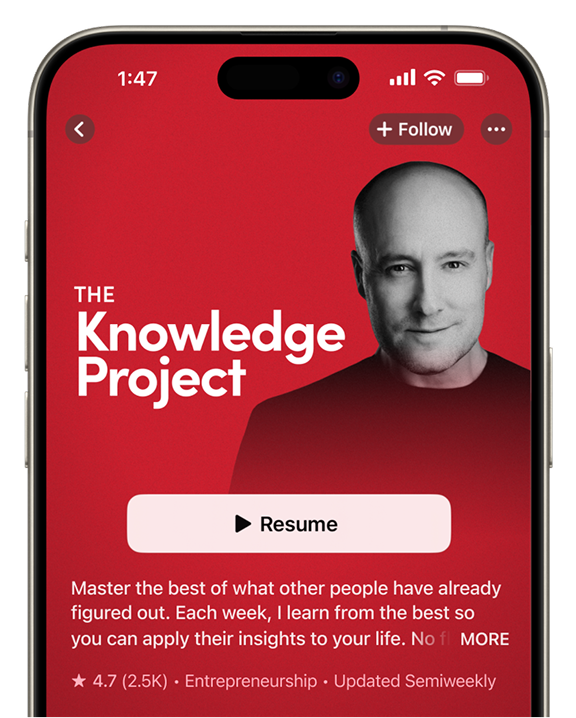
WordPress co-founder Matt Mullenweg shares how distributed work has transformed his company, Automattic, the philosophy behind open-source development, and the five levels of remote-work mastery. Learn how WordPress captured 38% of the web and why collaboration remains the key to innovation in both technology and leadership.
Listen on: Apple Podcasts |Spotify | Transcript
Here are a few highlights from the conversation:
WordPress could be used for and customized for any purpose, and it had a philosophy. Both an aesthetic philosophy, which was largely centered around jazz, both then and now. This idea that code could be poetry, but the open source philosophy, which I believe is the most powerful idea I’ve been exposed to in my lifetime and probably one that all of your listeners should incorporate into their lives.
We created a system that essentially allowed all the kids being bullied on the playground to work together and to gang up. Of course, that’s what makes humanity great is our ability to collaborate, so we started collaborating against the spammers. And so, they would adapt very quickly, but then the network would adapt in real-time to their changing tactics.
Automattic is structured a bit like a holding company. I like to think of us as like Berkshire Hathaway with a common digital platform, is definitely what we aspire to. And so, we can have these products like Tumblr, which run largely autonomously within. However, different from Warren Buffet and Charlie Munger’s approach, we do try to essentially get economies to scale and from our culture, our hiring, our technical platform, our infrastructure, the 30, 40 data centers we built around the world, things like that.
Our mission is to democratize publishing and commerce, so if we want to truly democratize it, which means everyone has access to it regardless of language, technical ability, anything, we need to get the world involved in building this. And so, I think about that for every aspect, even language. I want people who don’t even have the ability to speak or read English to be able to contribute to WordPress and have their code included.
I thought the larger an organization gets, the worse it gets, the more bureaucratic, and that was just a limiting belief I held and I had never really truly interrogated or questioned or challenged. Why can’t when you get more amazing people in an organization, it can’t actually get better?
One of the best advice I got early at Automattic. I actually hired a CEO, I consider him like a co-founder, Tony Schneider. He’s like my business soulmate. One of the things he taught me early on was make reversible decisions quickly and irreversible ones deliberately, and I still return to that on a weekly basis. If it’s a reversible decision we’ll probably learn a lot more by doing it.
I think far too often do we truly invest in creating deliberate patterns, ones that don’t just happen by accident, but that we truly challenge and choose to adopt in our life and actually practice much like an athlete would practice a certain move or a musician would practice a scale. These can become the raw technique of, I think, operating, particularly under pressure, under duress, or on high time-sensitive situations.
I believe all proprietary software to be an evolutionary dead end. Maybe it’ll take 50 or 100 years, but what happens, just like what happened fairly quickly with Encyclopedia Britannica and other encyclopedias and Wikipedia is that the thing which is open to all and gets everyone working together if it truly gets that humanity working together on the same shared resource, you get the opposite of the tragedy of the commons, versus the field being overrun, each person operating in their own self-interest kills the environment or kills the shared thing, and in digital world, we can do that because we have economics of abundancy versus economics of scarcity. That’s why open source will eventually win every market it’s in.