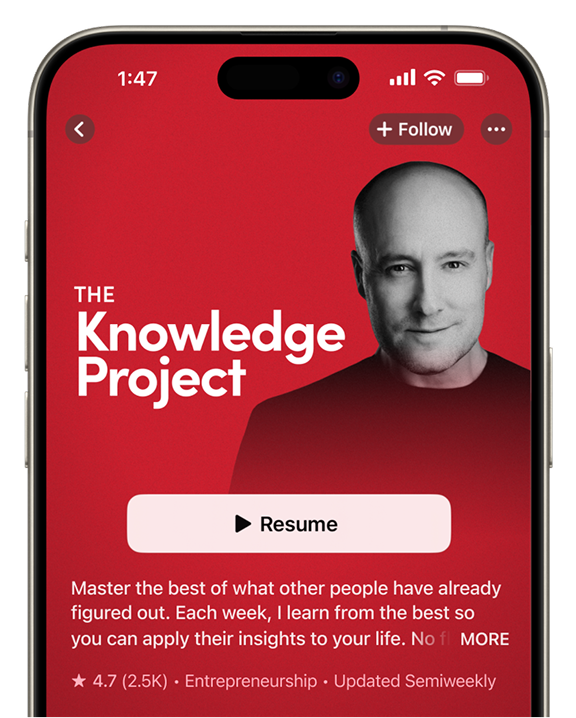
Robinhood’s co-founder reveals the brutal reality of surviving an 80% market crash, going “founder mode” to cut corporate bloat, and what actually happened during GameStop.
Featured clips
Setting the Scene: GameStop
Inside Robinhood
Internal AI at Robinhood
Deciding What to do Next
Vlad Tenev is the co-founder and CEO of Robinhood. Not only did he navigate the unprecedented GameStop crisis, but he also completely re-engineered the fintech giant to thrive.
He breaks down the brutal transition from bloated hyper-growth to a lean machine, why a “juicy falsehood is more powerful than a boring truth”, and the 3 distinct phases of AI integration separating the winners from the dead.
Believe it or not, GameStop was not his hardest moment.
Available Now: YouTube | Spotify | Apple Podcasts | X | Transcript
Key Takeaways
- Success is creating more value for the world than you capture for yourself.
- A compelling false narrative, once viral, cannot be overturned by facts. Accept that and play the long game instead of fighting the story with evidence.
- The hardest period for Vlad wasn’t an acute crisis, but the slow reversal of every tailwind that once powered Robinhood’s growth.
- When macro headwinds hit, the worst response is to batten down the hatches and wait. Instead, Vlad argues you need to build new products that thrive in the current environment instead.
- Reward employees disproportionately based on impact, not org size, otherwise you incentivize empire-building rather than efficiency.
- If you’re in doubt, push them out. If someone is not a fit after three weeks, six months of hoping is a waste for both sides. This is something Reed Hastings mentioned, too.
- Hire early-career talent aggressively and give them responsibility.
- Eliminate one-on-ones in favor of large-group leadership meetings, where everyone hears the same information simultaneously. This gives everyone context.
- Reversing decisions is hard. Practice admitting you were wrong on small, low-stakes decisions first.
- Think of AI compute as headcount: ask every team how much compute they need next year instead of how many people they want to hire.
- The next frontier for corporate AI is creative and marketing, where AI tools can increase personalized content output by 100x to 1000x.
- Train on harder problems than you’ll face. Mathematical reasoning trains the brain for business problems the way deadlifting 500 pounds makes picking up a baby trivial.
- The biggest inequity in capital markets is that the most important companies—AI, space, deep tech—are private, which means retail investors are shut out of the greatest wealth creation of this generation.
- He’s building Robinhood to be a financial super app that compresses margins by using technology in ways legacy companies struggle to compete with.
- Legacy banks are structurally dependent on the spread between checking and savings interest — they cannot compete on yield without destroying their own earnings.
Tiny Lessons
- “A juicy falsehood is more powerful than a boring truth.”
- “Success is creating dramatically more value for the world than you create for yourself.”
- No business problem is as hard as a really hard math problem.
- Practice reversing decisions on small things first. Then try something serious.
- “I’d rather have a small team of the best people than a large team of mediocre people.”
- If you pay people based on the size of their team, they’ll build empires. If you pay them based on impact, they’ll seek leverage.
- The anticipated backlash from cutting a perk is almost always worse in your imagination than in reality.
- When you’re the underdog, run upstairs. The incumbents are fat and happy; they won’t be able to keep up.
- “If you own something, you want to protect it.”
- Incumbents can often see what’s disrupting them. They can’t respond because their cost structure won’t allow it.
- Don’t build for the environment you want. Build for the one you’re in. The companies that adapt to current conditions rather than hoping for better ones create lasting value.
- In a downturn, there are three options: quit, hide, or build.
- There is always an opportunity in a crisis. People who would never take your call in normal times will reach out during a moment of extreme adversity.
- Communication is a clarity test.
- The most powerful competitive position is becoming the default.
- Imitation is the first stage of mastery. You earn the right to break the rules only after you’ve internalized them.
- If the CEO doesn’t think about the company’s story, the story doesn’t get told.
- When the financial system fails, the instinct to preserve wealth will improvise with whatever is tangible and durable.
- Stop one-on-one meetings. Use larger meetings to share context with everyone at once.
- Communication involves distilling the message to the core.
- If you’re in doubt, push them out.
- “If you can solve a hard math problem, you can solve pretty much any problem.”
More Details
A juicy falsehood is more powerful than a boring truth
The viral narrative that emerged was that Robinhood was colluding with hedge funds to protect their short positions.
Vlad explains that this was patently false: Robinhood has no meaningful business relationship with hedge funds. But the narrative was irresistible, retail investors vs. Wall Street, with Robinhood cast as the traitor. The fact that the company was literally named Robinhood made the false narrative too good not to spread.
One detail most people do not know is that Robinhood had been giving new customers free GameStop shares as sign-up bonuses throughout 2020. So when GameStop went parabolic, many of those customers suddenly had valuable holdings. Robinhood arguably seeded the entire phenomenon.
“A juicy falsehood is more powerful than a boring truth. Once a narrative gets any traction whatsoever, it doesn’t matter how crazy or false it is — facts do not tend to refute that.”
The GameStop crisis connected Vlad with Zuckerberg, Musk, and Benioff
A silver lining of the GameStop crisis was that it put Vlad on the radar of tech leaders who would not have otherwise noticed Robinhood. Mark Zuckerberg, Elon Musk, and Marc Benioff all called him during the crisis, offering their perspectives on navigating public firestorms. Later, when Spotify CEO Daniel Ek faced his own crisis over Joe Rogan, Vlad called him to pay it forward.
Vlad highlights his Clubhouse appearance with Elon Musk as the best media moment of that week — a low bar, he admits, given some disastrous other appearances.
In the movie Dumb Money, he reveals he only watched the six minutes featuring his character, played by Sebastian Stan. His favorite detail: the actor was shirtless in every single scene—grinding smoothies, shaving, handling business crises.
“The idea of me being shirtless, dealing with all these complicated business situations, just made me laugh a little bit.”
What came next was even harder than GameStop
Vlad argues that 2022 was actually harder than GameStop, even though GameStop was more acutely stressful. The GameStop crisis lasted only a few days in its most intense form. But 2022 was a gradual, grinding reversal of every tailwind that had powered the business during COVID.
First, the stimulus checks stopped. Then inflation surged, eating into discretionary spending and investing. Then interest rates went from near-zero to the highest levels in 30 years. When risk-free returns hit 5%, buying stocks became less attractive. For the first time ever, Robinhood’s entire business model, which was based on first-time investors entering the stock market, started to swim against the current.
The stock cratered from a $32 billion IPO valuation to around $6 per share, an 80% loss. People called it a broken IPO. Advisors suggested he pursue a buyout and take the company private. But Vlad refused to give up or to simply hunker down and wait for conditions to improve.
“I’m not going to be one of these people that gives up. I’m also not going to batten down the hatches and turn into an ostrich or a turtle.”
Build for the environment you are in, not the one you want
Rather than waiting (or wishing) for the environment to change, Vlad asked what products would help customers thrive in the current environment? This led to a bunch of new products.
The company systematically diversified away from being a zero-interest-rate business dependent on trading. By the time of this interview, Robinhood had 11 business lines, each generating over $100 million in annual revenue.
Firing himself and going Founder Mode
“I had to spend a lot of time trying to figure out how to fix things.”
Robinhood had bulked up massively during COVID, gaining muscle but also a lot of fat. The 2022 correction forced a massive phase of leaning out. The end result was a healthier, stronger company.
The hardest part of fixing things is admitting that past decisions were wrong.
Vlad observes that most people try to undo mistakes incrementally, which produces no results. As he points out, “things get easier if you do them multiple times.” He advocates practicing undoing small decisions and building up the muscle you need to do it for bigger things.
“We took off the wellness days, there was complaining for one day, and then we never heard about it again. Our deepest fears about the consequences were wrong.”
High performance means rewarding impact, not org size
Vlad lays out Robinhood’s core operating values. First is high performance: the company explicitly tells employees and applicants that this is not a cushy job. The expectation is to accomplish in one year what another company would expect in ten.
“We operate with extreme urgency. We push for progress without compromising quality—and when something is broken, we fix it. We’re driven by impact and pride ourselves in our ability to be nimble and quickly adjust our strategy when presented with new information. Friction and obstacles don’t deter us from pursuing what’s truly important.”
Compensation is tied disproportionately to impact, not empire-building. Robinhood wants maximum impact with the smallest possible team.
Second is “safety always” — the company moves fast but never cuts corners on customer security, money handling, or regulatory compliance.
“Trust is hard earned and easily lost. We take our responsibility for our customers’ finances seriously. We are compliant, approach risks thoughtfully, and never compromise trust for speed.”
Third is “lean and discipline” — scrutinizing every dollar and every process.
“We do more with less. Constraint drives us to innovate through scalable technology—not excess resources. We set ambitious goals, benchmark performance, and weigh trade offs before changing course. We respect each other’s time by reducing toil and bureaucracy. And by keeping costs low and efficiency high, we deliver exceptional value customers can’t find anywhere else.”
One that Vlad didn’t mention in the episode, which I particularly like, is first principles thinking.
“We only follow the crowd when they’re right. We’re innovators and problem solvers. We use data, empirical truth, and experiments to inform decisions. Our bold bets often make us a first mover, and we do what’s right for customers – even if it hasn’t been done before.”
He ends with this:
“I’d rather have a small team of the best people than a large team of mediocre people.”
Fire fast, but recognize hidden potential
When someone is clearly not a fit, Vlad wants to make the separation as frictionless as possible — even after three weeks. He argues that waiting six months once you know it is not working is a waste for everyone. He wants it to be easy to remove low performers.
But he draws a distinction: if someone does not hit the ground running but shows extraordinary ability in a specific area, patience can pay off.
Some people need six months to find their footing and eventually become exceptional. The key is distinguishing between “not a fit” and “slow start with high ceiling.”
Hire early-career people, put them on production work, and sit next to them
One unconventional element of Robinhood’s hiring, especially in financial services, is the heavy emphasis on early-career talent.
From the beginning, Vlad and co-founder Baiju Bhatt personally recruited at Stanford career fairs. The company still prioritizes interns and entry-level engineers on real production work, not coffee runs.
Vlad argues this keeps Robinhood connected to its young customer base. He points to how legacy financial firms age with their customers: Charles Schwab served baby boomers, E-Trade captured Gen X, but struggled with younger generations. The best defense against becoming a generational company is having young people embedded throughout the organization.
“If I can succeed and become the CEO of a company from an internship, then everyone should have the ability to do that.”
Replace one-on-ones with large leadership meetings (and a gavel)
Vlad’s weekly leadership meeting is deliberately large. He prefers everyone hearing the same information simultaneously over a series of private one-on-ones, which he has reduced to on-demand only for critical decisions.
The meeting format is simple: Vlad shares priorities or reflections from the weekend, then the team reviews goals using a green/yellow/red system. Green goals are skipped. Red goals get scrutiny.
To keep the atmosphere open, he uses a literal gavel, banging it against the wall when discussing underperforming goals. The ceremony lightens the mood so that people actually enjoy talking openly about what is not working.
The assumption is that everyone on the leadership team is at least very strong, so if a goal is red, there is usually a good reason beyond lack of effort. The group’s collective perspective can often find solutions faster than any individual.
Where he gets involved most, products and events
Vlad is personally involved in Robinhood’s major products and product launches, spending significant time on messaging, design, and the look and feel of each event. He presents at the events alongside the teams that built the products, treating each one like a television show.
Vlad admits his instinct is to get too jargony and detailed, assuming the audience knows as much as he does. The events correct for that by demanding simple explanations.
You learn how to tell stories. “It’s really about storytelling.”
When Robinhood first started doing events, the Apple keynote was the explicit model. Vlad compares it to learning an instrument — you start by playing what the masters composed, but eventually you know enough to innovate and break rules.
“You learn how to tell stories. “It’s really about storytelling.”
“Once you get to a certain level, you know enough to innovate, to break rules, and to change things.”
AI
Vlad breaks down AI adoption in customer support into three phases.
- Phase one: the company feeds its help center into an AI chatbot, giving customers better search. About 90% of companies doing AI customer support are here.
- Phase two: the AI accesses the customer’s actual account data to provide contextual, personalized support — but it is read-only. About 90% of the remaining companies are here.
- Phase three: the AI can take write actions—refunding subscriptions, making account changes, and resolving issues end-to-end without a human.
Robinhood is in phase three.
Vlad argues this is where the real value is, but also where the real difficulty lies. It requires deep integration into every backend system. Vendors cannot save you here; your own engineers must do the work.
What made it easier for Robinhood was years of prior investment in making internal data cleanly queryable, which was originally done for analytics, not AI.
“Most companies are vendering this, and vendors can’t save you much time in the actual process of plugging into all your systems. That’s going to be work that your engineers internally have to do.”
For software engineering, Robinhood tracks the percentage of code commits generated by AI alongside total monthly commits per engineer. The second metric is critical; it ensures that AI is not just doing a larger share of the same output, but that aggregate productivity is actually increasing.
Vlad reveals that Robinhood now thinks of AI compute as headcount. In planning conversations, teams are asked how much compute they need next year, not just how many people. Every team must demonstrate how hard they have tried to integrate AI agents into their workflow before requesting additional headcount.
Vlad identifies creative and marketing as the next domain where AI will create step-change improvements.
High-quality advertising collateral that previously required deep work by talented artists over long periods can now be produced at 100x to 1000x the volume using tools like ElevenLabs, Midjourney, and Runway — while also being far more personalized.
When pressed on whether this means anyone can do it, Vlad pushes back. He argues these are genuinely hard problems to get right. Most companies do not even have the metrics to track AI’s impact, let alone the engineering infrastructure to deploy it effectively. The gap between companies that can execute on AI and those that cannot is widening, not narrowing.
The case for mathematical superintelligence
Vlad is the co-founder and chairman of Harmonic, a company building what he calls “mathematical superintelligence” — AI that can solve math problems that exceed the best human mathematicians.
Harmonic’s model, Aristotle, achieved gold medal performance at the International Mathematical Olympiad, solving five out of six problems. It has also solved previously unsolved Erdos problems and recently achieved 97% on a software verification benchmark.
The key technical insight is that math problems can be posed as computer code, which allows machine-checking of proofs. This creates a synthetic data pipeline: the model generates proofs, the system automatically verifies them, and the correct results feed back into training. It is closer to training a chess engine than training a language model — the reward signal is precise and verifiable.
Vlad draws a direct line from mathematical ability to business decision-making. If you can endure 12 hours of beating your head against a single math problem, no business problem will feel overwhelming.
“No business problem is as complicated as solving a really hard math problem. If you get used to the pain and suffering and mental stress, it’s really good training — like going to the gym for business problems.”
The AI model landscape will specialize, not consolidate
Vlad predicts multiple specialized AI models rather than one winner-take-all. The differentiator will be data.
Harmonic has an advantage in math because mathematicians use it to solve complex problems, generating proprietary training data. Anthropic has specialized in coding and enterprise software engineering. Google’s Gemini benefits from arguably the highest-quality data source in the world, with few access restrictions, plus limitless compute funded by massive net income.
He notes the irony that when ChatGPT launched in 2022, Google called a code red about an existential threat to search. Now OpenAI is reportedly calling its own code red about Gemini. The narrative can shift remarkably fast.
“It’s amazing how quickly the narrative can shift. Google was being counted out as a big, slow company. They said, how are they ever going to catch up?”
The greatest inequity in capital markets is that retail investors are locked out of private companies
Vlad frames retail access to private markets as the single most important problem he is trying to solve. The most transformative companies of this era — in AI, space technology, and deep tech — are overwhelmingly private, with valuations in the tens or hundreds of billions. Retail investors cannot invest in them.
Simultaneously, going public has become harder, more expensive, and less common. Institutional capital has more avenues to fund private companies, creating an inadvertent system that shuts ordinary investors out of the greatest wealth creation of their generation. SpaceX, the largest and most impactful private space company, has been inaccessible to retail from the beginning.
Vlad argues that ownership creates stewardship: if everyone owns a piece of the industries shaping the future, they will want to protect and support those industries, leading to a more stable and prosperous society.
“If we make sure everyone is an owner, if you own something you want to protect it. And I think we’re more likely to have a stable and prosperous future.”
Robinhood Ventures is the vehicle for solving the private markets problem. Their first closed-end fund has been filed to go public.
In the US, the regulatory framework currently prevents tokenization of individual private companies because tokenized shares fall under securities regulations that are incompatible with decentralized finance. Instead, Robinhood is using 40 Act fund structures — portfolio vehicles that can hold baskets of private assets.
Outside the US, tokenization is already working. Robinhood tokenized hundreds of public equities in Europe and ran a tokenized giveaway of shares in OpenAI and SpaceX, which was enormously popular.
Vlad expects tokenization to be the primary vehicle for non-US investment until US regulatory clarity arrives, at which point it will seep into the American market as well.
The current administration has signaled openness to using these vehicles for alternative access, which Vlad expects will trigger a wave of innovation.
Vlad just doesn’t want to tokenize private markets; he thinks about tokenizing housing.
Price discovery is inevitable — private companies cannot control it forever
When asked whether secondary trading could distort pricing for private companies — particularly for employee option valuations — Vlad argues that transparent, two-sided price discovery is always the ideal. When one side has more information than the other, unfair outcomes are inevitable.
He acknowledges this is not the world we live in today. But derivative markets on private shares already exist, and the data is getting out. That genie cannot be put back in the bottle. If derivatives are pricing a company at one level but a financing round is priced differently, the market will increasingly demand reconciliation.
“It’s going to be tough increasingly in a global market to have as much control over the price as maybe private companies have historically had.”
Maximizing direct equity ownership is Robinhood’s North Star
Vlad articulates Robinhood’s single organizing principle: maximizing direct equity ownership by retail investors worldwide. Every strategic decision flows from this. Can they get people invested at a younger age? That is why they support Trump accounts and invest-in-America initiatives. Can they reach people outside the US? Can they open private markets?
He frames the coming $120 trillion intergenerational wealth transfer as a massive accelerator for these goals. If Robinhood can position itself as the multi-generational financial platform — where your spouse, parents, and children all have accounts — it captures a disproportionate share of that transfer while also fulfilling its mission.
Growing up in post-communist Bulgaria shaped everything
Vlad’s father left Bulgaria in 1991 for a master’s degree at the University of Delaware. At the time, inflation in Bulgaria exceeded 100%.
Vlad remembers his mother watching the grocery store line from their apartment window in Varna — if you did not arrive at the right time, there were no eggs or milk. Rolling blackouts forced the family to huddle around a battery-powered radio each night.
When Vlad arrived in the US at age five, he was shocked to see bananas in the grocery store. In Bulgaria, bananas had to be imported from Cuba and were treated like gold.
By 1996-1997, Bulgaria had hit 1,800% inflation—the highest in the world. The currency collapsed, requiring constant redenomination. His grandfather invested in copper cookware to preserve wealth. Copper pots and pans held value better than the national currency.
“My grandfather would invest in copper cookware. We had this closet in his apartment that was just full of copper pots and pans. They would hold value better than the currency.”
Vlad draws a direct line from this experience to his mission at Robinhood: if Bulgarians had easy access to investment tools to protect their wealth, the country’s trajectory could have been different.
How Robinhood Makes Money
On trading, Robinhood makes money on payment for order flow.
Robinhood’s credit card offers a flat 3% cash back on all categories. Vlad explains why this is so compelling: it eliminates the optimization game. Credit card enthusiasts maintain spreadsheets tracking which card to use for travel, groceries, and gas. Most people do not want to play that game. A flat 3% on everything becomes the default card at the top of your wallet.
The card has over half a million holders and is among the fastest-growing credit cards, driven entirely by word of mouth rather than paid customer acquisition. Customers are joining faster than Robinhood can onboard them.
The economic engine works because 3% cash back must be deposited into the brokerage account, creating a flywheel: credit card users become brokerage customers, brokerage customers use more products, and each additional product lifts engagement across all others.
Why legacy banks cannot compete
Vlad explains why American Express or JPMorgan cannot simply copy Robinhood’s credit card: their cost structures are fundamentally different.
Legacy credit card companies employ tens of thousands of people for manual account servicing and spend heavily on marketing. The economics of the card program itself are dwarfed by the overhead of operating the business.
The banking industry has a deeper structural problem. For a long time, banks were prohibited from paying interest on checking accounts — the concern was that competition over checking account yields would threaten bank solvency. That rule was eventually repealed, but by then the zero-interest checking spread had become such a large line item that banks had become structurally dependent on it. Asking a bank with trillions in checking to suddenly pass most of that interest to customers would crater their earnings.
“Banks play this game where your money goes in and out of checking, and they penalize you for doing the right thing. That’s an opportunity for us to differentiate.”
Success is creating dramatically more value for the world than you capture for yourself
Vlad defines personal success as creating more value for the world than he does for himself. He wants the aggregate impact of his work to far exceed his personal outcomes.
This connects back to his core mission: expanding ownership so that everyone has skin in the game across private and public markets. If he can play a part in ensuring more people own the great industries of the country, it leads not just to wealthier individuals but to a more stable and prosperous society.
“Success is creating dramatically more value for the world than you create for yourself. I think that’s the legacy I would get excited to tell my grandchildren proudly about.”