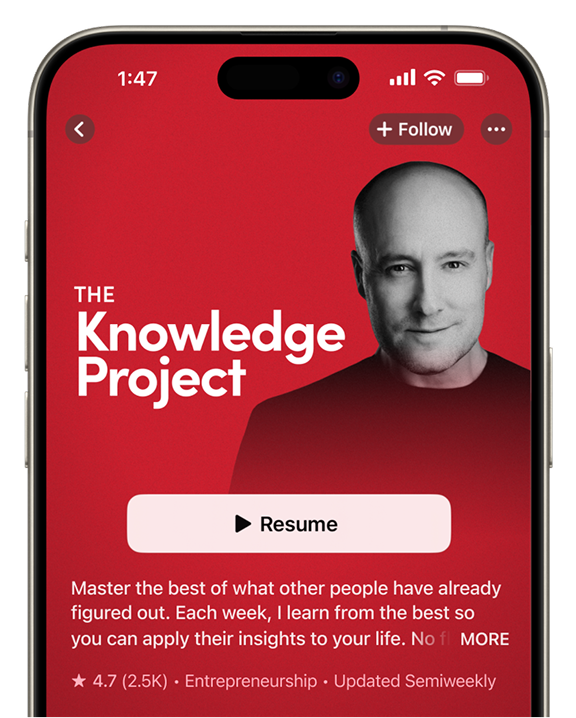
Explore the depths of human cognition with economist Sendhil Mullainathan as he discusses the chaos inside our minds.
This rich conversation covers mental models, decision-making frameworks, and the delicate balance between creativity and pragmatism. Learn about establishing effective habits, understanding opportunity costs, and the power of positioning over prediction.
Discover how metacognition can transform your thinking, why rules trump decisions, and strategies for personal growth that transcend traditional approaches.
Perfect for those interested in behavioral economics, cognitive psychology, and practical wisdom for navigating life’s complexity.
Listen on: Apple Podcasts | Spotify | Transcript
Here are a few highlights from the conversation:
I think a lot of people forget that creativity is the marrying of ideation and filtration. That you need the capacity to generate ideas, but you also need the capacity to filter ideas. And these processes are in such fundamental opposition.
There are very few people for whom you can trust their summary judgement. So I think for me the first issue is trying to be very open to feedback and criticism, or trying to get the feedback and criticism down to something granular rather than the sort of, oh, I don’t like it. Whereas every part of my personality really wants to say, give me approval, tell me you like it. Like that’s what I want to hear. So I think one filtration mechanism I think is architecting this social structure around you.
Metacognition is the capacity or skill to become aware of one’s own mental process. So on the one hand it seems kind of obvious, but if you say, today I’m going to try to notice and simply just notice a part of my mental process I had not yet been aware of. Now that’s interesting because what that is, it’s not just an observational thing. You’ll notice it opens doors to things you never thought of.
The opportunity cost is dictated by the hidden mental frame you have on the problem. So any decision you make, you are quite a bit narrowing the world down to some very tiny little world. Opportunity cost is the thing that is left out of that frame. Because what you’ve decided is you’ve said should I go to dinner with my friends, how much will dinner cost? The opportunity cost is the fact that you’ve left undefined the other things you can do with your time, for example.
The rule versus decision has another element which I really like, which is, there’s a person in my life I just do not trust. Like, even though I spend a lot of time with this person, I just do not trust them. Like, it’s embarrassing to say, but I don’t trust their motives, I don’t trust them to follow through on anything. And that person is me. Like, you should not trust yourself? So decisions, it’s like handing over bubblewrap to a five year old. It’s like, you know what’s going to happen. So rules versus decisions are in part also the recognition that you have an uneasy relationship with yourself.
Trees cast shadows that inhibit growth. And I think the toughest thing in founding things, whether it’s an organization like Ideas 42 or whether it’s in doing new research, the toughest thing is that you don’t want to cast a shadow, but yet you have ego. So I noticed early on in a lot of things I was doing, I was building more to make myself central inadvertently than I was asking myself the question how do I make myself obsolete.
I think we’re going to see a revolution both in behavioral sciences as a research discipline, so for example, here’s a telltale sign: Psychologists don’t work on self-help. That doesn’t make any sense. There’s a whole ocean of people who in good faith want to improve themselves. How does the research discipline of psychology largely ignore this? And if you look at it, most people buy behavioral economics, behavioral science books, they’re sort of very high brow self-help. You wouldn’t call it self-help, lest you be chastised, but it’s the deepest of human desires, to improve oneself, understand oneself.
I think academia has this illusion that it’s going this way as the only force, but there’s this strong feedback loop. So part of my career has been trying to, in my own life, enable that feedback loop so that I understand what happens over there. And I’ve found that super valuable. Like super enjoyable because, especially in areas like this, like in behavioral science, it’s just a practicing researcher would be foolish to think that they’re at the frontier. You know, like this area is so interesting, lots of different people are touching it from lots of different places. And you have a chance to contribute in both directions.
I think changing how people think is the most durable asset that you can create, because when people change how they think, they then produce in so many areas. It’s the ultimate force multiplier.