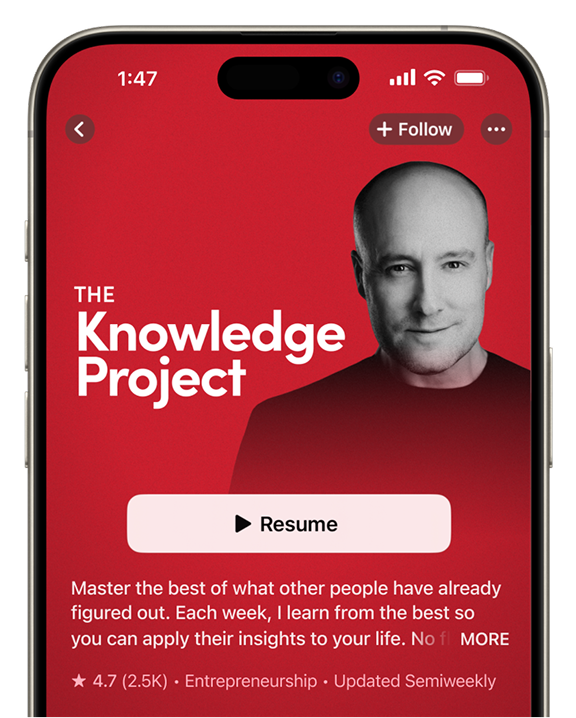
Retired United States Army General Stanley McChrystal calls on more than three decades of military experience to discuss the fundamental tenets of leadership, and practical advice for taking calculated risks and making important decisions. This wide-ranging conversation includes insights on mitigating risk, making decisions under uncertainty, why civilian leadership is tougher than military leadership, developing mental toughness, teaching discipline, and so much more.
Available now on: YouTube | Apple Podcasts | Spotify | Transcript
A veteran of four U.S. wars in the Middle East, McChrystal was a four-star general best known for his command of Joint Special Operations Command from 2003-08, when he oversaw special operations in both Iraq and Afghanistan. His troops were responsible for both the capture of Saddam Hussein in 2003 and the 2006 death of Abu Musab al-Zarqawi, the leader of Al-Qaeda in Iraq. After retiring from the military in 2010 he joined Yale University as a Jackson Institute for Global Affairs senior fellow, and in 2011 he founded a consultancy firm, McChrystal Group, which helps organizations tap into human potential in service of stronger business outcomes.
Here are a few highlights from the conversation:
There were people who would argue that if we are really good at predicting threats, we could dodge them or some threats you can reach out and do something about. But I would say, practically speaking, you’re right. We’re really not very good at seeing where all the threats are coming from, particularly in a complex environment.
Now, if we take each of those, they are a holistic system. But we can actually break out, almost like the human body. We can exercise certain muscles. We can make them stronger. And then of course, we can exercise the entire system so we’re more resilient. There are a number of things we can do really on a daily basis in our organizations to make ourselves ready for that next threat.
How often do people come to me and say, “Congratulate us, we’re going to have a baby.” My response is, “No, you’re not. You’re going to have a person, and you’re going to have him for at least 18 years.” I’ve only got one son. He lives next door to me. He’s 38. It’s great, but it’s a relationship that’s forever. Thinking about that sometimes is hard.
You could talk to a subordinate, and you could tell by the tone of their voice how their morale was, whether they were upset, whether they were shaky. You could hopefully be a reassuring voice to them. That’s hard to do in a printed thing.
What you have to remind yourself, and we had to keep telling ourselves, you’re not there. You don’t know how dark it is, how cold it is. You don’t know. You don’t hear the crack of the bullet. You’re not tired. So don’t fall into the self-deception that you have a better understanding of what’s happening than they do. Use that position and that visibility to gain some perspective, but then listen, talk, do everything else you can and support the person on the ground because, ultimately, they do know better.
And so much more.
Timestamps:
- 00:00 – Intro
- 01:13 – What is risk?
- 02:29 – Threats vs. vulnerabilities
- 05:31 – Practical steps to detecting and avoiding threats
- 07:07 – Reflecting on 9/11 and information contexts
- 10:05 – Is society becoming more risk averse?
- 13:53 – Short term vs. long term politicians and military leaders
- 19:28 – How to make decisions under uncertainty
- 21:11 – Shane’s heuristic for decision making
- 21:28 – Stanley’s heuristic for decision making
- 25:56 – Decision making in moral dilemma’s
- 28:27 – Commander’s intent
- 29:56 – Practical example of Map is Not the Territory
- 37:17 – Should politician’s spend time in war zones?
- 38:54 – The risk of NOT making a decision
- 41:03 – How organizations incentives for good decisions are awful
- 43:47 – How Stanley deals with stress
- 47:36 – How military leadership is easier than civilian leadership
- 50:12 – How to teach mental toughness
- 52:33 – What Stanley has learned from studying history
- 55:35 – History books that have influenced Stanley
- 57:19 – How to learn from someone who isn’t perfect
- 01:01:04 – The effects of changing history
- 01:03:15 – How to teach someone self-discipline
- 01:06:32 – How to assess the judgement of someone else
- 01:09:36 – Why are military budgets skewed to physical equipment and not cyber
- 01:13:39 – How Stanley would allocate the military budget today
- 01:14:53 – Stanley’s “One-Meal-a-Day” and the impact it had on others
- 01:16:43 – Misperception of being introverted
- 01:17:58 – How Stanley defines success