Bill Marriott built the foundation of the world’s largest hotel company.
But he didn’t open his first hotel until he was 55.
Everything starts with a nine-seat root beer stand in Washington, DC, and a simple goal: serve people well and build something that lasts. And of course, he didn’t just go from restaurants to hotels; along the way, he started the airline catering industry.
This episode explores the timeless principles that guided his success, including his obsession with downside risk, his practice of isolating variables, and his expansion during the Great Depression while his competitors folded.
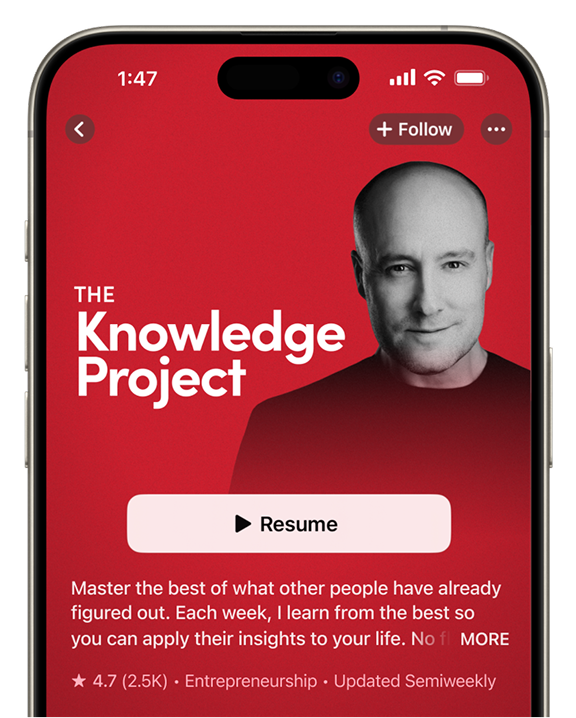
Listen and Learn: YouTube | Spotify | Apple Podcasts | X | Transcript
Tiny Lessons
- “Manage your time. Short conversations to the point. Make every minute count.”
- How you define yourself becomes your prison.
- “Perfection was one notch below the desired result.”
- “Do it and do it now. Err on the side of taking action.”
- “Guard your habits. Bad ones will destroy you.”
- “Make crystal clear what decisions each manager is responsible for. Have all the facts, then decide and stick to it.”
- You can’t expect what you don’t inspect.
- Take care of your people before your customers. People who feel disposable deliver a disposable experience.
- Never give your customers a reason to go to the competition.
- If a job is too big for one person, don’t work harder. Find the right incentive and let others carry it.
- Every major decision should start with your eyes, not your wallet.
- Trust people with something that matters before the world says they’re ready.
- Most companies lose their culture when the founder leaves because the founder was the culture and never put it on paper.
- “A leader should have character, be an example in all things.”
- Predictability builds a brand.
- Don’t accept seasonal thinking. When the crowd disappears, ask what people need now.
- You don’t lose control because you expand. You lose control because of bad debt and bad people.
- “See the good in people and then try to develop those qualities.”
- “As long as we are taking in more than we spent, I knew we were doing all right.”
- Survive first, grow second. You can’t compound what doesn’t exist.
- “Ideas keep the business alive. Know what your competitors are doing. Spend time and money on research and development.”
- The person who wrote the rule might say yes if you actually show up and ask.
- “Discipline is the greatest thing in the world. Where there is no discipline, there is no character.”
- Reward the behavior you want to see spread.
- Obsess over costs that don’t touch the customer.
- Three ideas built the company: friendly service, fair prices, and hard work.
- “People are number one. Their development, loyalty, interest, team, spirit. Develop managers in every area. This is your prime responsibility.”
- “My dad always told me to take time to smell the flowers, but I just don’t have the time.”
- “I’ve felt that dissatisfaction is the basis of progress. When we become satisfied in business, we become obsolete.”
Inside JW Marriott’s Head
These notes are meant to complement the podcast, not replace it. There is no story here, just obsessive observations.
How He Talked
JW Marriott talked like a man who’d grown up driving sheep across Utah and never fully left the ranch behind, even after decades in Washington. His language was blunt, compressed, and physical.
In his private diary, he wrote in clipped bursts:
Having a real struggle to expand and hold market without liquor. Must put in hotels. Will get a lot of criticism. I hate it.
— JW Marriott diary, early 1960s (BYU RSC)
There was no hedging, no deliberation, and no introspection. Just the problem, the necessity, and the feeling. In that order.
When he spoke publicly, the rancher in him came through in his metaphors:
In such times… real men tighten their belts, throw full weight into the harness of their daily activities, and pull with all their might… Let us choose for ourselves the hard right.
— JW Marriott, Depression-era address (O’Brien biography)
Harnesses. Belts. Pulling. This is the language of a man who literally drove cattle.
And when it came to his values, he was almost sermon-like:
A man should keep on being constructive, and do constructive things. He should take part in the things that go on in this wonderful world. He should be someone to be reckoned with. He should live life and make every day count, to the very end. Sometimes it’s tough. But that’s what I’m going to do.
— JW Marriott, late-life reflection (Phi Delta Theta)
The “sometimes it’s tough” is a rare vulnerability from a man who constantly seemed to project certainty.
He was folksy, with a typical Western warmth, calling people friends casually.
He was also an old-school Utah Mormon. When asked by Billy Graham what his favorite Bible passage was, he didn’t theologize:
That’s a good one and that’s good enough for me.
— JW Marriott to Billy Graham, on John 3:16 (Billy Graham eulogy, 1985)
Good enough. Next problem.
His humor was dry, self-deprecating, and perfectly timed. At a White House dinner with Charles Lindbergh, whose transatlantic flight happened the same day Marriott opened his root beer stand:
You know, we went into business on the same day, but you got all the publicity!
— JW Marriott to Charles Lindbergh (BYU RSC)
And when someone asked about his growing hotel empire:
Nothing good ever happens in a hotel.
— JW Marriott (Washingtonian)
His granddaughter Debbie said, “he had a great voice,” and loved to sing with family during car rides and walks in the woods. A&E’s documentary described him as “this lanky Utahan.” He was tall, thin, rancher-built, with a commanding presence that could flip from tender — singing with grandchildren in the New Hampshire woods — to imperious in a single breath: “Oatmeal is not negotiable!”
A good glass of water, he said, was “the greatest stimulant in the world.” While Washington elites drank cocktails, JW Marriott evangelized hydration.
How did a Man Who Hated Decisions Build an Empire?
Perhaps the single most surprising thing I discovered in my research was this description of his father by Bill Marriott Jr.:
My father hated making decisions, for fear that some better option was just around the corner or the risk was too great.
He continued:
I don’t suffer from the same kind of indecisiveness that plagued my dad. In fact, I’m sometimes accused — with some justification — of being very impatient about making decisions. I’d rather make a decision and get on with it.
You can infer by the word “plagued” that Jr. did not see this as a repackaged strength in his father, but rather as a general limitation that he would compare himself against.
Yet this man built a $4 billion empire. How?
He resolved the paradox by minimizing the number of decisions he had to make.
He would systematize everything by writing step-by-step instructions for every task, creating procedural manuals for every operation, and inspecting relentlessly.
If the system was good enough, the big scary decisions didn’t arise. They were preempted by the accumulation of small, correct ones.
Almost from the start, my parents — especially my father — launched the process of figuring out how to do something right and then writing it down.
— Bill Marriott Jr. (Utah History Encyclopedia)
The details mattered.
There were 66 specific steps to clean a hotel room. Recipe cards for every dish. Waitress inspections checking uniforms, shoes, stockings, and menu knowledge.
“It’s the little things that make big things possible” wasn’t just operational advice; it was, perhaps, a psychological coping mechanism for a man who feared big decisions. And he was self-aware about it.
In his 4 a.m. letter to his son the night before handing over power, he wrote:
Decide to decide.
— JW Marriott, 1964 succession letter
He was warning his son against his own weakness, which is even more interesting because, as pointed out earlier, Jr was well aware of it.
And yet he himself never overcame it, or at least he didn’t think he did. Either way, it was much easier for him to focus on the details.
During the biggest bet of the company’s history, the $500 million Marriott Marquis in Times Square, JW called his son with an urgent concern:
When are you going to put AstroTurf on the balconies of the Twin Bridges Hotel?
— JW Marriott to Bill Jr. during the Times Square hotel decision (Continuum)
While his son was making a bet-the-company move, the father retreated to his comfort zone: operational details.
How He Made Decisions
Step 1: Observe.
Before every major move, he watched. He watched the A&W stand in Salt Lake City before opening one in DC. He watched pilots eating at Hot Shoppe No. 8 before calling Eastern Air Transport. He and Alice literally stood on opposite sides of the Potomac, counting cars to determine where to build their first hotel.
One interesting thing I learned about locations was how important bridges are.
My dad loved the bridges because he says, they’re going to always change the highways, but they’re never going to change the bridges. So if you’ve got a restaurant or a hotel next to a bridge, it’s always going to be busy.
— Bill Marriott Jr. (NPR Wisdom Watch, April 2013)
It seems so simple: Find the thing that doesn’t move and build next to it.
Step 2: Systematize.
Once he found what worked, he wrote it down.
He wrote down every recipe, every cleaning product, every service standard. He created 66 steps for cleaning a hotel room in under 30 minutes.
He applied “chain-store merchandising, with its huge volume and low prices,” to the restaurant industry, borrowing from retail and transplanting it to food service.
Step 3: Inspect.
You can’t expect what you don’t inspect.
— JW Marriott (Richard Marriott, BYU speech)
He spent 50-75% of his time in the field, not the office.
When he had six or seven stores, he drove to every one every day, sometimes twice. He obsessed over the smallest details, checking food temperatures, running fingers under the shelves for dust, and inspecting parking lots for litter. His managers never knew when “Big Tamale” would show up.
Step 4: Fix the cause, not the symptom.
Eliminate the cause of a mistake. Don’t just clean it up.
— JW Marriott
This was root cause thinking as a management imperative. It’s basically the same principle Toyota would systemize with the “5 Whys”, but Marriott hit on it through operational obsession.
The faith filter.
Every decision also passed through four religious principles: clean living, hard work and prayer, staying out of debt, and the golden rule.
His 1931 cancer diagnosis, when doctors gave him months to live and he attributed his survival to a priesthood blessing, made “pray about every difficult problem” non-negotiable for the remaining 54 years of his life.
The anti-complacency engine.
I’ve felt that dissatisfaction is the basis of progress. When we become satisfied in business, we become obsolete.
— JW Marriott
He cultivated being unsatisfied as a deliberate mental state.
Perfection, his son said, “was one notch below the desired result.” He didn’t aim for perfection. He aimed past it.
Employees First, Always
His most famous principle, in its full three-part form:
If he took care of employees, they would take care of customers and the money would take care of itself.
— Source: Northwest Adventists
Most people only quote the first two links.
The third — “the money would take care of itself” — is the radical part. He believed you should not directly optimize for money. Instead, money was an emergent property of the employee-to-customer chain.
As you can imagine by now, this wasn’t just rhetoric. These were important values with specific behaviors:
When they were sick, he went to see them. When they were in trouble, he got them out of trouble. He created a family loyalty.
— Bill Marriott Jr. (UNH Rosenberg Center)
He started profit sharing and medical benefits during the Depression, before any legislation required it.
He and Alice gave every employee a Christmas present: a day’s pay for each year of service. When a carhop couldn’t afford a trip to the golf regionals, JW paid his way. When a chef needed $200 for eye surgery, JW covered it.
His feedback method had a name:
The old ham sandwich routine — he’d give them a kick, a kiss, and a kick.
— Bill Marriott Jr. (Selling Power)
He could simultaneously tell employees how bad they were while still believing in them.
The expanded framework, in his own words:
Motivate them, train them, care about them, and make winners out of them… they’ll treat the customers right. And if customers are treated right, they’ll come back.
Four verbs in sequence: motivate, train, care, make winners. This is the way.
When the JW Marriott luxury hotel brand was created in his honor, his son presented him with a 242-foot-long card containing the signatures and well-wishes of thousands of Marriott employees.
The man who was never satisfied — who threw out ten hamburgers over the salt content, who ran his finger along furniture checking for dust — was rendered “nearly speechless.” The employee card mattered more to him than the company itself.
The Father: Domineering But Brilliant
Outliers are spiky, and some of those spikes are sharp.
Here was a man who visited sick employees and treated hourly workers better than nearly anyone, but was also harsh, critical, and emotionally distant with his own son.
Very tough on me growing up. There were plenty of rules and high expectations and not much time for affection. He had an obsession for cleanliness and order, and he had plenty to say about how I raked the leaves on the lawn, how I shined his shoes or washed the car, and about the grades I got in school.
— Bill Marriott Jr. (LinkedIn, Father’s Day 2021)
My domineering but brilliant father, who, throughout my life, was often a harsh critic.
— Bill Marriott Jr. (LinkedIn)
He knew why he was this way:
I don’t ever tell you you’re doing a good job because my father never told me I did a good job. But you are. I’m happy.
— JW Marriott to Bill Jr. (Washingtonian)
The generational transmission was precise: Hyrum (JW’s dad) couldn’t praise him. JW couldn’t praise Bill. There is no judgment here, none of us are prefect parents. And if you’re like me, you have high standards for your kids.
There is a bit of irony in the fact that the same emotional toughness that drove obsessive excellence also produced a father who checked his grown son’s furniture for dust. Eventually, his wife Alice had to intervene:
You can’t treat him like this. What are you going to do if he decides he doesn’t want to stay with the company?
— Alice Marriott to JW (Washingtonian)
He didn’t even trust his son with a restaurant:
He was afraid to entrust me with one of his Hot Shoppe restaurants because he didn’t think I was smart enough to do that.
— Bill Marriott Jr. (NPR, April 2013)
Bill got the hotel division almost by force because his father feared the debt it brought so much. And yet it would become the foundation of the world’s largest hotel chain.
The father couldn’t help but keep his son in check. When Bill was called as bishop of his local church ward in 1975, JW secretly called the president of the LDS Church to ask him to cancel the appointment without Bill’s knowledge. The president refused.
And even after death, the father’s voice persisted.
During the 1990 financial crisis that nearly bankrupted Marriott (a crisis caused by the debt JW had always warned against), Bill broke down:
I have disappointed my father so much. He’s up there looking at me right now and I’ve let him down.
— Bill Marriott Jr. (LinkedIn / Van Atta biography)
And yet. On the night before handing his son the company, unable to sleep, JW got out of bed at 4 a.m. and wrote:
A leader should have character, be an example in all things. This is his greatest influence. In this you are admirable. You have not taken advantage of your position as my son.
— JW Marriott, the 4 a.m. letter, January 20, 1964 (Wikipedia / Without Reservations)
The praise was always there; it was just never spoken.
After JW died, they found a handwritten note at his desk:
The best things in life are free.
— Source: Bill Marriott Jr., LinkedIn
A billionaire’s final message to the world wasn’t about business.
In his heart, though, dad was a cowboy who treasured faith and family above all things.
— Bill Marriott Jr. (LinkedIn)
Marriott vs. Hilton
Conrad Hilton was JW Marriott’s contemporary and rival.
They built the two largest hotel empires in history through opposite temperaments.
Decision speed. Hilton bought his first hotel on impulse. He tried to check into a hotel, and when he found out it was full, he made an offer on the spot. Marriott took 30 years from his root beer stand (1927) to his first hotel (1957). You can think of them this way: Hilton was an opportunistic sprinter. Marriott was a cautious marathoner.
Financial risk. Hilton pioneered creative leverage — 99-year land leases, loans against leased land. Marriott avoided all debt as both a religious conviction and a psychological imperative. Hilton went bankrupt during the Depression and clawed back. Marriott survived the Depression because he never overextended.
Prayer. Both prayed. The difference was timing. Hilton:
I think intuition can be a form of answered prayer. You do the best you can — thinking, figuring, planning — and then you pray.
— Conrad Hilton, Be My Guest
Hilton: Think → Pray. Prayer as confirmation of analysis.
Marriott was the opposite: Pray → Think. For him, prayer was the starting point that precedes analysis.
Both built empires. But it’s helpful (although not always accurate) to see them through mirror-image temperaments: one bold, one cautious; one who seized, one who waited; one who leveraged, one who saved.
The Hidden Partner: Alice
Alice Sheets Marriott was not a supporting character; she was an active participant.
She was the first bookkeeper, chef, interior designer, and quality inspector. She’s the one who sweet-talked the chef at the Mexican embassy into giving them their first recipes. She kept the books in a red ledger with four columns: date, receipts, expenditures, and balance. She sat in the car at night, counting customers, and joined JW in counting cars at potential locations.
More critically, she was JW’s decision-making partner for the choices he couldn’t make alone:
When J. Willard was struggling with the decision to hand off his role as CEO to his son, Alice’s soft-spoken but no-nonsense style helped her husband come to terms with passing the business to the next generation.
She had a “knack for sizing up people and analyzing business concepts.”
For JW’s most personally difficult decisions (the ones that threatened his identity as a leader), Alice was the one who broke the deadlock.
She was also the referee between father and son, softening JW’s blows and keeping Bill from leaving. Both JW and Alice were hospitalized simultaneously from overwork stress; she shared his self-destructive habits, not just his ambitions.
When asked the secret to his success, JW had a three-part answer:
(1) Being born right. (2) Developing good habits. (3) Marrying right.
— JW Marriott, via Richard Marriott’s BYU speech
On their first date, he showed her pictures of his sheep and took her to view the family herd. She married him anyway. He arrived two and a half hours late to his own wedding because he was collecting commissions. She waited.
What Kept Him Up at Night
JW Marriott kept handwritten journals for four decades.
His biographer, Dale Van Atta, pored through them to write “Bill Marriott: Success Is Never Final.”
The diary voice is compressed, urgent, and more honest than his public persona:
I sweat terribly and overdo. But I love to work.
— JW Marriott, diary entry (Source: O’Brien biography)
He knew he was destroying himself. He said it plainly. And then he kept going — not out of duty or fear, but because “I love to work.”
The workaholism was a choice, not a compulsion. Or at least that’s what he told himself.
I must give her credit for rearing my two sons. I’ve had such a busy life in business and civic work and church affairs that I had little time for our family.
— JW Marriott (Source: O’Brien biography)
No excuse. No elaboration. Just plain confession.
His relationship with adversity was almost welcoming:
Allie knew that problems didn’t really bother Bill. In fact, he welcomed them. He often said life was an obstacle course. That’s how you got ahead.
And his relationship with failure was equally distinctive:
Failures? The only failures I had were temporary. [Everything] usually evened out.
— JW Marriott (Source: O’Brien biography)
Genuine perspective from a man who survived the Depression, cancer, five heart attacks, a burst blood vessel, and hepatitis, and built a multi-billion dollar company through it all.
At 73, standing before 23,000 students, he distilled a lifetime into one sentence:
Discipline is the greatest thing in the world. Where there is no discipline, there is no character. And without character, there is no progress.
— JW Marriott (Source: O’Brien biography)
In one of his last interviews, at 84, eight months before he died:
My dad always told me to take time to smell the flowers, but these days I just don’t have the time.
— JW Marriott, Dun’s Business Month, December 1984 (via Encyclopedia.com)
A man at 84, still unable to follow his own father’s advice. He had one motor: on.
Then, at a family cookout in New Hampshire, he bit into an ear of corn:
We’ve got to get some better corn around here.
— JW Marriott’s last words, August 13, 1985 (Selling Power)
Then he sat down and died from a heart attack. His last act on earth was a quality complaint.