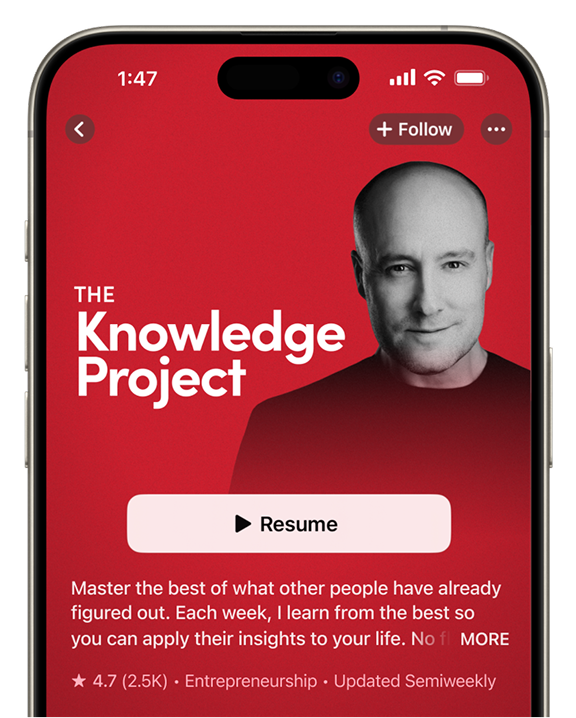
Bernie Marcus is the co-founder and former CEO of Home Depot.
This is how he built a culture of ownership, kept going when everyone turned him down, nearly lost it all, and created one of the most successful retailers in history.
This episode is based on the book: Built From Scratch.
Available Now: Apple Podcasts | Spotify | YouTube | X | Transcript
+ Members have access to all of my highlights from Built from Scratch.
Tiny Lessons
- Bad money is worse than no money.
- No partner is better than the wrong partner.
- Outcome over ego.
- Every customer is on loan.
- Bureaucracy is a fungus.
- A great partnership is symbiotic.
- Sales are an addiction; low prices are a discipline.
- It’s not a value until it costs you money.
- You can make money honestly, or you can make money once.
- Invisible benefits often outweigh visible costs.
- The one-man show doesn’t scale.
- Companies are built on instincts and opinions.
- You are only as good as your people.
- All the time you spend replaying the past comes at the expense of focusing on the future.
- “The more you give, the more you get.”
- “I’ve always surrounded myself with people who are better than I am.”
- When it comes to people, look past the resume and at their heart and soul.
- “Even a fool doesn’t want to stick his head in a lion’s mouth.”
- You’re never as smart as you think you are.
Lessons
- Bad money is worse than no money. Hitchhikers will pay for the gas as long as you do what they want and go where they want to go.
- Outcome over ego. All the time and energy you spend trying to prove how right you were in the past comes at the expense of building the future. Revenge costs everything but pays nothing.
- Every customer is on loan. The moment you think you own the customer, you have lost them. Customers are earned every single day in every single interaction.
- Bureaucracy is a fungus. It is always there, unseen, trying to cover you. Without an opposing force, it eventually destroys the company.
- Pitchers need Catchers. Great partnerships aren’t about being the same; they are about complementary force. One person throws the heat (Bernie), and the other quietly calls the game (Arthur). You don’t need two pitchers.
- Promotions are an addiction; low prices are a discipline. Running sales creates artificial spikes that hide the fact that your core operations are inefficient. Everyday fair pricing is harder to implement, but it forces you to run a better business every single day.
- It’s not a value until it costs you money. Values are established when you pull over on the highway and tell a check-writer to walk because they wanted to cut employee health insurance.
- Win-Win or walk away. You can make money honestly on repeat, or you can make it deceptively once.
- Hire people better than you. “Why have I been successful my whole life? Because I’ve always surrounded myself with people who are better than I am.” Don’t just hire good people and let their potential go to waste. Challenge them to surpass you.
- The best information isn’t in a spreadsheet; it’s in the customer walking out empty-handed. Growth comes from obsessively solving the problems of the people you failed to serve today.
- Invisible benefits often outweigh visible costs. You can change culture with efficiency metrics, but you’d better be careful not to destroy the benefits that don’t show up on a spreadsheet.
- The one-man show doesn’t scale. Pat Farrah was brilliant at fixing things himself, but he never learned to teach. When you know how to do something and don’t share that knowledge with someone else, you’re stealing from your company.
- Instincts beat spreadsheets. The biggest companies aren’t built on miracles; they are built on gut feelings about who to trust and who to avoid. Logic will talk you out of the risks required to be an outlier.
- The money is the scorecard, not the motivator. Bernie realized early that he hadn’t made “real money” working for others, but the drive to build Home Depot wasn’t about the cash. It was about proving he could do it.
- You’re never as smart as you think you are. “You have to look at yourself, your talents and abilities, realistically. We thought we were better, we thought we could handle anything. Success was breeding a little arrogance, and we learned that: sometimes you believe you can do more than you really can do.”
- Sometimes the company outgrows the people. “The most difficult thing which I have had to do,” he said, “and I think I have done well, but it was very hard, was look at the people who have helped me build this company, get to half a billion, then a billion and so on, and recognize that at some point along the way, they ran out of steam. They were terrific people, but they did not have the capacity to take me from a billion to $5 billion, from $5 billion to $10 billion. Recognizing that and dealing with it will be your greatest challenge.”
The Customer Bill of Rights
These six items are, we believe, the only things a customer wants to pay for at The Home Depot:
- The right assortment.
- The right quantities.
- The right price.
- Associates on the sales floor who want to take care of customers.
- Associates who have been trained properly in terms of product knowledge.
- The expectation that our associates will be there when the customers need them.
Together, these six things represent “excellent customer service.”