• Skip to main content
  • Skip to header right navigation
  • Skip to site footer
Farnam Street Logo

Farnam Street

Mastering the best of what other people have already figured out

  • Newsletter
  • Books
  • Podcast
  • Articles
  • Log In
  • Become a Member
TweetEmailLinkedInPrint

The Knowledge Project Podcast

Morgan Housel: Wealth is What You Have Minus What You Want

Morgan Housel breaks down the exact framework he uses to build wealth, minimize financial stress, and buy freedom.

Featured clips

Happiness vs. Satisfaction

07:22

Happiness vs. Satisfaction

Investing: Can You Beat the Market?

21:05

Investing: Can You Beat the Market?

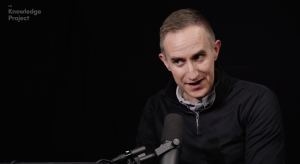
Step by Step Investing
28:39

Step by Step Investing

What Should You Optimize For?

01:32:27

What Should You Optimize For?

What Is Success For You?
01:53:36

What Is Success For You?

Available Now: Apple Podcasts | Spotify | Transcript | YouTube | X

While most financial advice focuses on how to get rich, Morgan explains why the skills needed to stay rich are completely different. You will learn why “boring” investing beats complex strategies, how to avoid the social traps that destroy wealth, and the specific equation for finding contentment.

Morgan Housel is a partner at Collaborative Fund and the bestselling author of The Psychology of Money.

Enjoy!

+ Check out Episode 195 with Morgan.

+ Read the Granola notes here.

+ Members get access to my 78 highlights from The Art of Spending Money

Tiny Lessons

  1. “Wealth is what you have minus what you want.”
  2. “Money buys fewer bad days, not more great days.”
  3. “It’s really good to have people in your life who you don’t want to disappoint.”
  4. Luxury quickly becomes a necessity.
  5. Saving money is buying freedom.
  6. Excellence is the capacity to take pain.
  7. Optimize for sleeping at night, not maximizing a spreadsheet.
  8. Contrast drives happiness, not absolute levels.
  9. Nobody is paying attention to you. Stop trying to impress strangers.
  10. “If I can be average for 50 years, I’ll end up in the top 3% of investors.”
  11. “99% of Warren Buffett’s net worth was accumulated after his 65th birthday. That’s just how compounding works.”
  12. “Every dollar you save is a step toward independence.”
  13. Remember, there was a time when you wanted what you have now.
  14. “Nothing is more damaging to your investing psychology than getting rich quick when you’re young.”
  15. Passive income is largely an illusion.
  16. Your social network sets your expectations.
  17. All the time you spend thinking about things you don’t control comes at the expense of things you do control.
  18. Give your kids money when they need it—in their 30s—not when they’re 75 after you die.
  19. “Loyalty to people who deserve it is one of the most rewarding things in life.”
  20. “Independence is a spectrum. Even $100 in the bank beats zero.”
  21. “Rich-people food looks better than it tastes. Poor-people food tastes better than it looks.”
  22. “No generation handles their 20s with grace. That’s why every older generation criticizes the young.”
  23. Simple scales, fancy fails: “The simpler my finances, the higher the odds I can leave them alone for 50 years.”
  24. “We underestimate the odds of bad things happening. If we didn’t, we couldn’t get out of bed.”
  25. Very few people can beat the market.
  26. The biggest financial mistake you’ll make has nothing to do with money.
Transcript

Get transcripts, early access, ad-free episodes, and so much more. Learn more or sign up now.

Already a member? Head over to the Members Only area to access transcripts and other Member Only content.

Become a Member

More Episodes

[Outliers] The Multidisciplinary Approach to Thinking | Peter D. Kaufman

One of the people I’ve learned the most from is Peter D. Kaufman.  Peter has been the chairman and CEO of GlenAir since 1977. And …

Listen Now[Outliers] The Multidisciplinary Approach to Thinking | Peter D. Kaufman

James Clear: How to Build Good Habits & Break Bad Ones

James Clear is the author of Atomic Habits, a global bestseller that has shaped how millions of people think about habits, consistency, and …

Listen NowJames Clear: How to Build Good Habits & Break Bad Ones

Pierre Poilievre on the Role of Government, Freedom, and Affordability

We released a special episode of TKP this week with Pierre Poilievre. While we don’t often tackle politics on the show, we are trying …

Listen NowPierre Poilievre on the Role of Government, Freedom, and Affordability
The Knowledge Project Podcast with Shane Parrish

The Knowledge Project

A podcast about mastering the best of what other people have already figured out. The Knowledge Project focuses on insights and lessons that never expire. You’ll walk away from every episode with actionable insights that help you get better results and live a more meaningful life.

Listen now onApple Podcasts
More Options
  • Spotify
  • Overcast
  • g id="Pocket-Casts-Roundel---Red">Pocket Casts
  • RSS

Never miss an episode

A podcast about mastering the best of what other people have already figured out.

Articles

  • Mental Models
  • Decision Making
  • Learning
  • Book Recommendations
  • All Articles

Podcast

  • Latest Episodes
  • Organized by Theme
  • ChatBot

Books

  • Clear Thinking
  • The Great Mental Models
  • All Books

Newsletter

  • Archive
  • Sign Up

About

  • About Shane
  • Speaking
  • Inquire about Sponsorship

Farnam Street Logo

© 2026 Farnam Street Media Inc. All Rights Reserved.
Proudly powered by WordPress. Hosted by Pressable. See our Privacy Policy.

We’re Syrus Partners.
We buy amazing businesses.


Farnam Street participates in the Amazon Services LLC Associates Program, an affiliate advertising program designed to provide a means for sites to earn advertising commissions by linking to Amazon.