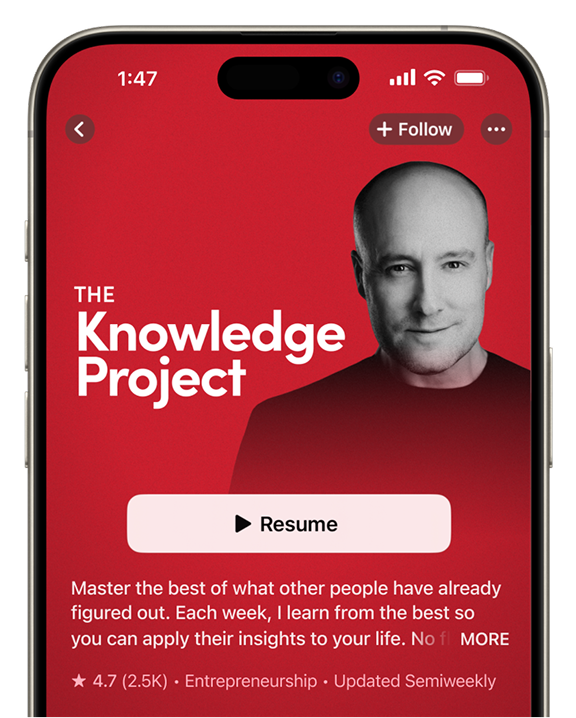
What if the secret to revolutionizing retail wasn’t focus groups or data analytics, but trusting your gut while obsessively gathering information from every possible source?
Mickey Drexler, the legendary retail executive who transformed Gap, created Old Navy, and reinvented J.Crew, shares his unconventional approach to merchandising.
From discovering his father wasn’t the “big shot” he pretended to be to designing the Apple Store with Steve Jobs, Drexler reveals how breaking rules, avoiding bureaucracy, and maintaining a “love affair” with your business drives retail success.
Available now: YouTube | Apple Podcasts | Spotify | Transcript
Key takeaways
- Success isn’t about money but about impacting people’s lives positively.
- Being a merchant means knowing what will sell before it sells, not looking in the rear-view mirror at last year’s data but having vision for what comes next.
- The best judge of a boss is the person who works for them, not the person above them, because corporations create upward-sucking dynamics that obscure reality.
- Quality and taste matter more than data. If you love something and believe in it non-negotiably, that conviction becomes your competitive advantage.
- Keep it simple is the greatest business lesson. Bringing everything to its simplest common denominator eliminates confusion and creates clarity.
- Only the paranoid survive in retail, which is why flying immediately to check out competitors beats reading reports about them every time.
- White space in the market exists where you control your own brand and pricing rather than selling the same brands everyone else discounts.
- Breaking rules requires genuine curiosity. You can’t teach someone to be creative or to see patterns, but gathering information constantly helps you challenge false assumptions. (Note: information gathering means being in the details.)
- Focus groups guarantee average results because customers don’t know what they want until you show them. Vision requires leading, not following.
- Every bad detail gives customers a reason not to buy: one ugly button can ruin a perfect sweater.
- Corporations favor safe choices over creative ones because people protect their salaries, but business only moves forward through creativity and risk-taking.
Growing Up with a False Big Shot
Mickey’s father worked buttons at a garment company while pretending to be important in the family. He was angry, bitter, unsuccessful, and never showed emotion or treated Mickey’s mother well. The relationship was so difficult that Mickey believes his ambition came from wanting to be his father’s opposite: constantly living in fantasies to escape his reality.
At 16, Mickey discovered the truth when asked to take the company payroll to the bank. Ducking through freight entrances to peek at pay stubs, he found his father was among the lowest-paid employees despite constantly putting down his peers.
This cold reality shattered the illusion forever.
“He wanted to be a big shot, so in my family, he acted like a big shot.”
From Department Stores to Running Ann Taylor
After 12 years in department stores, Mickey couldn’t find stimulation in the political, suck-up culture where people constantly tried to please their bosses rather than serve customers.
In 1980, he was called to run Ann Taylor, a $25 million business, despite having no experience running a company. With no supervision or instruction, he relied purely on gut instinct to identify good people from those “full of it.”
His philosophy emerged early: corporations breed self-interest because bosses review and promote you, creating safe choices rather than creative ones. People go to the right schools, follow scripts, and avoid risks to protect their salaries. This realization about corporate dynamics would shape his entire approach to business leadership.
Transforming The Gap Through Creative Destruction
Taking over the Gap meant immediately getting rid of old merchandise that tied up cash, despite founder Don Fisher’s nervousness about earnings.
Mickey renovated all 430 stores simultaneously without focus groups or testing. The stock dropped 50% in the first year, and they even discussed bankruptcy plans. Working scared but determined, Mickey threw out all existing merchandise and redesigned everything.
The pressure was immense: if he didn’t turn it around, he’d fail publicly. But he depended on his gut and instinct, knowing intuitively who was good or bad, who was authentic versus fake. His merchant mentality meant knowing what would sell before data proved it, focusing on what he loved rather than chasing last year’s winners.
“To be a merchant is having a sense of what’s going to sell. If I think it, it is. Non-negotiable.”
Creating Old Navy from Competitive Paranoia
Reading a buried New York Times article about Target planning “a cheaper version of Gap,” Mickey flew to Mall of America the week it opened without telling anyone.
Within five minutes in the store, he exhaled with relief but took the threat as motivation. This paranoia-driven reconnaissance became the seed for Old Navy, whose name came from a neon-lit bar sign Mickey spotted while leaving Paris.
The board didn’t like the name Old Navy, but Mickey’s vision prevailed.
The store became revolutionary in apparel retail, becoming the first apparel business to hit $1 billion in sales. The lesson: touching the territory beats filtered reports, and only the paranoid survive.
Steve Jobs on the Board and Getting Fired
Steve Jobs joined Gap’s board after a year of recruiting Mickey for Apple’s board, finally making a deal: “I’ll join Gap if you join Apple.”
Jobs was a troublemaker board member who brought up uncomfortable truths and alienated people, but Mickey loved his irreverence. Though Jobs wasn’t detail-oriented about Gap operations, his challenging presence was valuable even as his health declined.
After one bad year, the board fired Mickey while Jobs was absent from the meeting.
At 9 PM, Jobs called: “Don just told me you’re getting fired. They didn’t tell me until now because they were worried I would tell you, and of course I would tell you.” The next morning, Don Fisher handed Mickey a one-page note: his 18-year tenure ended without a single board member calling except Jobs.
“There’s no such thing as an independent director.”
Designing the Apple Store and Board Dynamics
Mickey’s first contribution to Apple was redesigning their retail concept. Jobs’s original store design was ugly. Mickey insisted they build a prototype in a warehouse, the same approach he’d used at Gap.
Together they created the clean, simple aesthetic that became iconic: screens for demonstrations, minimal displays, everything painting a clear picture. That original design remains essentially unchanged today.
The difference between Jobs’s cluttered first version and the final product demonstrates how iteration and tactile experience matter.
Mickey operates through mental photographs: walking into a shop either paints a picture or doesn’t. One bad color ruins a great painting, just as ugly wheels destroy a beautiful car. Never give customers a reason not to buy.
The Philosophy of White Space and Brand Control
Mickey learned at Ann Taylor not to sell other brands that competitors could discount. Instead, he found manufacturers to create exclusive Ann Taylor Studio labels, controlling quality and pricing.
This white space strategy—avoiding competition by owning your category—became fundamental to his approach. Today’s retail problem is everything’s on sale; his advice is to Google any item before buying because you’ll find it cheaper somewhere.
At department stores, he’d witnessed the Brooks Brothers decline when non-merchants ran it, taking out quality to maintain prices. The lesson shaped his belief that you must have vision, be a “pain in the ass” about standards, and compete relentlessly.
Success requires finding white space where you control your destiny rather than fighting on price.
J.Crew Transformation and Anti-Logo Philosophy
Mickey transformed J.Crew from a discount brand to an upscale, aspirational retailer—a near-impossible feat with close to zero base rate of success.
Unlike Ralph Lauren’s prestigious horse logo, Mickey eliminated logos at J.Crew, focusing on quality and design rather than status signaling. The transformation required vision and imagination, ignoring the “Dr. No’s” who said it wouldn’t work.
His approach was pattern recognition combined with preempting trends.
When he saw potential in personalization by noticing painted dogs on tote bags selling out instantly, he pushed the team toward customization despite resistance. The business thrives on recognizing patterns then moving ahead of them, requiring constant push against organizational inertia.
“To see around corners, you have to have a vision.”
Information Gathering and Breaking Rules
Mickey vacuums up information from every source: cafeteria workers, janitors, frontline retail staff. It’s all driven by genuine curiosity rather than obligation.
When he hears something two or three times, he brings it to work immediately. Every Monday morning, he shares weekend observations, cutting pictures from magazines and doing “detective work” on trends and opportunities.
His anti-authority reputation actually reflects constant questioning and rule-breaking. Corporations resist change. Following rules means absolution from judgment; nobody gets fired for following rules except CEOs. Real drive requires creativity and willingness to challenge what exists.
Madewell and the Power of Naming
Mickey bought the Madewell name after his friend David Mullen showed him the “Madewell since 1937” logo but couldn’t afford to purchase it himself.
Having a vision for work clothes like Carhartt, Mickey struggled for three years trying men’s and women’s lines before focusing solely on women’s. Success came after hiring Somsack Sikhounmuong as creative director. Nothing works without the right team.
The story exemplifies Mickey’s approach to opportunity and timing. Great companies need great names that communicate clearly: “boxer shorts” not “short pajama pants.” Complicated naming confuses customers; certain words immediately convey meaning. This clarity principle extends throughout his business philosophy: keep it simple, make it obvious, don’t overthink.
Timeless Style and No Expiration Dates
Mickey wears clothes with no expiration dates—40-year-old scarves from Michael Drake, Alden shoes he special-ordered 10 pairs of, vintage watches, cashmere socks started at J.Crew. Classic items like well-fitted jeans and hooded sweatshirts never go out of style. This philosophy of timeless design over trendy fashion drives his merchandising decisions.
His uniform approach—wearing the same Alex Mill slub t-shirt daily—reflects deeper values about discretion and style over flash. When someone wears something memorable for the wrong reasons (the purple shirt guy, the car with ugly hubcaps), it’s a failure. Good design is subtle, lasting, and doesn’t call attention to its individual elements but creates a coherent whole.
“I wear clothes that have no expiration date.”
Resources
- Only the Paranoid Survive (Book)
- Andy Grove (Outliers)