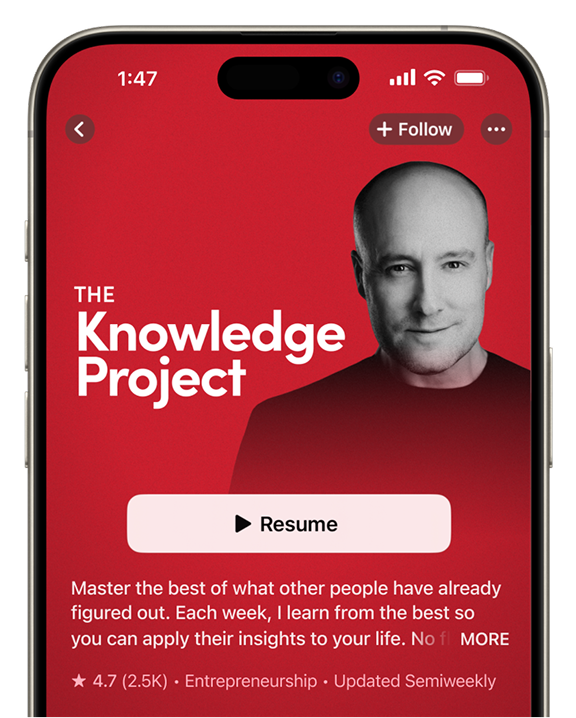
In this thought-provoking episode of The Knowledge Project, acclaimed science writer Matt Ridley explores the unstoppable power of human innovation.
Discover the crucial difference between invention and execution, why failure is essential to progress, and how collaborative problem-solving drives breakthrough technologies. Ridley reveals why innovation clusters geographically, explains why execution often matters more than ideas, and offers a hopeful perspective on our innovative future.
This is a must-listen for anyone fascinated by how human ingenuity transforms the world by exchanging ideas, embracing failure, and creating abundance through collaboration.
Listen and Learn on: Apple Podcasts | Spotify | Transcript
Here are a few highlights from the conversation:
I think on the whole, we will win battles against most pathogens because we have so much possibility of ingenuity now of human ingenuity to help us defeat them. We’ve only totally extinguished one major human disease and that’s smallpox. But boy, is that an important one, it’s probably maybe the biggest killer of all. Certainly, when you think that it was responsible for killing the vast majority of the people who lived in the Americas when smallpox arrived with European contact. But we’ve reduced polio to almost extinction. We’ve done the same with a lot of other diseases. We pretty well wiped them out, we’re getting on top of malaria and HIV, etc.
I am worried about the effect social media is having on society. It clearly has polarized us. It’s clearly accentuated the effect whereby good news is no news and bad news is news. But that’s not new, we’ve always been like that, we’ve always stressed the negative, not the positive.
I deliberately talk about innovation rather than invention because I think we’ve talked a lot about inventors, about brilliant people who come up with bright ideas that change the world. I want to talk about innovation, which is the process by which a bright idea is turned into something practical, reliable and available and affordable for ordinary people. And that’s a long slog, and it’s a lot of hard work, and it’s often more important, more difficult than the process of coming up with a good idea in the first place.
To some extent, I’m trying to get away from this word creativity, which tends to imply that a special sort of juice runs in the vein of inventors that doesn’t run in the vein of ordinary people. If you look at the careers of people like Thomas Edison or Jeff Bezos, or talk to any great innovators today, they all emphasize the importance of trial and error, failure, of getting things wrong and starting again. And they also emphasize the importance of collaboration.
I tend to take the view that we overvalue the idea and undervalue the execution, the turning of the idea into a practical innovation. Because we put statues up to the people who discover the basic principle or the first prototype. But we then don’t put statues up to the people who build a business around making that device cheap.
I think the great theme of human history over millennia is that we become more specialized in what we produce and more diversified in what we consume.
Most of humanity has spent most of the last few 100 years living under regimes that told them what they can do and can’t do most of the time, whether it was in an empire or military state or whatever, or a feudal state before that. It’s extraordinarily rare for people to have the freedom to act as merchants and investors and entrepreneurs. Anywhere that allows that to happen, will get results.
We have to get away from zero sum thinking here. The prosperity of another country is not a problem for you, it just means that there’s some rich consumers out there prepared to buy whatever you’re good at selling. The whole point of the Ricardo principle, the principle of comparative advantage, a brilliant concept, it doesn’t matter if somebody else is better at you at making everything, then they’re still going to find it easier to make the things they’re best at, and buy the rest from you. So, there’s always going to be something you can sell to another country, however prosperous they become.
One of the problems with social media is that the stronger the view you express, the more likely it is that it will be amplified. If you say, I think there are two sides to this question on Twitter, on the whole, everybody ignores you.