David Baszucki is the co-founder and CEO of Roblox, a platform built around a simple idea: give people the tools and incentives to create together.
Featured clips
Connection Between Physical and Mental Health
The Signs of a Great Product
The Email You Should Never Send
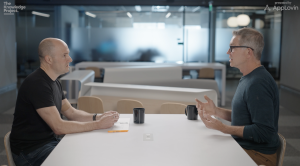
How Roblox Uses AI
In this short conversation, he shares how a health decision saved his son’s life and how it changed how he eats, why bureaucracy compounds unless you actively destroy it, monitoring your mind before making decisions, and why the best products often improve by removing complexity.
It’s time to Listen and Learn.
Available Now: YouTube | Spotify | Apple Podcasts
+ Members get the longer, extended version of this conversation, with additional content not included in the public release.
What you’ll learn
How do you build something ambitious without letting complexity, bureaucracy, or your own emotions get in the way? Roblox co-founder and CEO David Baszucki joins Shane Parrish to share how he thinks about products, people, and decisions.
- Check your state before trusting your judgment. How David recognizes when his decision-making is at its best and why an angry email should wait until morning.
- Build better products by removing things. Why David favors a few excellent tools over complicated products, and how that preference shapes his approach to running Roblox.
- Fight bureaucracy before it becomes normal. Why leaving an organization alone doesn’t keep it stable, and why simplifying how people work requires continual attention.
- Give feedback that helps someone improve. How timing, tone, and your intentions can change the way a difficult message lands and why the goal should be the employee’s learning.
- Make it clear who owns the decision. Why identifying one decision-maker and giving them room to think can be more effective than pursuing a group decision.
- Combine a long-term vision with small, fast steps. How Roblox pairs ambitious goals with rapid iteration, and what David learned from launching its simple early avatars despite advice to make them more sophisticated.
Listen for David’s distinction between making a decision that feels good in the moment and making one that serves the outcome you actually want.
++ Note: Shane and guests may hold positions in assets discussed in this episode. This podcast is not investment advice, and is intended for informational and entertainment purposes only. Nothing in this conversation should be considered investment advice, financial guidance, or a recommendation to buy or sell any security. Always do your own due diligence or consult with a qualified financial advisor before making investment decisions.
++ Note: This episode discusses health and medical topics for informational purposes only. Shane and his guest are not medical professionals, and nothing in this conversation should be considered medical advice. Please do your own research and consult a qualified healthcare professional before making decisions about your health.
Transcript
Shane Parrish: I want to start in an unexpected place. I want to talk about how keto changed your family’s life.
David Baszucki: So this is super interesting. I had dabbled with keto maybe 10 or 12 years ago. Then this thing happened with my son where he got super bad bipolar, probably 8 to 10 years ago. We tried every medication. We tried every solution to get him off medication. And here we were four or five or six years later, doctors had told him, “You’re going to be on five medications for the rest of your life,” he wasn’t quite himself, lots of hospitalizations, all kinds of stuff. And then out of the blue, someone I knew in the metabolic health community just said, “Hey, by the way, keto solved my bipolar.” And so, you could imagine, after trying every resource in the world, just all these doctors and all of that, we said, “Let’s give it a shot.”
So we found a super smart keto doctor, super smart keto dietician. And the fact that he said, “I will try it,” oh, my gosh, what a relief, huge. And then the next step, kind of three weeks in on the keto thing, was him saying, “Whoa, I feel a little different,” and kind of picking up just a little bit more of him, cutting through. Still heavily medicated, but the real him starting to poke through.
Shane Parrish: That must have been so hard on you and your wife as well.
David Baszucki: So hard on us. What’s really freaky is the number of families that it’s that hard on. We walk around the world, and we go to a football game, and there’s 60,000 people. There’s probably many people in that stadium going through that same thing.
Shane Parrish: Was there ever a moment where you just felt like you were breaking?
David Baszucki: Luckily not. Either through some combination of, as you can imagine, here’s this patient, we got to be there for him. So it’s just like, “Okay, luckily I don’t have what he has, so how do I, in a way, take care of myself so I can be there for him?”
Shane Parrish: And how do you think about the relationship between mental health and our body, I guess, in that sense?
David Baszucki: If I roll back the clock and think about my mind and how I thought about mental health 10 years ago, I use that as a template for how everyone without someone in their family must think about it. It’s just, “Oh, people go crazy. Oh, they’re having a mental health thing.” I never thought of it as a super physical thing because now I think of it the same as a broken arm. It’s just part of your body is physically not working. It just happens to be your brain.
With this keto thing, I think I’ve developed a theory that in some cases, mental health things are very physical. Is your brain getting enough energy? The theory behind keto is that arguably we were eating some maybe more primeval foods up till 10,000 years ago. We hit the agricultural revolution. That was wonderful in many ways. Our population flourished. But in certain ways, we might not be fully adapted. There may be certain people who just are not fully adapted to that many carbs in their diet. And so, for my son, he may be one of those people. And that launched a family foundation, I’d say, for the last four or five years doing research on this.
Shane Parrish: What’s your current metabolic routine?
David Baszucki: It’s interesting. I do think I’m doing pretty well on not eating a lot of complex carbs that spike my glucose. So I’m wearing a CGM right now, so I have a little app on my phone and I can see my glucose level whenever I want to see it.
Shane Parrish: But you’re not tracking your ketones?
David Baszucki: I’m not tracking my ketones, although I have in the past. And so, I kind of know what’s going to spike me. But generally I eat fair amount of protein, fair amount of fat, not too many carbs, and I don’t eat any sugar, I basically don’t eat any starch, like anything that’s going to give me a glucose spike.
Shane Parrish: How does your metabolic state affect your decision-making?
David Baszucki: I do think eating a lot of food or even a lot of carbs, we can all feel that kind of slow down, kind of hibernate, sleepy mode. I think in a more fasted state, you can feel that more alert, like I want to go do stuff kind of thing. And I do think it’s good to make decisions in that if you can tell the difference in that I-want-to-go-do-stuff mode. I think those end up being longer-term decisions. They can be decisions that in a less optimistic mode seem, “That’s impossible. That’s so hard.” And I do feel I have learned to tell when I’m in an on-mood, when I’m in an off-mood, when I’m a little more of an optimistic mode, which I think is general. I do try to observe that from the outside-in and say, “All big decisions, make in the optimistic mode.” I do try to say, “Is the decision-making machinery in the optimal state?”
Shane Parrish: Outside of Roblox, how do you think about great products?
David Baszucki: I like the notion of less is more. So I like the notion of telling everyone it’s very easy to add knobs and stuff. It’s very hard to remove all of the knobs and sliders in a great product. It’s fun when we think about products. In a kitchen, for example, when we think about great products, there can be various philosophies. I definitely would not like a dedicated appliance to cook hot dogs. That would feel like a very weird dedicated thing as opposed to a beautiful knife and a beautiful frying pan. So I think I like simpler things of higher quality rather than complicated things.
Shane Parrish: How do you think of removing when it comes to the company? I mean, you’ve been at this a while now. You’re going to be at it for a lot more time, hopefully. Sediment builds up inside the company, and bureaucracy is the natural sort of entropy of an organization, and then there has to be a counterforce almost to get rid of that.
David Baszucki: We do use the term, “Destroy bureaucracy” inside the company at times. I would say that if one is not reducing bureaucracy, there’s no neutral ground. I think in a lot of situations where one thinks, “We’re pretty good. We’re just going to let it be in this steady state,” that’s actually things are imploding in a way. If one is not trying to improve things, it is going backwards.
Shane Parrish: How do you give feedback to people?
David Baszucki: I’m probably not the best in the world at giving the feedback. I think what I have tried to do is move to more frequency, more in the moment, relaxed, not a big deal, rather than, “Let’s have a feedback session.” So I would say trying to be in the moment, “Oh, what do you think about that?” I think is much better than blocking or waiting or trying to organize it.
Shane Parrish: How would you think that people receive that feedback?
David Baszucki: I think the feedback is hypertone-related. I actually think if delivered in a neutral positive tone where people can sense my blood pressure’s not going up, where I’m just like, “I got your back no matter what. It’s all cool,” even if the feedback’s pretty harsh, it’s like, “Whoa, that was okay.” Whereas I do feel if feedback is delivered aggressively or it’s just like, “Oh, it’s traumatic,” I think that can actually influence it more than the feedback.
Shane Parrish: I like the idea of tonal because so often, in a distributed workforce or people working from home, a lot of feedback is written over text or Slack, and then you don’t have that tone or softness that goes with it.
David Baszucki: I support that. Also, if I get riled up, don’t touch text or email, just walk away. It’s so dangerous.
Shane Parrish: Do you recognize it?
David Baszucki: Oh, yeah, just red alert. Do not send that email.
Shane Parrish: To you or the one that you’re about to send?
David Baszucki: No, just imagine writing an email where you’re thinking, “I’m so pissed off. It’s going to feel so good to send this email,” don’t send that, because then the next morning you’re like, “Oh, my gosh, thank goodness I didn’t send that. I can call this person. I’m going to have a lot more impact in delivering that same message without being all worked up about it.” They’ll go, “Whoa, cool. It’s all good. That’s pretty hardcore feedback.”
Shane Parrish: And the next morning, you probably read it, and you’re like, “Oof, I’m glad I didn’t send that.”
David Baszucki: Absolutely. Plus, also, what is one trying to optimize? When someone’s trying to send that email, I’m optimizing for myself. I’m just optimizing. It is going to feel good to send that aggressive email like, “I’m going to send that thing.” Whereas when the next morning comes around, you can say, “Well, actually, I should optimize for the learning and excitement of this employee.” They’re going to go, “Whoa, this is a great relationship. I just learned something there.” So changing what one’s optimizing for, I think.
Shane Parrish: I like that a lot. I think of it in terms of outcome over ego.
David Baszucki: Absolutely. We’re just constantly trying to make it a better experience for the employee who cares about me being pissed off.
Shane Parrish: When you see people make mistakes, what are the patterns of mistakes that people make when it comes to seeing reality, ego, decision-making in that vein?
David Baszucki: I don’t know. I don’t think there’s a lot of mistakes. I think the typical pattern is, “Hey, can we make this simpler? Hey, can we look a couple years out and think about what’s going to happen with that? Hey, that looks a little complicated. You have two things doing the same thing. Hey, can we take that from a appliance that heats up hot dogs into two separate appliances, a pan and a knife that are both the best in the world?”
Shane Parrish: Can you spend a few beats and explain the principles of good decision-making and good thinking as you see them?
David Baszucki: It’s so funny, we were having this discussion in our Roblox values. So we have Roblox principles and Roblox values, they’re not as extensive as maybe… Some people have published books with 400 principles. We’re trying to keep it to 15 or 16 so people can remember these principles. But there is something, I think, inside of an organization where, for many decisions, it’s actually more important just to, “Let’s identify the person who’s going to make the decision and let them be somewhat free and creative to make the decision,” than in many cases a group decision or a confused decision or we’re trying to do all of that. So I think you’ll see more and more, us at Roblox, it’s just like, “Can we identify the decision maker?” Having them have a little freedom to make their own decision I think is super powerful.
Shane Parrish: Aside from systems thinking, what are some of the mental models that you use to think through problems?
David Baszucki: I think one mental model that we’ve had in thinking through problems is kind of an irreverence, in a way, to the problem.
Shane Parrish: Double-click on that.
David Baszucki: If one goes through a problem-solving exercise, and time and time again, we think we have the solution, it’s pretty good. Oh, we even have a simpler solution. The simpler solution is different than what most people are saying, so all of a sudden we had even a more compact decision that a lot of people said, “That’s not going to work.” And then we see that solution actually work really well. It can make sure we’re not kind of locking into traditional mindset. We’re really trying to push, “Is there a gem out there, or even something we haven’t though of?”
Shane Parrish: There’s many ways to get to the outcome.
David Baszucki: One of the decisions, I think back to the early founding of Roblox, and I would call this set an irreverence, is the very earliest version of Roblox had what we would call the classic Roblox character. We were saying, “Okay, we’re building a user-generated gaming platform. We’re going to have an avatar.” The very first Roblox avatar was a very fast programmer art avatar to get something working. Its proportions are ridiculously simple. The legs are 1 by 1 by 2, the body’s 2 by 2 by 1, so you can actually see it’s super simple, and it’s got a head on top of it. The face of the early Roblox avatar was just programmer art that we put together.
Universally, all of the gaming industry people we would talk to, “Whoa, whoa, whoa, do not ship that. You need a full avatar. You need a meshed avatar. It’s got to be high res. Your objects need to look better,” but we decided it’s better to ship that early and start getting feedback on it. I thought that was a great decision. And we found out actually that a lot of the input we had been getting, thank God we didn’t listen to that basically.
Shane Parrish: How do you deal with a situation where your instinct and the data disagree?
David Baszucki: We get that quite often, I would say. It’s interesting to think of the whole Roblox community and how smart and creative they are and how passionate they are. There’s a really gentle line that needs to be worked on as we both drive the product forward as well as listen to that community, and that creates many conditions where our instincts are different than the community’s vibe. There have been situations where our instincts have been different, the community’s been right, and it’s like, “Whoa, they had it.” But there’s many other cases where our instincts have been right, and the community then follows along and says, “That’s an absolutely great idea.”
Shane Parrish: But how do you resolve that? So much of getting to good decisions and good outcomes is seeing reality and adapting to reality.
David Baszucki: I think a lot of decisions that can be made incrementally that aren’t one way, those are a lot easier. We try to make faster decisions in the right direction. We can adjust. I think realizing when we need to adjust is super powerful. One could make the argument that if a decision can be the evolutionary design of the eye, for example, for some reason, we evolved to have eyes, that was probably trillions of small little decisions that kept going in the right way. The more a decision can be decomposed to a long-term goal like, “We want to be able to see,” we’re going to take thousands of small steps to get there. Those types of things I think can have both a long view as well as be pretty resilient.
It’s interesting because two of our values are take the long view and get stuff done. We kind of like to say there’s a magic decision-making quadrant where the magic quadrant is it’s both a long view decision with hyperiteration to get there, and that’s kind of a magic, safe quadrant. All of the other quadrants have a little weirdness to them. If we go through the other decisions, take the short view and iterate, there may be a much better long view, that’s not very good. Take the long view, but don’t iterate. Work on it for two years and then dropship it, not as good. Take the short view and don’t iterate, that one’s not even a quadrant. So that’s a quadrant we really like.
Shane Parrish: Walk me through one of the bigger mistakes that you’ve made and what you’ve learned from it and who you’ve leaned on during that time.
David Baszucki: I wouldn’t call it a mistake, but I would say, for a while, what we were trying to do as a vision and a mission, you could say when we had 50 or 100 million DAUs, probably even less than that, we were just saying, “Our goal is billion DAUs, blah, blah, blah, blah, blah, blah, blah. That’s our plan.” And in retrospect, I think sharing with all of our employees like, “We’re going after gaming. We’re going after immersive communication. We’re going after working together. We’re going after school together,” painting all of that was a pretty big broad thing. When we crisped it up to saying, “We’re going after 10% of the gaming space on Roblox. Everything we’re going to build is going to help these other areas, but this is the right order,” I would say that would be not necessarily a mistake, but a cleaning up of how we were talking about things.
Shane Parrish: When things aren’t working the way you want them to, what’s your inner monologue in those moments?
David Baszucki: Interestingly, I think when we’re running companies, we have all the evolutionary biology of being out there in the wilderness trying to survive and having battles and all of that. So I think CEOs can get that feeling like, “Oh, my gosh, do I have enough firewood for the next three winters?” And it’s like, “Well, it’s not feeling too right.” That has been, for me, an intuitive early thinking thing. What’s great is it leads to typically a refinement in strategy. Then all of a sudden the light goes on. It’s just like, “Oh, we got the plan. We know exactly what to do. We’re going to send four people out. They’re all going to have axes. We’re going to put in three months, get three years of firewood. We think we can do it in three weeks. Everything’s great.”
Shane Parrish: Do you manufacture threats as a way to motivate or focus yourself? I think of Michael Jordan playing for the Bulls. He used to manufacture things that other players said about him.
David Baszucki: We are running right now… I’m not going to say what the company looks like. It’s not an existing company. In my own mind, I’m imagining the company across the street that could call it a threat like what’s it look like, who are the people, how many people, what are they building.
Shane Parrish: Do you analyze your mistakes? How do you do that? What’s your process?
David Baszucki: I would say typically my mistakes have come, I think, from being maybe overly logical and less intuitive. One can fall into the trap of just saying, “I have to go down this path,” in a way and not popping out of the box and thinking of the more outside-of-the-box solution. So trying to think of mistakes I have made have been typically where I’ve hung on to a concept too long when I actually was very free to change my course. And in retrospect, just like, “Oh, yeah, I could have just changed course right there.” I think we have a lot more optionality than we imagine when I look backwards in time.
Shane Parrish: Is it fair to say that Roblox is the biggest generated human universe in the world?
David Baszucki: It’s worth thinking about that because it would be worth thinking what’s the definition of a human-generated universe. There’s universes in books and in movies. As far as an interactive multiplayer universe where people can go together and do things together, I mean, it might be.
Shane Parrish: So through this virtual world, what have you learned about human desire and psychology?
David Baszucki: What I think I have learned is that we need to have enormous respect for all the people in this virtual world. I think it’s surprising how much people can attach to their digital identity. I mean, it has to be very carefully respected. This is real stuff. There are real emotions happening, real interactions happening. And I think I’ve also learned that I feel it’s still very, very early.
Shane Parrish: Say more about attaching to your virtual identity.
David Baszucki: Once again, this is an area that I love the Roblox community on, and I think they’re very sensitive to this in that we’re migrating all of our avatars to a position where, rather than just being a monolithic block, for those users who choose, the head may smile if they want it to smile or something like that. But in the migration of this process, the Roblox community has just been absolute sticklers for perfection in the migration, and it’s because people have been familiar with their avatar for such a long time. It’s like, “You can’t take my head and adjust a few… What are you doing?” And I think they’re right.
Shane Parrish: Does that make updating harder?
David Baszucki: In certain cases, it does. That is an incredible balancing act. Sometimes we think about updating. There’s two schools of thought on updating. One is, 30 years ago when the PC came out, they had MS-DOS. Today, an MS-DOS program will still run on a PC. It’s mind-blowing. If you take a AutoCAD from 30 years ago, you can boot it up on a PC, boom. The other side was like the Apple Macintosh. They just threw stuff away five times like System 7, next step, blah, blah, blah. I think we make judgment and we sometimes use those two ends of the spectrum to figure out when is it appropriate to just, “We got to keep that forever,” versus when, “No, we have to keep moving forward.”
Shane Parrish: How do you think about things like capital allocation? You guys just announced your first buyback recently.
David Baszucki: Super thoughtful. Knock on wood, we’ve made a lot of cash in our history, a lot of positive free cashflow starting from the investment we’ve had and where we have come. I would say a lot of the decisions we make have come from not necessarily capital allocation, but what are we trying to do, what is the big picture of the opportunity, and what we’re trying to grow for them. I would say we’ve refined that many times throughout our history.
It’s almost like we’re in Roblox version 5.0 right now in that, when we started the company, the vision we had I think was spot on. We were imagining a new category, human co-experience category, the metaverse category, the holodeck category, the Snow Crash category. We really could see that coming, but we were very moderate and modest in the very first thing we were going for. When we started, for those of us who could remember, Club Penguin was a really popular kids game, and we just thought that was, “Oh, that’s huge. Club Penguin, they’ve got X many people. We like what they’re doing.” We started with arguably a much bigger, deeper technical foundation.
I would say though, along the way, we’ve refined our aspiration and what we’re trying to do. When we went public, we were talking about connecting the world. Two years ago, we talked about getting 10% of global gaming on our platform. That continues to refine as we have a bigger percentage of global gaming on our platform. I think you’ll continue to hear us kind of expand our ambition.
Shane Parrish: What percent are you now?
David Baszucki: Well, you can look at where we’re tracking on our bookings, and I think if you divide our bookings by 200 billion, we’re in the 3 to 4%.
Shane Parrish: That’s amazing. That’s incredible.
David Baszucki: It’s incredible. And at the same time, it actually seems like… It’s exciting to me because there’s a lot of room beyond 3 or 4%.
Shane Parrish: What about incentives for people? What have you gotten right and gotten wrong over the years?
David Baszucki: I think we got really lucky in being really fascinated with incentives. And I think very early on when we started building Roblox, some of the early founders, John and Erik and Matt and myself, we were just really into economics and incentives and what makes people do things in a nice appropriate way and drives it. At the very start of Roblox, we thought just the incentive of user-generated content like, “Whoa, everyone can make their own game, and they can come and play it and show it to their friends.” We thought that would be an amazing incentive, and we thought that would give us amazing amounts of content. That did prove to be really true. Along the way, we had a lot of questions around economic incentives. Roblox got pretty big without a way for developers to earn money on the platform. It was a hobby for everyone.
We had people who were working 24 hours a day, just they loved their Roblox creation. They were struggling like, “Wow, I got to make a living. I just want to build on Roblox.” We had a lot of board-level discussion, “Should we turn this into something where someone could make a living?” In retrospect, it’s crazy. We then went back and forth a lot like, “Well, I’m not so sure we should do that.” But we did come up with a notion, “Okay, we’re going to build a really elegant system. Creators can make, whatever, wide range of experiences. They can have users participate economically. It’s going to be free for most people. Some of these creators who are working 24/7 might be able to make a living on that.” I think we thought about that very systemically because that system has just been the engine behind us ever since then.
Shane Parrish: One of the things that you and Erik disagreed on was the API.
David Baszucki: So Erik Cassel, co-founder, started Roblox with me, passed away from cancer eight years ago, rest in peace, but in a way, a values template for the company. And when we started Roblox, Erik and I were the first two engineers. We wrote the whole system. We had some false starts too, by the way. There’s a really fun story that I would say we both knew what we wanted Roblox to be, and we knew we want user-generated, multiplayer, build your own thing, go play it with your friends. That’s what we want. Along the way, we tried to ship early a subset of that, and just… It did not work. It was a non-avatar-based, more puzzle thing, and it’s just like, “Whoa, back to the drawing board.” I was in a way, “Okay, we’re making this game creation platform. Let’s try to hardwire all these types of games you could make and have all of this extra cruft on the system, elements from games.”
I remember actually in our core C++ code, we actually mocked up a capture the flag game, and we had a flag as part of our core API. In retrospect, it’s an absolute disaster because a flag is such a user-generated, complex, specific game thing. For me to have put that deep into our core stuff was just terrible engineering. Erik was very different. He’s like, “Whoa, whoa, whoa, don’t do that. We need an interface of language with this thing. We need an API. We need to have this thing be very generalizable. There’s a game-creation language called Lua. Let’s connect that up and don’t do any of this stuff.” It’s weird that I was initially like, “Whoa, I don’t know if I trust that.” But we started doing that. The power was just absolutely enormous. Rather than my hard-coded stuff, the power of this generalizable thing, that was kind of a core engineering foundation that gave Roblox a lot of its UGC boost in a way.
Shane Parrish: You mentioned a couple of false starts. What are some of those false starts where you guys went down the wrong path, and how did you realize you were going down the wrong path?
David Baszucki: Along the way to building an economy on the platform, we started with a very different economic model. It was a membership model. You got a few extra places to build on Roblox. In retrospect, that was a really bad idea because building should be unlimited. But along the way, that economic model started to fail actually, and we had a situation where our user growth was going up, up, up, up, up, up, but less people wanted to buy this membership. And so, this is really interesting, right? Our users are growing, it’s all great, but money is flat to going down.
And so, what we did on that, I would say, is a very typical tactical response. “Okay, something’s up. Let’s fix the current system. Let’s make a list of 50 things that might be broken, 50 small tune-ups that we can do towards this system. Okay, let’s do that.” So as you would imagine, we made that list of 50 things, did 30 of them. Oh, we still have the problem. Now what? But in the back of our head, we had been thinking about the economy, about virtual currency, about how this was a whole outside-of-the-box game changer. This wasn’t just tuning up something that was arguably broken. This could be 100 times bigger than what we’re doing.
And so, then all of a sudden, maybe in a disparaging moment, just, oh my gosh. All of us in the company had said, “We just have to do this, this big hard thing.” But then we had absolute clarity. We’re just betting it all on this new economy system. We were very thoughtful that the economy system was a bunch of complex parts. It needed virtual currency. Users needed to be able to buy virtual currency. Some of the early things were in some of the games. You could buy a flashlight if you wanted it. Some of the games, if you wanted to be a eagle instead of a sparrow, you could buy an upgrade for that. And then finally we said, “You know what? In addition, we’re going to show which of the games on Roblox are making the most Robux. Where are people spending it?”
And so, launching all of those things at the same time, there’s virtual currency, people can buy it, creators can incorporate it, you can see what’s earning, it created a loop or a system that within eight hours we just said, “Yep, we got it. Boom.” Because we could see within eight hours, creators are like, “Oh, I got to add this. I got to do this.” There’s the top grossing game on Roblox. People are actually interested in that.
Shane Parrish: You invented a world where people can do whatever they want.
David Baszucki: That’s right. And so, we knew, okay, we finally got it. And after all those months of fixing those 50 little small things, the right system just… All done.
Shane Parrish: That’s awesome. How does the virtual currency work? Specifically, how do you value it? Does it get tethered to outside forces? How do you think about that?
David Baszucki: We have generally thought it’s better not to inflate it, to have it be a somewhat consistent value. If you or I were to go buy some Robux, we would see it’s generally somewhat like a penny per Robuck. It’s generally been that way for about 20 years. So I would say no promise long-term. It’s directly tied to the dollar, but I think we’d try to keep it stable and not inflating or deflating.
Shane Parrish: Do you ever see a world where you can use that currency outside, and I can go buy a Starbucks or something with it?
David Baszucki: I do see that world. No future plans. We haven’t announced anything. But it’s interesting to think that many, many 8 through 12-year-olds, their first exposure to money is Robux. My first exposure to money was I got 6 cents or 10 cents a week allowance. I could go buy a comic book and learn to make decisions. It was actually very valuable for me because I can remember trading cards. Baseball trading cards were a big thing when I was a kid. And I remember, this is triggering a childhood memory, okay, three weeks of allowance, I got some baseball trading cards. I went and hung out with the neighbor. We played some trading card game, and I lost all my trading cards and I was so devastated, but I think it was a positive lesson. So I do think, for many young people, learning how to use a virtual currency, not to spend it all at once, maybe to divvy it out a bit can be a lot of learning. And so, it’s interesting to think over time if young people get sophisticated enough to use that to go to a 7-Eleven or something.
Shane Parrish: What would have to be true technologically for that to be possible, or is it possible today?
David Baszucki: I don’t want to go into too much details. We’ve thought about a lot of that. I think it’s a little bit more of a what’s the focus of the company right now, and it’s a little bit more should the focus of our company be young kids are doing a lot, or we have an increasingly larger percentage of what is play in the world. So we’re pretty focused on just what is play in the world.
Shane Parrish: What does focus mean to you?
David Baszucki: I think one way to think about focus is is there one statement in your head that everyone in the company can just understand. Is the focus human-understandable? We are just doing this, and everyone just says, “Oh, I got it. I can rally around that.” So I think that’s a little bit how easy is it to present it or share it.
Shane Parrish: Double-click on that understanding and how important words are in communication, not only for the sender, but the receiver, and how you spread messages throughout the company.
David Baszucki: We’re still learning on that. It even goes into how you think of the product, what your vision and mission are. They really, really, I think, really matter. I’ll use an example that very early on in the formation of the company, when we are very small, we use the tagline, “You make the game.” That’s kind of fun, right? I would say that was an idea that anyone could make very simple games in Roblox. I think as we think about that notion and we think about AI and what’s going to become possible with AI in the future, it’s actually been fun to go back to those words and think, “Are they now possibly even more true than they’ve ever been?” and that the more we have the ability to use AI for anyone to make a game they think about, those words can have really big meaning.
So I think going after… Say our vision is 10% of the gaming market, that’s a pretty good focus, a lot of people understand it, but I think that’s constantly should be reevaluated a bit as we think about where we’re going in the future.
Shane Parrish: Do you use AI internally to help make decisions or help expand your context window on the company?
David Baszucki: I would say we have all kinds of AI. We have a bunch of internal systems that we have built. So we have a thing called the Roblox Operating System that we use for tracking the work in the company, more and more helping people see how they fit into the organization. Those are all MCP-enabled, so anyone can take their AI system and run it on top of those. In a way, we think of all of our Roblox systems as things that either people or AI can look at and run things against. So we have all kinds of people building custom little things that are looking at the work tracker or doing some things. Some people auto-generate our one-on-one discussion topics. So I would say yeah.
Shane Parrish: I want to get into talking about a lot of the policy that’s coming out of governments all around the world in terms of age bans. Without commenting maybe on whether they should or should not exist, who do you think should implement those? Should those be at the company level specifically, or should they be at a platform level like Apple?
David Baszucki: I mean, when I talk to senators in the United States, I say, “Please, how can we help you take a look at what we’ve done on our own without any laws requiring it? We’re now using AI to check the age of every single person on our platform. We’ve open-sourced our voice-safety filter.” I do say, “Look at what private industry can do.” And then of course I think there has to be a lot of thought and caution. And I think universally, legislators I’ve met with, they do have a balancing act. They are trying to enact great legislation, but they’re trying not to have the tragedy of good intentions. They’re trying not to craft laws that’s just like, “Oh, my gosh, I wish we wouldn’t have done that.” One could say, for example, “Well, on a mobile phone, whoever makes the mobile phone should check the age of everyone on the mobile phone.” We said, “We’re not waiting for that. We’re going to do it ourselves,” in a way.
Shane Parrish: But do you think that that is a better solution from an industry point of view? You’re not waiting, that’s great, but do you think it’s more elegant to have it at a device level or at an individual company and you’re responsible for that?
David Baszucki: This is what makes it so tricky in that I would say both in that, knowing what we do, given that we’re doing age check for all of our users for comms, for example. We know, for example, a lot of parents don’t have the time to configure their device or a lot of parents to say, “Yeah, take my iPad and go do that.” And so, if that iPad is configured, for example, as a parent, it’s handed off to a kid, that can be a little tricky. So I would say even when devices maybe have an age in them, we’ll still keep doing our own thing.
Shane Parrish: Do you think there’s second and third-order maybe unintended consequences to the way that we’re going about this now?
David Baszucki: Yeah, I think our legislators are trying to do their best, and it’s a very complicated world out there. We’re trying to set the example. For us, know the age of everyone on the platform, use AI to do it, ultimately other signals to do it, don’t allow image sharing, things like that, that’s worked well for us.
Shane Parrish: But that’s had a cost on you. I was listening to your last earnings call this morning, and it slowed down growth.
David Baszucki: I would say the opportunity to build a global platform that has more and more people playing together, which is amazing, and all around the world, not just, quote, “over 13,” but of all ages, I mean, this is foundational to our growth. We’re very optimistic.
Shane Parrish: I think where I was going with that is you’re able to take a longer view in part because you’re a majority shareholder, you’re the founder, you carry a lot of weight in that, and you can make these decisions. Not every company is going to feel that they can take an immediate short-term pain for longer term gain.
David Baszucki: Yeah, I would say this is once again where our aspirations are. We think digital play is just amazing. I shared we’re in the 3 to 4% of the world right now. Imagining what the future is going to be for the types of interactions we’re going to have, it’s pretty amazing. So I do just feel the work we’ve done safety, civility platform-wide is foundational for platforms like this.
Shane Parrish: How do you think about positioning and optionality?
David Baszucki: Positioning, I think about constantly clarifying what we’re trying to do. I think, more and more, our positioning is going above the company itself. I think there’s a really elegant future way to think about positioning as almost a bigger thing than the company itself. Right now, it’s kind of interesting. Because when I think about the world we’re in, everyone’s getting, “Okay, we got all these digital devices. What’s going on? Social media, social networking, gaming, AI, all of that,” having a message that goes above all of that I think is super interesting. So for us, I really like the notion of play. I like the notion, whether it’s digital or physical, play is really important to people being together and doing it. And so, I think thinking about a positioning that kind of goes above one’s company can be super elegant.
Shane Parrish: If you close your eyes, I want you to tell me what Roblox looks like in five years from now.
David Baszucki: I’ll share a couple examples. One, we’ve shared the other side of that, which is the technology we’re building for Roblox Reality. It’s surprising that… It’s actually hard to imagine what a photorealistic multiplayer game would feel like. We’re not used to it. We’re used to looking at gaming footage and saying, “That is an amazing game. That looks so good.” But I do think when we look at it, we say, “But that is a game, by the way. That’s not like Bourne Identity.” Whereas if we ran Bourne Identity on a 2K screen, that looks different than that. So I do think there’s going to be a future world where we have all the aspects of the multiplayer gaming interesting, but it feels like that, and I think that’s going to be pretty mind-blowing. It’s going to be a little bit like going from black and white to color or going from 512 to 2K. People don’t quite realize how big that can be. So I think that’s one aspect of it.
I think there’s another aspect where the notion of you make the game is really going to come full circle because games are much more complicated than code. They have images and assets, and they have environments, and they have stories, and they have all of that. But getting to the point where you or I make a beautiful thing, share it with our family, play it just by talking about it, I think, is going to come true as well.
Shane Parrish: I think that that’s incredible. What do you think will be the second and third-order consequences of that?
David Baszucki: I think the positive thing to think about is actually the fun parts around connection and digital play will in a way become very… They’re already quite meaningful. I think the consequences will be more fluidity in digital play, the feeling that it’s not me as a user and them as a creator. It’ll almost be like, in the old days, only 1% of us were oil painters documenting the king’s portraiture, whereas now I think we all feel like we’re oil painters. We have our phone, we have digital image tools, and we’re all kind of feeling like we’re part of it. And in a way, rather than a digital technology reducing the job market for oil painters, it’s probably increased the job market. There’s a lot more people doing digital imagery. I’m actually thinking the same thing will happen for gaming and that both the hardcore creator market and all of us will be more involved in the creation of immersive experiences.
Shane Parrish: What was your reaction to watching Ready Player One?
David Baszucki: Ready Player One, the book I loved. The movie V1, I love. But I do like less-intrusive far-out VR. I’d say Black Mirror, when they do VR, you just put a little white dot on you, and it takes over their eyes and your body and all of that. It’s less intrusive. I think that’s probably more where it’s going to go than just goggles and stuff like that. Huge fan of Ready Player One, but I think there’s a wide range of technical coverage of how this is going to work. I’m a stickler, I would say, on sci-fi movies. The more real and the less comedy or cliche or whatever, the more I like it. And I think it’s really hard to find sci-fi movies that are just trying to be real.
Shane Parrish: How does your background in physics help you think through problems?
David Baszucki: I’m wondering if it’s a background in physics helps you think through problems, or more an interest in building stuff leads to a background in engineering, or whether it’s correlation or causality. I would say where I grew up, I luckily grew up in a hyperbuilder type environment. I grew up in the far suburbs of Eden Prairie, Minnesota. Everyone had a workshop, everyone had tools, everyone was building go-karts and model rockets and all kinds of stuff, so there’s a lot of hands-on building stuff that I think I was always interested in. So I think almost that growing up in a builder culture led to engineering type interest, maybe in reverse a bit.
Shane Parrish: What was your childhood like?
David Baszucki: I feel my childhood was pretty idyllic because I grew up… I can remember the moon landing.
Shane Parrish: Where were you?
David Baszucki: I was in Chicago, Illinois, moon landing, 1969. We all like nostalgia and all of that, but it was a pretty fun place to grow up, the ’70s.
Shane Parrish: Did it inspire you when the moon landing happened? Did it light a fire inside you?
David Baszucki: It did inspire me because I remember going to my school, and I made a huge model out of cardboard of the Saturn V and the lander and painted it all up, and I had the landing module and all of that thing, and I brought it in to show my teacher just because I was so into it like, “Check this out. You can take this Apollo thing off, and you can dock it.” And so, then I do remember, this is a really cute story, this was in Arlington Heights, whenever there was then a subsequent Apollo, they would pull me into a classroom with my model. And if they watched half an hour of TV, I’d say, “Here’s what’s happening. This is going off and doing that.” So yeah, I think I was pretty inspired by that.
Shane Parrish: That’s awesome. I want to get this right, so I’m going to read this, but my 16-year-old submitted a question for you.
“If you were starting out at 16 today with no money, no contacts, no network of people that you could rely on, how would you spend the next five years to maximize your chances of building a company that matters?
David Baszucki: Oh, my gosh. Well, I’ll tell them what worked for me is that was the last thing on my mind when I was 16. I was into, in a way, hanging out with people I liked. I was into what naturally I was good at and interested in, whether it’s building model rockets or go-karts. So I think if one is 16 and actually that’s what you’re into, there is a notion to… As one goes through the normal course of life, you’re going to go to high school, you’re going to maybe go to college. In parallel, can that be your fun little hobby in a way? Can you warm up on that in an authentic way?
Shane Parrish: We always end these interviews with the same question, which is, what is success for you?
David Baszucki: I feel every day I’m already feeling very successful.
Shane Parrish: What goes into that feeling?
David Baszucki: Waking up every day just saying, “I’m so fortunate.” So I actually feel that way.
Shane’s Reflections
Shane Parrish: I hope you enjoyed that episode as much as I did. While I was in San Francisco recording Ed Catmull, I sent Dave Baszucki a message and said, “Let’s do this.” So we hooked up, and this is the conversation. We actually did it inside Roblox headquarters.
I want to tell you something really unique about Roblox headquarters. After listening to this conversation, you’ll see why it’s important to Dave. All the snack foods are labeled with a whole-food index. Maybe I can show you guys a picture or something, but it basically says, “Whole food, good energy.” It’s got two check boxes, “Is it real whole food?” and, “Does it offer good energy?” And all the ones that are neither checks go at the bottom, two checks at the top. I thought it was fascinating.
The most important part of this discussion was just how much food changes everything. Not only did it completely turned around his son, Dave is super healthy. He looks healthy, he looks fit, looks like he’s got tons of great energy. He talked about how the metabolic state and a lot of these things that we think of as maybe being overworked or bipolar can possibly be addressed with diet. And I’m not a doctor, I don’t play one on a podcast. I think that this is worth researching.
And Dave is spending a lot of money doing double-blind studies, and he’s funding all this research, and the preliminary results are actually astonishing. And I think that the n of 1 is his son, but this could be beneficial to so many people in the world. So I’m hoping that this takes hold. And if you’re struggling with any of those things, this might be the thing you need to do to play around with and to try, and obviously consult a doctor before you do any of that, but it is so powerful. And we talked about how that state of mind, how your metabolic state, influences your decision too.
One of the other things that stood out about this conversation was sort of like take the long view and iterate. You don’t have to go these big steps. You can do these long views. And he called it the… I think it was the magic safe quadrant, and it combines sort of long-term direction with rapid iteration, and I think that that makes a ton of sense.
Another idea that really stood out from this episode was stop trying to fix a broken system. So this happened when Roblox users group membership revenue flatlined, and the instinct that Dave had was the same instinct that all of us would have in that situation. Let’s list all the things that are wrong with it and prioritize 25 of them and do that, but then nothing changed. And the real answer came when they replaced the model with a virtual economy. I think he said within eight hours, creators started adapting, and then the world just exploded and came alive.
Just going back, I want to touch a little bit more on sort of making big decisions when the machinery is working, the machinery of your mind, that ties to the metabolic state of your mind. But also, Dave mentions that he sort of focuses on am I being optimistic, energetic, or am I tired and defensive, and how that affects your decisions. So you can’t always control your mood, but you can control what you decide while you are in it. You don’t have to make these decisions when you’re in a bad mood, when you’re tired, when you’re feeling drained of energy, when the world does not look abundant.
Another idea that stood out is sort of like, we talked about this, and Dave had a really good practical solution, but there’s no neutral ground on bureaucracy. The natural entropy of the world is basically expansion. My desk gets messier if I don’t clean it daily. Everything just sort of grows and grows, and bureaucracy is the same way inside of organizations. It’s all about simplification, staying in the basics, not getting lost, and not getting distracted.
And the other mean idea that I took away from this episode and our conversation was sort of angry emails optimized for the wrong person. That heated message that makes you feel so good and so righteous, it serves the sender. It doesn’t do anything to the receiver other than escalate. So it releases frustration, but it rarely improves the outcome.
Thank you for listening and learning with me. I’ll see you next week.