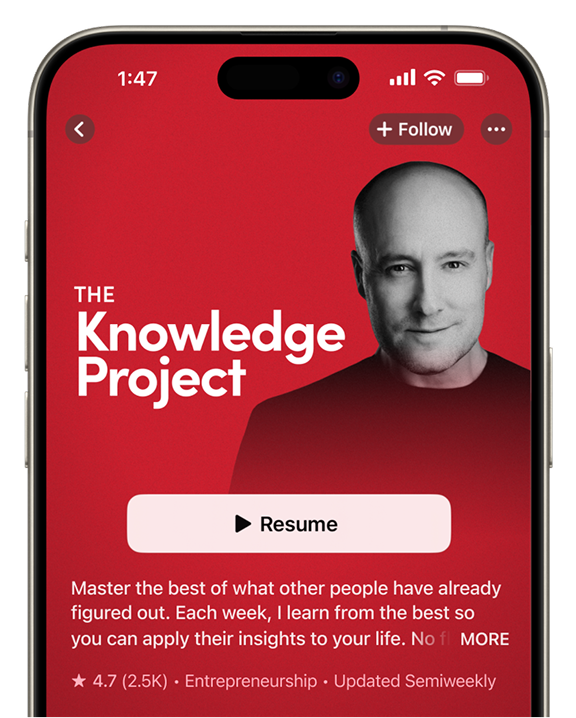
The Knowledge Project closes 2023 with a look back at some of the best conversations of the year.
Featuring interviews from nine of the most downloaded episodes of 2023, this collection of conversations offers a variety of insights into the power of intention, how to become a better listener, how to give and receive feedback at work, the Four Pillars of Integrity, facing the realities of life, the importance of having deadlines, taking responsibility, building trust in a large organization, and when to double-down on your plans for success.
Listen and Learn: Apple Podcasts | Spotify | Transcript
Guests on this episode include: Mindfulness expert Jack Kornfield, executive coach Carloyn Coughlin, organizational expert Aaron Dignan, leadership expert Jim Dethmer, venture capitalist Ravi Gupta, author and Wired co-founder Kevin Kelly, doctor of psychology Julie Gurner, veteran CEO Frank Slootman, and performance psychologist Gio Valiante.
Here are a few highlights from the episode:
There’s one Zen saying that says, when you sit, just sit and when you eat, just eat, to just be where you are. And you can practice this. And you start to pay attention to what it’s like when you do it in a gracious way. And it doesn’t mean you can’t set a goal and it doesn’t mean you can’t give it your very best. And if there are certain moments you need to really throw yourself into something. But even that you can do it with a good spirit and with fun rather than being afraid of how it’s going to turn out. – Jack Kornfield
Another is giving it language. I love hearing that listening to win is such a powerful phrase. It is, because you can just say that. It’s like having some sort of a reminder every time you do something, like a light goes off, something flashes. And it helps to create the connection, a really instant connection, a reminder of what you’re doing. So the idea of listening to win absolutely can be super helpful in shifting a pattern, because it helps you to notice the pattern instantly each time it’s coming up. – Carolyn Coughlin
When you protest too much, that would be the Shakespeare of it. Thou doth protests too much. When you’re speaking constantly about these are our values and they’re so important. Integrity, integrity. That’s a clue that something is going on that’s not healthy, when in fact good change and good patterns and culture are quite fluid. – Aaron Dignan
So those are the four pillars of integrity. Take responsibility, feel your feelings, speak candidly, authentically reveal, and be impeccable with your agreements. Now, in my experience, when I live like that, I feel incredibly alive. – Jim Dethmer
If you tear apart the iPhone, even the board underneath is clean and gorgeous and thoughtful. Even the words on the back of the iPhone, where it says “Designed in California, assembled in China.” It doesn’t say “Made in China.” Every choice that they made, those are cool stories about Jobs and the standard that he had and the sort of willingness to be disliked in the name of [striving for] excellence. – Ravi Gupta
Deadlines were the difference between a dream and something that you complete. And what happens with deadlines, for me anyways, [is that] you’ve got to ship, you have to abandon the project, and it’s not perfect. Oh my gosh, it’s not perfect. But because it’s not perfect, you kind of have to be ingenious about making it a little different. And I find that the deadlines force me to make decisions that you don’t have enough time [for]; you never have enough time. – Kevin Kelly
I think that there are two ways of looking at things that have happened to you. You can be a victim or you can be a survivor. Those are two very different cognitive positions. You can’t control what happens to you in either circumstance, but one is very powerful. – Julie Gurner
I go after cultural issues. People that are just egregious violators of … things that we all generally find normal and acceptable, we very quickly separate on behavior. Performance is something that we will give more time; behavior we won’t. And that’s because behavior is a choice, not a skill set. – Frank Slootman
Well, how did Tiger Woods do that when he was in the lead, the one being chased? Well, he was playing against history. So even when he was leading the tournament, he was still trailing Jack Nicklaus. So he benchmarked; he would index his thinking to the fact that he hadn’t caught Jack Nicklaus. So he was, in his mind, always chasing. – Gio Valiante