• Skip to main content
  • Skip to header right navigation
  • Skip to site footer
Farnam Street Logo

Farnam Street

Mastering the best of what other people have already figured out

  • Newsletter
  • Books
  • Podcast
  • Articles
  • Log In
  • Become a Member
TweetEmailLinkedInPrint

The Knowledge Project Podcast

Abigail Shrier: The Parent-Therapy Trap [The Knowledge Project Ep. #194]

Over the last decade, therapy has become the default solution to solving every problem for kids. Parents getting divorced? See a therapist. Lose a loved one? See a therapist. Middle school crush dump you? Therapist. Someone said something mean? Therapist. But instead of helping kids work through difficult circumstances and solve real problems, what if it’s just making the problems worse? That’s what Abigail Shrier thinks is happening, and in this conversation, she reveals some surprising reasons why.

Shane and Shrier discuss the real reason therapy is “bad,” how we got to this point of acceptance as a culture, and what you can do as a parent to get back to normalcy. Shrier also shares her experiences with lifelong therapy patients, who should actually be in therapy, and the one thing that makes someone a successful parent.

Available now: YouTube | Apple Podcasts | Spotify | Transcript

Abigail Shrier is an author and former opinion columnist for the Wall Street Journal. She’s the author of Irreversible Damage: The Transgender Craze Seducing Our Daughters and Bad Therapy: Why the Kids Aren’t Growing Up. She holds degrees from Columbia University and Oxford University and a Juris Doctor from Yale Law School.

Here are a few highlights from the episode:

When you drop your child off at therapy, you’re ruining the parent-child relationship.

We don’t trust ourselves to handle our lives in the way that we used to. We think that basically our lives require a certain amount of expertise.

The rising generation never says it’s shy. They say they have social phobia. They never say they’re sad; they say they’re depressed. They never say they went through a tough time in middle school; they say they have PTSD. They’re speaking the language of psychopathology to understand themselves and each other.

You can be as affectionate as you want, but you can’t not be the authority in your home.

There may be kids who need the stimulant, but stimulants are profound and they’re given out way, way too readily without first seeing if we can make adjustments in a child’s environment to help them handle their distractibility.

Expectations are one of the greatest things you can give kids because it’s a way of saying, “I have faith in you. You can do great things.”

There is a major conflict of interest with schools getting involved in mental health.
Timestamps:

00:00 – Intro
01:12 – Inverse: How do we raise mentally unstable kids?
03:57 – How we got to now
07:13 – Bad therapy…or just social trends?
08:49 – Being your kids’ friend: good or bad?
11:23 – The parenting type that raises the BEST kids
17:03 – Is this all the parents’ fault?
25:21 – Is “Bad Therapy” a world-wide problem?
28:25 – Talk to your kids’ therapist about these things
37:37 – The importance of facing adversity in childhood
42:34 – Can we blame grad schools for all of this?
44:42 – On technology and social media
46:31 – Schools should “never” have gotten involved in mental health
50:11 – Did COVID accelerate “bad therapy?”
51:35 – How to return to normalcy
53:49 – Why Shane shares negative YouTube comments with his kids
56:51 – Shrier’s experience being “cancelled”
59:41 – On prestige media
01:03:15 – Small steps parents can take to return to normal
01:06:30 – Dealing with schools saying one thing and parents saying another
01:09:00 – Why is the silent majority…silent?
01:12:00 – If this continues, what happens?
01:13:47 – What makes someone a successful parent?

Transcript

Get transcripts, early access, ad-free episodes, and so much more. Learn more or sign up now.

Already a member? Head over to the Members Only area to access transcripts and other Member Only content.

Become a Member

More Episodes

[Outliers] Bernie Marcus: The Home Depot Story 

Bernie Marcus is the co-founder and former CEO of Home Depot.  This is how he built a culture of ownership, kept going when everyone …

Listen Now[Outliers] Bernie Marcus: The Home Depot Story 

How to Think Like a World-Class Marketer | Rory Sutherland

Ogilvy Vice Chairman Rory Sutherland reveals the formula for persuasion, why people make decisions and how you can …

Listen NowHow to Think Like a World-Class Marketer | Rory Sutherland

[Outliers] Mary Kay Ash: The Greatest Saleswoman In History

How do you get ordinary people to achieve extraordinary results? Mary Kay Ash built a two-billion-dollar company by solving that specific …

Listen Now[Outliers] Mary Kay Ash: The Greatest Saleswoman In History
The Knowledge Project Podcast with Shane Parrish

The Knowledge Project

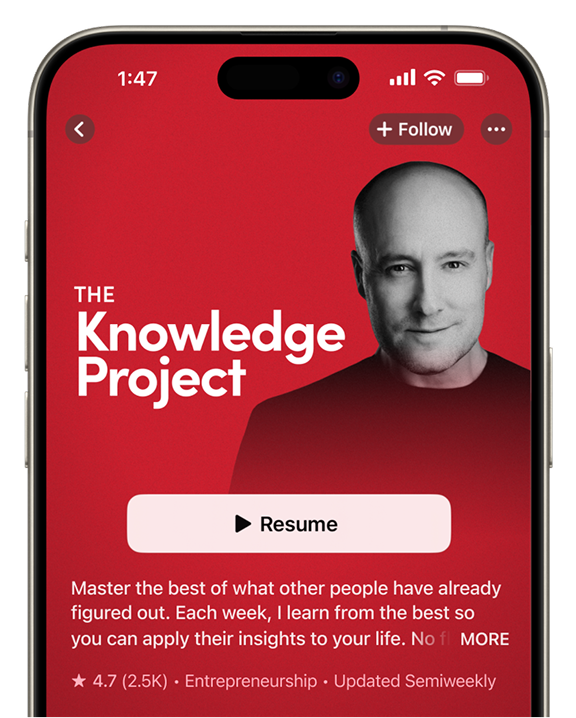
A podcast about mastering the best of what other people have already figured out. The Knowledge Project focuses on insights and lessons that never expire. You’ll walk away from every episode with actionable insights that help you get better results and live a more meaningful life.

Listen now onApple Podcasts
More Options
  • Spotify
  • Overcast
  • g id="Pocket-Casts-Roundel---Red">Pocket Casts
  • RSS

Never miss an episode

A podcast about mastering the best of what other people have already figured out.

Articles

  • Mental Models
  • Decision Making
  • Learning
  • Book Recommendations
  • All Articles

Podcast

  • Latest Episodes
  • Organized by Theme
  • ChatBot

Books

  • Clear Thinking
  • The Great Mental Models
  • All Books

Newsletter

  • Archive
  • Sign Up

About

  • About Shane
  • Speaking
  • Inquire about Sponsorship

Farnam Street Logo

© 2025 Farnam Street Media Inc. All Rights Reserved.
Proudly powered by WordPress. Hosted by Pressable. See our Privacy Policy.

We’re Syrus Partners.
We buy amazing businesses.


Farnam Street participates in the Amazon Services LLC Associates Program, an affiliate advertising program designed to provide a means for sites to earn advertising commissions by linking to Amazon.