
Every year, on September the twenty-sixth, an old man flew a flag.
He put on his good clothes, played a round of golf, and received visitors at his estate. And if you asked him exactly what he was celebrating, his voice might even crack when he told you.
September the twenty-sixth wasn’t his birthday. It wasn’t even his wedding anniversary.. September the twenty-sixth, was the day a merchant in Cleveland, Ohio back in 1855, looked down at a desperate sixteen-year-old in a dark suit who’d been pounding the pavement for weeks… and said to him “We’ll give you a chance.”
From then on, he called it “Job Day.” And he celebrated it every single year for the rest of his life.
That first job paid just fifty cents a day. A few days after he started, the boy walked into a shop and bought a small red notebook for ten cents. In it, he recorded every penny he earned…every penny he spent, and every penny he gave away.
He called it Ledger A and would keep it in a safe-deposit box for the rest of his life, like it was a birth certificate… or a deed to something sacred. It was one of his most treasured possessions on earth. He would say that that’s where it all started: with a ten-cent notebook.
Decades later, when he was the richest man on the planet, he still called Cleveland home.
His mother was a Baptist: devout, unyielding, and iron-willed. She ran her household like a fortress to survive her husband’s long absences. She kept her own strict ledger, teaching her five children that every single dollar must be accounted for down to the last penny.
His father was a travelling snake oil salesman who sometimes went under different aliases from town to town, selling fraudulent remedies to desperate people. At home, his philosophy of fatherhood, announced loud and proud was: “I cheat my boys every chance I get. I want to make ’em sharp.”
That was the home he grew up in.
And somehow, out of that home, came the man who would one day control roughly nine out of every ten barrels of oil refined in the United States. A man who would be vilified as the most hated corporate monster in his country, only to become, just a few decades later, its most generous.
A man whose company the Supreme Court would eventually take nine years to break apart, and who would get richer when they finally did.
At the peak of his power, his company employed tens of thousands of people. His net worth, adjusted for the size of the economy he operated in, has likely never been matched, before or since. He sat at a desk at 26 Broadway in Manhattan, and the men who came through his door knew he could end their business with a single word. Sometimes he did.
This was the same man that got down on his knees every night and prayed. He taught Sunday school at the same church for decades. He tithed from his very first paycheck. When he was making a dollar a day, he was giving away pennies. When he was making more, he gave away more. A lot more. He built universities and medical laboratories with the same intensity that he built an industry.
In his old age, he walked around with a pocket full of dimes and handed them out to everyone he met. Caddies. Porters. Waiters. Children on the street. “Here. A dime.” From the richest man in the world. Over the course of his life, he gave away something like thirty thousand dimes. People today still leave dimes on his grave.
Who was this man?
That’s what this episode is about. And I want to warn you, we are not going to answer that question with a simple, tidy, narrative, because he was not a simple man.
He was the young clerk with a ten-cent notebook who, through focus and determination, became the most powerful private citizen the United States has ever produced. He was a man who loved Cleveland until the city turned on him, and yet, chose to be buried there anyways. And he was a man whose philanthropy has improved the quality of life of most people on the planet.
He was born in 1839. He died in 1937. He lived almost a century, and now, nearly a hundred years after his death, the question of who he really was is still very much open.
This is Outliers. I am your host Shane Parrish. And this is the story of John D. Rockefeller.
You might think you know his story. But you don’t.
John D. Rockefeller’s family had been moving his entire childhood, drifting from town to town across New York before heading down into Ohio. It was an unstable existence of shifting addresses. Finally, in the fall of 1853, the fourteen-year-old boy arrived in downtown Cleveland. His father dropped him off at a boarding house near the Erie Street Baptist Church, opened a small back account for him, and left him to fend for himself and disappeared.
Cleveland in the eighteen-fifties was a boomtown of twenty-five thousand people. Situated on the south side of Lake Erie, it sat at the perfect convergence of water and rail, making it an ideal base for commerce of all kinds. The city boasted three daily newspapers, a library association, and even a small university. But none of it could really disguise Cleveland for what it truly was: a young, muddy city just a single generation removed from the frontier, filled with people hustling in every direction at once.
And young John D., this quiet, serious, thin-lipped boy (every biography I could find mentions his thin lips), was on his own in the middle of it.
He didn’t fit in. At Central High School he was the country boy among the children of Cleveland’s wealthiest merchants and professionals. He hid his upbringing and avoided making close friends. One classmate later remembered him as the best debater in the whole class, but noted he spoke so quietly that most people didn’t even notice him.
He didn’t play sports with the other boys, and instead kept score on the sidelines with a notched stick. If he noticed anyone in those years, it was a girl who would later be their class valedictorian, a composed, serious girl named Laura Spelman. We’ll come back to her.
The only place where the young Rockefeller truly fit was the Erie Street Baptist Church. Singing hymns beside the city’s working class, he found something his father had never provided: solid ground.
He was baptized there by immersion in 1854 and began attending services twice-a-day on Sundays and prayer meetings on Friday nights.
That church was where his mother’s distinct habits found a home in his adult life.
“How well I remembered then, as I remember now,” he said once, “the words of my dear mother: ‘Willful waste makes woeful want.’”
That was one of his favorite sayings and he had gotten it directly from her. He got a lot from her.
His mother, Eliza Davison Rockefeller, ran her household with the rigid efficiency of an army under siege.
With her husband constantly on the road and with no indication of when, or if, he would return, she was left entirely alone to manage. She lived in houses she didn’t choose and in towns she didn’t pick, yet the heavy work of the homestead happened regardless.
The meals were always on the table, the accounts stayed tight, and the clothes were meticulously mended.
Big Bill, his father, was the family’s sole, volatile source of income. When he vanished, the household finances were limited to whatever cash he had chosen to leave behind, which was often dangerously little.
Eliza stretched every penny out of sheer necessity. In her household, careful money was not a personal preference; it was an absolute survival mechanism.
She was a devout Baptist who always tithed her household income, no matter how small, and expected her children to do the same. She kept her own ledger and she taught her children that every dollar was held in trust whether anyone was watching or not.
John D. would tell a story about her for the rest of his life. He told it to his children and to interviewers who asked. He wrote it in his memoir at age sixty-nine when he tried to explain to the world where he had come from.
His mother had started in on whipping him for something she assumed he had done but he swore up and down that he did not. He protested loudly as she started. When she kept on with the whipping despite his innocence, he asked her why? She said the line that her son would repeat with affection.
“Never mind. We have started in on this whipping, and it will do for the next time.”
It was, in his telling, the right way to raise a child. The infraction will be punished, this time or some other time. She had a system, and once in motion, she stuck to it.
There were five children in the chaotic Rockefeller household, but John D. absorbed these lessons earliest. As the eldest son, he spent his youth beside her running the farm. Along the way he picked up her mental habits the way a child naturally adopts an accent.
From her he inherited an unbreakable internal discipline, an intense frugality, and unwavering conviction that a promise was an ironclad debt. What she gave him most was a psychological frame: A way to see the world, with your daily work to be done front and center.
She taught him how to view a dollar through the lens of stewardship, and how a promise was supposed to weigh on a man once it was made.
She left him one phrase above all, and he carried it into every negotiation of his later life. “We will let it simmer,” she would routinely say. It was her standing counsel against deciding anything in haste. John D. Rockefeller would use those exact words to outmaneuver and out-wait Wall Street tycoons and independent refiners for the next 70 years.
Before he was anyone’s father, Big Bill was a traveling con-artist, and one of his favorite routines was to work a town as a deaf-mute peddler. He hung a small slate around his neck with “I am deaf and dumb” chalked across it, and with it he went door to door selling cheap trinkets, scribbling his half of every conversation.
People spoke freely in front of a man they thought couldn’t hear. He later boasted that the act let him flush out every secret in a town.
It was while running some version of this con, a long way from anyone who knew him, that he first turned up at the farmhouse of a prosperous Baptist named John Davison. Davison had a daughter named Eliza who was devout, sheltered, and altogether unprepared for a man like Big Bill. She was taken with him before she ever learned the truth. “I’d marry that man,” she said out loud, “if he were not deaf and dumb.”
He could hear her perfectly well. Eliza’s father saw straight through the act and tried to wave his daughter off the match. But, she married him anyway, in 1837. And in the towns they passed through after that, people came up with their own name for the charming stranger she’d chosen.
They’d call him Devil Bill.
After marriage and the children came, Big Bill Rockefeller continued to be a snake-oil salesman, peddling fraudulent miracle cures to the vulnerable and hopeful. He would be gone from the family for long stretches without much accounting for it. What he did on those trips was not always what he told his family.
When home, he came to his sons with lessons and platitudes of his own. He told them to keep clear of crowds. He told them to tend to their own business. He drilled them on the sanctity of a contract. And more than anything else, he taught them to be, in his words “sharp.”
“I cheat my boys every chance I get,” he said once to a neighbor. “I want to make ’em sharp. I trade with the boys and I just beat them to be sharp traders.”
He taught his sons by example. He loaned them money at the going rate of interest, showing them that they could do it too. But then, after they absorbed that lesson and tried it out for themselves, he’d go one step further and call in his loans to them suddenly, when they least expected it, just to see how they’d react.
He treated parenting as a series of small unannounced examinations.
He taught distrust as a physical lesson, too. When John D. was small, the story went, Big Bill would stand him on a high chair and hold out his arms, coaxing the boy to jump. John D. would jump and Big Bill would catch him. But then, one day, when John D. was a little older, Big Bill let his arms drop and let his son crash to the floor. “Remember,” he told him, “never trust anyone completely. Not even me.”
In old age, John D. had this to say about his father.
“I confess that this little discipline should have done me good, and perhaps it did. But I was not particularly pleased with his application of tests.”
By the age of eight, John D. could milk a cow and drive a horse and buggy on his own. Before he was a teenager, he had saved enough money to buy candy by the pound and then sell it piece by piece to his siblings at a marked-up price… keeping his profits in a little box on the mantel. “It was safe there,” he said. He added, with some pride, that he “had loaned out money and got interest on it before I was fourteen years old. And I knew well how to make out a note. My father taught me these things.”
These lessons culminated in the first little red notebook for John D. which he remembered fondly, writing: “From early boyhood I kept a little book which I remember I called Ledger A, containing my receipts and expenditures as well as an account of the small sums that I was taught to give away regularly.”
The entire architecture of his life sits within that single sentence: recording the receipts, balancing the expenditures, and, on the exact same page, accounting for the sums he gave away.
He learned the earning of money from his father and the giving of it from his mother, and before he was an adult he had both running on the same page.
Back in Cleveland, those two inheritances were about to collide.
The Erie Street Baptist congregation where young John D. felt most at home was small. Its members were not wealthy, each giving only what they could. But the church building carried a mortgage of two thousand dollars for which John D. discovered they had no realistic plan for paying off. When the note came due and the church could not pay, the individual that held it began to prepare for foreclosure. The minister sadly told his congregation that the doors would soon close if the mortgage was not paid.
So the congregation began to scrape. They took up pledges and counted what they thought they could give but it was soon clear it wouldn’t be enough. The problem was that many of the pledges that had been made were not, in the end, being paid.
What the church needed was someone who would stand at the door after the service ended and not let anyone forget what they had promised to give.
John D. stepped up to the task. He was still a teenager but he took to the work as if the building belonged to him.
He stationed himself at the church door and spoke to each member as they went out, asking for pledges from each and every one. Then he wrote each pledge down in a book of his own. He told the people who had pledged that he would be back next Sunday to ask after it, and the next Sunday of course there he was for both services. He chased the small sums in nickels and dimes and quarters from people who had little to spare, and then he chased the larger ones at their places of business during the week. He did not stop for anything. He did not take no for an answer.
This campaign went on for weeks and as a result the full sum was raised, the mortgage got paid, and the church, the place John D. felt most comfortable, did not close. That same congregation would, in the prosperous years to come, follow Cleveland’s money eastward and be reborn as the Euclid Avenue Baptist Church, a new address for the same families and the same faith, and John D.’s spiritual home for the rest of his life.
In his memoir, decades later, he set down what that experience had done to him in one line.
“My first ambition to earn more money was aroused by this.”
He had contributed what little money he could and regretted he could not give more.
Somewhere in those years, a minister handed him the sentence he would build his life on. “Get money; get it honestly,” the man preached, “and then give it wisely.” “I wrote that down in a little book,” John D. said.
When he finished at Central High School, he didn’t even bother to attend graduation or pick up his diploma. Instead, he paid forty dollars for a course at Folsom’s Commercial College. The course was mostly accounting and bookkeeping and he took to it like a fish to water. “It was fascinating,” he said later, “to know at all times the resources and the liabilities, to keep an exact record of just how a business stood.”
He completed the course in mid-summer of 1855. Soon after he turned sixteen. He started looking for work.
“I did not guess what it would be,” he reminisced about that summer’s plans to find work, “but I was after something big.”
What followed was six weeks of pounding the pavement. He took down a copy of the Cleveland city directory and made a list of every firm in town he felt was worth approaching. Then he put on his best clothes and after breakfast each morning, started walking.
He had no letters of introduction and did not know a single person of consequence in the city. He walked into banks and railroad offices and commission houses and shipping firms. And at each one, he asked to see whoever was in charge. He stayed at it until the offices closed for the day. He did this six days a week that summer.
When he reached the bottom of his list and still had no job, he went back to the top and worked his way down it a second time.
He could have landed a clerkship or a messenger position. Other young boys did. But he would not lower his standards. He had told himself that the right beginning mattered more than an easy one, and he was not going to give up just because he was tired. “I was not discouraged,” he later said.
He refused to count those weeks as idle. “I was working every day at my business,” he said — “the business of looking for work. I put in my full time at this every day.”
But the strain must have begun to show, because at some point in those weeks his father offered him a way out. “It’s all right, John. You go out to the country, and I’ll take care of you.” The thought of staying dependent on his father, John D. later said, sent “a cold chill” down his spine. He continued his search.
On September 26, 1855, he stopped again at a commission house called Hewitt & Tuttle. The junior partner, Henry Tuttle, interviewed him.
“Come back after dinner,” Tuttle said after speaking with him. “We may have a chance for you then.”
John D. composed himself and left the office, walking until he was out of sight of the windows. Then, with no one watching, he began to skip with joy. Six weeks of serious composure had finally given out. He returned later and met the senior partner, Isaac Hewitt. Hewitt looked at a sample of his handwriting, which was of course excellent, and delivered the verdict: “We’ll give you a chance.”
In old age, John D. set the moment down in his own words.
“This was September 26, 1855. I joyfully went to work.”
The memory never lost its charge. Even as an old man, he would go quiet over it. “All my future seemed to hinge on that day,” he said, “and I often tremble when I ask myself the question: What if I had not got the job?”
For the rest of his life, every September twenty sixth, a flag flew over his house.
Job Day.
The work itself was bookkeeping. And the stereotypical picture of the profession was a man in an eyeshade on a high stool, hunched over a ledger, doing tedious work. John D. didn’t argue with the picture. But he did argue with the idea that the work was tedious. He called the work simply “delightful.” It wasn’t a job, it was a “position.”
More than that, he called it a “gentleman’s position.”
In a small firm like Hewitt & Tuttle, the title of bookkeeper was misleading. He was soon doing a lot more than just posting the books.
A commission house bought and sold goods on commission: Grain, Beef, Granite, Pork. It didn’t matter, whatever was moving through the Great Lakes that month was on their table. And the business was made possible mostly by two specific tools, the railroad and the telegraph. The telegraph gave the merchant news of price changes in distant markets. And the railroad let them chase those prices before the swing closed.
Hewitt & Tuttle was small enough that John D., now seventeen years old, could touch and understand all of it. Within a year, his boss Tuttle left the business, so John D. started running the office and posting the books. Soon he was handling the cash, collecting debts, and even writing the checks.
People along the waterfront started to call him “Mr. Rockefeller.” While just a clerk, he worked as though he owned the firm.
“I scrutinized every bill,” he said later. “If it had ever so many items, I went over each one, verified it, and carefully added the totals. The bill had to be accurate in every detail before I okayed it to be paid.”
The reason he gave for the strictness was striking, coming from a teenager. He had trained himself to understand that his check on a bill was quote “the executive act which released my employer’s money from the till.”
The release of the funds was to him almost sacred. Every penny was to be watched, tracked, and accounted for.
One day a schooner captain came in with a bill that did not match the cargo the man had unloaded. Rockefeller would not approve it.
“Now, look here, captain,” he told the man, “I can’t make out the bill for that amount. It just doesn’t tally with the actual cargo.”
“Come, come, young man. You make it out the way I say. Nobody’s ever going to know. Why, everybody allows a margin like that.”
“I am sorry to say no. But if the weight and price are a certain amount I must make my entries accordingly. If I’m going to do right by you, I can’t begin by doing wrong for somebody else, can I? If I did, you would soon be afraid that I would cheat you, too. Isn’t that so?”
“Nonsense, you’re too strict.” The captain exclaimed.
That strictness held to the end of his life.
Decades later, as an old man with a yearly income well past three million dollars or more than fifty million dollars today, Rockefeller caught an error of ten dollars and eight cents in a railroad’s payment to him. He had his secretary write a letter asking for the missing payment. A week later, he turned up an error in the opposite direction, where a payee had short-changed himself by eight dollars. He sent the eight dollars back right away.
Everything had to balance in the ledger; nothing more, nothing less.
There’s a story he told about those years behind the ledger that explains something about all the years that came after.
One day his employer took in a banknote for four thousand dollars. An unimaginable sum to a young man earning fifty cents a day. He showed it to him, and then locked it in the safe. The moment the man left the office, Rockefeller opened the safe back up. He lifted the note out and just stared at it, he said, “with open eyes and mouth,” then locked it away again. He couldn’t leave it alone. “Many times during the day,” he remembered, “did I open that safe to gaze longingly at the note.”
Around the same time, he got hold of a book, the published diary of a New England merchant named Amos Lawrence, who had given away more than a hundred thousand dollars in his life. John D. read it the way other boys read adventure stories. What stayed with him wasn’t the size of the fortune. It was the giving. “Crisp bills!” he said. “I could see and hear them. I made up my mind that, if I could manage it, some day I would give away crisp bills, too.”
He learned one lesson in particular at the commission that he tucked away for later, very quietly.
The official bill on a railroad shipment always showed a fixed rate, the same rate the railroad printed on the public schedule for everyone to see and what Rockefeller assumed at first, everyone would pay.
But the right kind of shipper, after he had moved enough volume across enough months, could receive a rebate at the end of the month against that fixed, public rate. The size of that rebate, Rockefeller came to learn, could be substantial.
The posted rate was the public rate. The real rate, the one that applied to the men whose volume the railroad needed, was agreed to behind closed doors.
In 1857 a sharp depression hit the country and nearly took Hewitt’s firm with it. The doors stayed open, but as Rockefeller would later put it, “they were bankrupt.” Hewitt was carrying on too many things at once, giving more time and attention to land deals and lawsuits than to the commission business that was supposed to be funding it all.
Hewitt sent Rockefeller out to collect on their bad debts, and he learned to deal with each defaulter as if he were an opponent across a chessboard.
One of the names on his collection list was a man called Wheelan. When Rockefeller arrived, Wheelan opened with the line you always heard from someone who didn’t want to pay: “You come around next month.”
“That’s what you always say, Mr. Wheelan. I still insist that we settle today.”
“It won’t hurt Hewitt to wait a little longer.” was the man’s reply
“But you know very well Mr. Hewitt has been waiting a long time already. I simply can’t go back to him without the money.”
Worn down, Wheelan eventually pushed the money across the table and told Rockefeller he had never met such a pestering collector.
Rockefeller was just nineteen years old.
In the spring of 1859, Hewitt raised Rockefeller’s salary to seven hundred dollars a year. Rockefeller pressed for eight hundred. Hewitt said he would think about it.
Time passed… And Hewitt did nothing…
So, without a fuss, Rockefeller resigned.
The next month, three months short of his twentieth birthday, he opened a commission house of his own. He partnered with a man he had known since the bookkeeping course, a twenty-eight-year-old Englishman named Maurice Clark. As the older man, they put Clark’s name first on the door, but they were equal partners. The firm became known as Clark & Rockefeller.
In its first year, they did nearly half a million dollars in revenue and netted $4,400. In the second year, $17,000.
Rockefeller was now twenty. He was thrilled to be his own boss.
“It was a great thing to be my own employer,” he remembered. “Mentally I swelled with pride — a partner in a firm with four thousand dollars in capital!” That first night, he went home, knelt on the floor, and asked God to bless the new firm.
A Clark & Rockefeller circular went out across the Midwestern states in their second year in business. It said the firm was “prepared to make liberal advances on consignments of produce, etc.”
The most important word in that line is “liberal.”
In the 1850s Midwest, farmers were desperate for cash. They only got paid when they harvested their crops which meant borrowing money the rest of the year. This is where commission houses came in, giving cash advances to farmers and taking delivery of product later on.
But farming was a risky business and most firms only gave small advances. So, Clark & Rockefeller began offering larger advances, and earlier in the year than others. This set them apart. But to make those advances, the firm had to borrow heavily.
Rockefeller’s father, Big Bill, initially helped. But his purse didn’t even begin to meet his son’s growing needs.
And those needs were growing fast. The gap between what they had and what they needed was enormous.
Every bushel of grain sitting in a warehouse waiting for a buyer, every shipment on a canal boat that hadn’t reached its destination, every advance they’d made to a farmer who hadn’t paid them back yet. All of it was capital tied up. And the faster the business worked, the more money it consumed.
“There seemed as though there was no end to the money needed,” Rockefeller said later. He did not say it with complaint. He had already figured out that if the return on borrowed money exceeded the cost of the loan, then the rational move was to borrow more. Interest was just the price of growth. And the more you grew, the more you could borrow again.
That logic would carry him a very long way.
So Rockefeller went to the banks.
He passed over the smaller banks and went straight to the most prominent banker in the city. A man named Truman P. Handy.
Handy was president of the Commercial Branch Bank and its principal stockholder. He had arrived in Cleveland from Buffalo in 1832 and in the decades since, had built himself up to be at the center of civic and cultural life. In Cleveland in those years, an endorsement from Truman P. Handy was a passport to borrowing from anyone.
Rockefeller knew this. That was why he picked him. If Handy said yes, every other door in the city would open.
He knocked on Handy’s office door one morning, sat down across from him, and laid out the particulars of his business in his usual simple and forthright way. Then he asked for a loan.
“How much do you want?” Handy asked.
“Two thousand dollars.”
“All right, Mr. Rockefeller. You can have it. Just give me your warehouse receipts. They’re good enough for me.”
Rockefeller never forgot how it felt. “Just think of it,” he said. “A bank had trusted me for two thousand dollars! I felt that I was now a man of importance in the community.”
It looked, from the outside, like the easiest thing in the world. A twenty-year-old walks into the office of the most important banker in Cleveland and walks out with two thousand dollars.
But Handy hadn’t made that decision on instinct alone, it was years in the making.
Handy was active in the Young Men’s Christian Association. Recently, so had been John D. Rockefeller. And as a member of the Board of School Managers, Handy had taken to visiting nearby Central High School to observe the progress of its pupils. Rockefeller had been one of them just 4 years earlier. And for the past couple of years, Handy had watched the young man walk into his bank at regular intervals to make deposits into a savings account. Always small amounts, but put away steadily, month after month.
When Rockefeller sat down that morning and asked for a loan, Handy already knew who he was lending to. “In those days in Cleveland,” Rockefeller later observed, “everybody knew almost everybody else.”
After that morning, the doors of Cleveland’s banks were open to him. But not always as warmly as Handy’s. Rockefeller was younger than any of the men he was asking, and he asked with a directness that many found grating. He was often told no.
“What if the president of a bank refused to make me a loan?” he said later. “That was nothing. He might lecture me on the folly of making a loan for the purpose for which I was seeking it. That made no difference to me; simply meant that I must look elsewhere until I got what I wanted.”
Like many outliers, John D. refused to quit after someone said no.
Next, he began pressing the railroads for more cars during peak shipping season to handle the growing amounts of inventory he was buying. They too, would often rebuff him.
But Rockefeller kept pressing.
That was where the firm was at the end of August 1859. Rockefeller was still just twenty years old, but already you can start to see something is different about him.
That very same month, in a township in western Pennsylvania, a man named Edwin Drake struck oil.
Drake had been hired by a small group out of New Haven, Connecticut that suspected there were large amounts of crude petroleum in the rock under the Pennsylvania creeks. They wondered if drilling for it like they did for water might just work. It turned out, they were right.
Drake’s well, the first commercial oil well in the United States, hit at sixty-nine and a half feet underground. By the next morning, a barrel and a half of crude oil sat in a tub at the foot of the well.
That’s when the chaos started.
In a short time, it seemed like every man with a horse and a shovel and a bit of money to risk became a wildcatter. Butchers became drillers. Bakers became drillers. Land that had been worth a dollar an acre was changing hands now at thousands. Wells were going in along the creeks faster than anyone could count them. Prices for crude spiked, then crashed, then spiked again. Fortunes were made and lost inside a week.
And John D. Rockefeller was watching from a desk in nearby Cleveland. He was twenty years old. He owned half a commission house that handled produce from one of the most productive farm regions in North America. He had a reputation along the waterfront for paying his bills. He had a banker who lent him money on a growing pile of warehouse receipts. And he had a partner who was beginning to grow nervous about that borrowing.
And he was watching an infant oil industry that had no idea where it was going or what was coming next…
Rockefeller observed the oil frenzy for three years and did not move. And because he watched, he saw the pattern.
Drillers would punch holes in the ground and pray. When, or if they hit, they flooded the market and the price of crude oil collapsed. Many of the men who had borrowed to drill would then go broke. A few months later, the survivors and any newcomers started the cycle all over again.
But there was one part of the business that seemed different: refining.
A refiner bought crude oil at the market price and turned it into kerosene, a product people needed to light their homes. When crude was cheap, the refiner’s margins got better. The refiner was a step removed from the chaos. They didn’t gamble on geology. They controlled the one step every barrel of oil had to pass through before it could become light, the step between sitting in the ground and burning in a lamp.
Rockefeller saw that step and chose it.
The man who helped convince him was named Samuel Andrews. Andrews was a chemist that Rockefeller had come to know from the Erie Street Baptist Church, the church he still attended and had been baptized at a decade earlier.
Andrews had learned to refine crude oil into kerosene better and cheaper than almost anyone else in Cleveland and he was convinced that this cheap kerosene would soon light the world.
Rockefeller heard him out.
The numbers were incredible. Crude averaged two dollars a barrel while refined kerosene sold for thirteen. And a refinery could be built for a thousand dollars and run with just a handful of men. He soon made his decision to enter.
In 1863, he and his partner Clark formed a new firm with a new name: Andrews, Clark & Company. Samuel Andrews would run the refinery and Rockefeller and Maurice Clark would handle the money. 24 year old Rockefeller referred to this oil refinery a side-hustle to their main commodity business. It would not remain this way.
They found a three-acre site in Cleveland along the river, right where the Atlantic & Great Western Railroad met the waterway. The rails could bring crude from the oil regions in Pennsylvania. And water or rail could bring the oil they refined to the eastern markets of New York. The location proved to be of critical importance because, they could play one transportation method against the other.
The refinery was called Excelsior Works. Andrews ran the equipment. Rockefeller would run everything else.
He threw himself into it, and his own family got a daily view of the obsession.
In the predawn dark, Samuel Andrews and a growing group of men would gather at the Rockefeller house and wait in the dining room while John ate his breakfast.
At night, Rockefeller would nudge his brother William awake in the room they shared and say, “I’ve been thinking out a plan to do so and so. Now, what do you think of this scheme?”
“Keep your ideas till morning,” William would groan at him. “I want to sleep.”
His schemes kept coming anyway.
The year was 1863 and all of this was happening during the middle of the Civil War.
The war was terrible for the country but good for many of its businesses.
Union soldiers wrote letters home by the light of kerosene lamps. General Grant was drafting his dispatches by one in his tent. Demand for kerosene kept climbing even as prices swung wildly, and through all of it the drills in Pennsylvania rarely stopped. They paused exactly once, only when General Lee invaded the state and the oil men put down their tools briefly to help defend it.
The new firm made money in refining every single year of the war. This only seemed to accelerate Rockefeller’s appetite for growth.
But Clark, his original partner, began to get cold feet. When Clark looked at the same numbers Rockefeller did, he only saw risk. And he wasn’t alone. Many people thought the Pennsylvania oil fields were a fluke. They would give out soon, they said, just like so many gold mines did out West.
It took two years, but the tension between Rockefeller and Clark finally came to a head.
“We have been asking too many loans in order to extend this oil business,” Clark told Rockefeller one morning. “Altogether we have borrowed a hundred thousand dollars.”
Rockefeller replied calmly, not for the first time, “We should borrow whenever we can safely extend the business by doing so.”
“If that’s the way you want to do business we’d better dissolve and let you run your own affairs to suit yourself.” Clark said, walking out. It was not the first time he said this, nor would be it be the last time. But Rockefeller had had enough of the disagreements.
The other partner, Samuel Andrews walked in. Rockefeller put it to him straight.
“Sam, we are prospering. We have a future before us, a big future… Will you come in with me?”
“Yes,” Andrews said.
Rockefeller calculated.
He had Andrews on his side. It was 1865 and the Civil War was now winding down. This would likely end the wartime buying that had been propping up their commodity business. But new oil wells were still coming in across Pennsylvania making the crude supply look safe for now. The demand for kerosene seemed insatiable…
Last, he checked his credit with the banks…
And then he baited Maurice Clark.
They met one evening in February. Maurice Clark, assuming Samuel Andrews was on his side, called for a dissolution of the business. Rockefeller agreed. Then, he ran a notice in the Cleveland press the next day announcing the news. By the time Clark learned Andrews was actually with Rockefeller, it was too late.
They agreed to auction the oil business between them.
The bidding opened at five hundred dollars. It climbed past ten thousand. Past fifty thousand dollars. Clark said seventy-two thousand.
Rockefeller countered again with no sign of stopping.
“The business is yours,” Clark told him.
Rockefeller was now twenty-five. He owned the majority of a refinery in a city he’d arrived in at the age fourteen with almost nothing. It was one of about thirty refineries in Cleveland.
Two months after the auction, Robert E. Lee surrendered, ending the civil war. On a spring morning that April, the funeral train carrying Abraham Lincoln’s body stopped in Cleveland, Ohio.
Then the country put down its grief and turned, with an almost guilty hunger, to the business of getting rich. One banker later said of the years that followed, “It was such a period as seldom occurs, and hardly ever more than once in anyone’s lifetime.” Returning soldiers wanted what the young businessmen at home had gotten. Everyone, it seemed, was chasing a fortune at once.
Shortly before he took over the oil business from Maurice Clark, Rockefeller got married. Her name was Laura Celestia Spelman and she was a schoolteacher. He called her Cettie.
They had met years before as students at Cleveland’s Central High School, where Cettie was the valedictorian of their class. She stood out to Rockefeller then and later, when they met again while taking similar commercial courses. Upon their high school graduation, the title of her address to the class tells you most of what you need to know about her. “I Can Paddle My Own Canoe.”
She came from an abolitionist household and not the quiet kind. Her father had run a station on the Underground Railroad, hiding men and women fleeing north and helping them on towards Canada. And her mother gave herself over to the temperance cause, advocating for complete abstinence from alcohol. Theirs was a home where faith meant action. At twenty-two, Cettie was an assistant principal, real authority for a woman of her time.
Even though the Spelman family was a rung above the Rockefellers economically in Cleveland, they valued a young man with ambition and sound Christian character.
And Cettie was, above all, practical. She saw something in Rockefeller earlier than almost anyone else. A friend of hers put it this way: “She saw that he was ambitious, and she thought that he was honest, which probably appealed to her more than anything else.”
She was short and slender, with a round face, dark brown eyes, and chestnut hair parted down the middle. Like Rockefeller she was soft in voice and manner. But that softness sat on top of something hard. Her own sister called her “gentle and lovely, but resolute with indomitable will.” She was never known to lose her temper, something she shared with the man she would marry. She’d be more than just a spouse, she would be a silent partner in everything he did.
They were two quiet people, each with a core of iron.
His courtship started in high school where he’d walk her home at the day’s end. When he started his own commodity house, he’d come by her house and describe his business to her and she’d listen with delight. He recorded everything in his ledger. The bouquets he bought her. The lectures they attended together. And in April 1864, he recorded a diamond ring. That fall they were married. Rockefeller was 25.
They were a perfect match of temperament. Both were convinced that life was for duty rather than enjoyment. In those first years of marriage, Rockefeller carried the company’s books home at night and went over the figures with Cettie at the table. She came to know the state of the business almost as well as his partners did. From the start, she studied his career and even began to coach it.
With Maurice Clark gone, Rockefeller did exactly what his ex-partner had feared. He borrowed and he grew, plowing every dollar of profit back into Oil. The schemes he had once tested on a half-asleep William now had real money behind them.
Rockefeller wasn’t just borrowing to buy more crude oil. He was borrowing to save on costs, building a shop right next to the refinery to make their own barrels. Barrels were one of the biggest costs in the trade, with other refiners paying three dollars a barrel. Rockefeller was soon building his for a dollar fifty.
Then he hired a plumber by the month instead of calling one for each repair job. These were small things, but as they grew their business, they compounded.
The borrowing carried a private cost though that few ever knew about. Rockefeller often went to bed worrying about how he would ever repay the loans, then woke in the morning, refreshed by sleep, and determined to borrow even more.
It was in these years that he began a habit he would keep for the rest of his life. At night, head on his pillow, he would deliver little sermons to himself. The subject was usually the same: reminding himself to stay the course: “You’ve got a fair fortune. You have a good property—now. But suppose the oil fields gave out!”
At the office he never showed a flicker of doubt. But on the pillow, he would rehearse disaster nightly.
The best-known example of his cost obsession came a few years later, on a plant inspection. Rockefeller stopped at a line where men were sealing kerosene cans with solder, and he asked how many drops it took to seal one.
Forty, he was told.
“Have you ever tried thirty-eight?”
The men tried thirty-eight. A few cans leaked.
They tried thirty-nine. None leaked.
Thirty-nine drops became the standard across every plant the company owned. One drop of solder, multiplied across what was eventually millions of cans, easily saved hundreds of thousands of dollars.
His partner Andrews kept improving the refining process. And soon, they were squeezing more kerosene out of each barrel of crude than anyone in Cleveland. And then they started working out how to sell those byproducts that other refiners just threw away.
That instinct to use what everyone else threw away had always been a habit of Rockefeller’s. And it pulled the company toward something the old oilmen had distrusted: science. The first men in oil worked by smell and luck. Rockefeller hired chemists instead, and would, in time, put a working laboratory inside every refinery he built, and owned. The patient, measured application of science became an integral part of how they grew.
Within a year of the Clark auction, their profits funded a second refinery, which they simply called the Standard Works. Rockefeller’s brother William, was put in charge of it.
Rockefeller was twenty-six years old, running two refineries, and still hungry for capital. What he needed next was a partner with access to real money.
Aside from his wife, Rockefeller was closest to his brother William and to one other man. Henry Flagler.
The two of them went back to the grain trade, before there was any oil between them. They’d met when Flagler shipped carloads of wheat through Rockefeller’s commission house. He’d gotten rich doing so and then moved into the salt trade and lost it all. He came back to Cleveland broke and looking for the next big thing. Oil looked to be that thing. He took an office in the same building as Rockefeller, and an old acquaintance soon turned into something closer.
Flagler was eight years older than Rockefeller and was everything Clark as a business partner had not been. He was as bold as he was impatient. He was a born dealmaker who could talk a railroad president into almost anything. His motto: “Do unto others as they would do unto you, and do it first.”
Flagler brought to the table a network of wealthy connections. And with their money he joined the firm which was now named Rockefeller, Andrews & Flagler.
Overnight, they were able to outspend every other refiner in Cleveland.
Rockefeller and Flagler lived just a few doors apart from one another and began walking to work side by side each morning. Then home again for lunch, back to the office, and then home again at night. They did their thinking and planning on those walks. And by the time they reached the office, the thing was usually decided. One historian called it the partnership’s parliament-of-two.
At the office, their desks sat back-to-back. Letters would pass between them, again and again until the wording was exact. And Flagler, Rockefeller remembered, “drew practically all our contracts.”
Rockefeller was the systems man: bringing relentless cost discipline, patience mixed with a willingness to act, and a temperament to bring everyone in line. Flagler was, as Rockefeller remembers, “always on the active side of every question.” He fought the railroads constantly, and pushed always to build bigger and more permanent.
Flagler put it this way: “A friendship founded on business is a good deal better than a business founded on friendship.” That was their partnership in a nutshell.
With Flagler, they took one profitable oil refiner and rebuilt it as a business vehicle for swallowing up their Cleveland rivals. And later, once Flagler drew up the legal forms, and the incorporations that would allow them to become the Standard Oil Trust, they were able to reach across state lines and do the swallowing of other business entities whole.
Years later, when asked who designed the structure of early Standard Oil, Rockefeller did not hesitate. “No, sir. I wish I had the brains to think of it. It was Henry M. Flagler.”
Rockefeller was a Baptist down to the bone. Watchful and suspicious of anything that announced wealth too loudly. Flagler started out that way but drifted the other way, toward the bold and the expansive and finally the gilded.
Standard Oil was an exhibit of both at once. Rockefeller’s economy of self-command, and Flagler’s hunger to build something grand and visible. Their friendship, Rockefeller said, ran a lifetime without a single interruption.
Late in life, Flagler ordered his Standard Oil correspondence burned. Almost everything he wrote in the company’s early years went up in smoke. What survives comes mostly from other men’s letters and from testimony he gave under oath. He was trying to disappear, and it worked. Ask anyone today who built Standard Oil, people will say Rockefeller. They should say Rockefeller and Flagler. The company could not have grown nearly as large without both of them.
On paper, Cleveland didn’t look like the best place to refine oil. The raw crude oil came from Pennsylvania, a hundred miles to the southeast. A city like Pittsburgh made sense as it was closer to the oil.
And then New York City was closer to the customers and the ships that could bring the refined product to the world. For these reasons, many thought Cleveland would have a short life as a refining town.
But what Cleveland had something important: water.
It sat on Lake Erie, with the Erie Canal feeding east and the Great Lakes opening west. And water freight was cheap. Far cheaper than rail. When the canal and the lake were open, Rockefeller could float his oil to market for something close to half what a railroad charged.
The railroads knew it. So, when they quoted Rockefeller a rate, they were really quoting against the water.
Rockefeller had first learned this at his first job at the commission house. Rockefeller played them both against each other. When the water was open, they shipped more by boat and let the railroads watch their traffic float away. When winter came and the canal iced over and the lake went to a gray slab, they moved everything onto rail, and the railroads, who had spent months hungry for traffic, were glad to have the business back. When one road dropped its rate, the firm shifted cars to it. When the other matched, they shifted again.
They built themselves a position where they could not be pinned down by anyone. A competing refiner in Pittsburgh on the other hand had only one option: the Pennsylvania Railroad. They had no other way to move their oil. So they paid whatever rate the railroad set. And they shipped only when the railroad said so.
Rockefeller never wanted to be at the mercy of others. He and his partners, sitting in Cleveland, in what was supposed to be the worst of the three refining locations, had the most options of anyone in the trade. And the more they grew, the more each carrier valued them as a customer, and the harder they competed to keep them.
Flagler turned that logistical advantage into a weaponized system. He used a piece of knowledge Rockefeller had learned from his teenage days at the commission house: that the posted railroad rates were a fiction. The real rate for shippers with enough volume was negotiated behind closed doors.
Flagler went to the railroads and negotiated rebates their smaller competitors couldn’t get. And the more Standard Oil shipped, the bigger that rebate grew. Which meant more reinvested into their business. Which meant lower costs, more capacity to refine. That made it easier to undercut competitors. Which brought in more customers. Which meant more volume. Which meant a bigger rebate the next time.
It was a flywheel. Once Flagler set it spinning, it was almost impossible for anyone outside it to compete. It might sound unfair, but it’s not. If I want to ship 1 case of soda from the east to the west coast, I am going to pay more per case than if I want to ship 10,000 cases.
The new balance of power showed in how Rockefeller carried himself.
In 1868 he was 29. In that year, the richest man in America was Cornelius Vanderbilt who was 74. He owned many of the railroads. One day Vanderbilt sent word that he wanted a meeting with this up-and-coming Cleveland refiner.
Rockefeller didn’t go.
He wrote his wife about it. “We were sent for by Mr. Vanderbilt yesterday, at twelve o’c & did not go. He is anxious to get our business… We sent our card by the messenger, that Vanderbilt might know where to find our office later.”
The emperor of the railroads could come to him.
By the late 1860s, Rockefeller, Andrews & Flagler were well on their way to becoming the largest oil refining operation in the world. It had happened in just a few years of borrowing, building, vertically integrating, and squeezing costs out of every link in the chain. They made their own sulfuric acid, ran their own wagons, and were building massive storage tanks to buy up crude cheap to hold it and wait out the depressed prices.
And Rockefeller read his success the way he read everything, through his faith. A few days before Christmas in 1867, he had missed a train that later wrecked and killed many of its passengers. He wrote to his wife at once: “I do… regard the thing as the Providence of God.” The Lord, he was increasingly sure, was watching over his enterprise and approving.
And yet in 1869, for the first time since entering oil, Rockefeller was afraid. A disaster had arrived, just not the one he had been rehearsing on his pillow. The oil fields had not given out. In fact, the opposite had happened.
Refining had become so profitable that new people kept piling in, exactly the way the drillers once had when Oil was first struck a decade before. “In came the tinkers and the tailors and the boys who followed the plow,” Rockefeller reminisced decades later, “all eager for this large profit.”
By 1870, the country’s refineries actually had the capacity to process three times more crude oil than was being pumped out of the ground. This made the price of kerosene sink so low that, by Rockefeller’s estimate, nine out of ten refineries in the country were actually losing money.
His own brother saw it firsthand. “Refined cheaper than crude,” William wrote to him one day from New York, meaning he’d seen the price of kerosene fall below the cost of the crude oil it was made from. Refiners sold at a loss just to keep their plants running and service their debts.
And this is where Rockefeller arrived at the idea that would drive everything he did for the rest of his life.
He had built one of the most efficient refiners in the world but saw that it wouldn’t save him, because the very industry he was in was now broken. The way he saw it, every man struggling hard to get all the business brought “nothing but disaster” to himself and everyone else.
To Rockefeller, the solution was cooperation. Bring the refiners under one roof, he reasoned. Cut down the excess capacity, steady the prices, and then run the whole system the way he’d run his business.
He gave this idea the grandest possible framing: “It was the battle of the new idea of cooperation against competition.”
He watched the chaos eat the industry and concluded that he, personally, should be the one to organize it. That was the momentous shift. He stopped thinking of himself as an individual refiner competing in a market and started thinking of the entire oil industry as one giant, interrelated machine. A machine that one person, him, needed to run.
There was a problem though. Buying up refineries on that scale would require an enormous amount of money, and he and Flagler did not want to give up control to get it. The solution was to incorporate. On January 10, 1870, the partnership became the Standard Oil Company of Ohio. The name was chosen to advertise kerosene of a uniform, standard quality. The new company had a million dollars in capital and ten thousand shares. Rockefeller held the largest allotment. He was thirty years old.
Older businessmen told him the scheme was reckless. One called it a “rope of sand” that would collapse like attempts before it had. But Rockefeller didn’t bat an eye. Around Cleveland, he began telling people, quietly, exactly what he intended. “The Standard Oil Company will some day refine all the oil and make all the barrels.”
Almost nobody took him literally.
In the last days of November 1871, Rockefeller checked into a hotel in New York City and disappeared into a series of meetings with the most powerful railroad men in America. He was thirty-two years old. He would be gone for weeks.
He wrote home to his wife almost daily. The letters show a man who knew he was walking up to a line. “A man who succeeds in life,” he wrote to her, “must sometimes go against the current.”
Here is what was being drawn up behind those closed doors.
There were three railroad lines now carrying oil east. They were The Pennsylvania. The Erie. And the New York Central. And they could not stand each other. They were forever at war over rates, each cutting prices to steal the others’ traffic. Sometimes, one would haul freight at a loss just to keep a rival from getting it. Then, exhausted and broke, they would all shake hands and agree to hold rates steady, dividing the traffic evenly. But, soon after, somebody would always cheat, and the war would start again.
A railroad has enormous, fixed costs. Track and cars that must be paid for whether they run full or empty. This is why guaranteeing volumes was so important to them. What the railroads needed was one customer big enough to hand each of them an agreed share of their oil traffic, month after month, and make the peace stick.
No customer had ever been large enough to make that work. Standard Oil though had now grown big enough to be that customer.
So the railroad men proposed a scheme, and it came with a shell company that had a deliberately boring name. They called it the South Improvement Company. A handful of the biggest refiners would join. Standard Oil would be, by far, the dominant member, with Rockefeller and his circle holding the largest block of the new company’s stock.
The members would agree to guarantee the railroads steady traffic. And in exchange, the railroads would grant the refiners three things.
First, rebates. The railroads would publicly double all their freight rates. But then, they would secretly hand the members half the rate back. Only companies not in the South Improvement Co. would pay retail.
Second, and this was the real innovation, something called drawbacks.
The railroads would also pay the members an additional cut of what their competitors paid in freight. On one route for example, Standard Oil would collect as a rebate forty cents for every barrel it shipped, and then they’d receive another forty cents for every barrel its competitors shipped. Rivals would be partly funding the war chest of the very company crushing them. And the biggest rivals would be funding them the most.
Third, information. The railroads would also report the members’ competitors’ shipments. Every shipper, every barrel, every destination would be reported almost in real time. This information was something Rockefeller valued more than money. If he knew his rivals’ numbers, he wouldn’t really be competing with them anymore. He would basically be managing them. And it would make buying them a whole lot easier.
All members were sworn to secrecy.
You can hear Rockefeller talk himself into it in the letters home to his wife. “The project grows on me,” he wrote her. He was stuck in New York and he hated it. The city was “full of Sham, Flattery, and Deceptions,” he wrote, while home was “a haven of rest and freedom.” He missed her badly. One night the homesickness followed him into sleep. “I dreamed last night of the girl Celestia Spelman,” he wrote, calling her by her maiden name. They had been married for seven years.
So here was the shape of his days. By daylight he sat in a closed room with a handful of men, drawing up a secret plan to bend the entire oil industry to their will. By night he lay in a hotel bed and dreamed of his high school sweetheart.
When the talks dragged into January and he was desperate to get home, the other men would not let him leave. They knew how badly they needed him. “They are nervous, and lean on me,” he wrote his wife. “I feel like a caged lion and would roar if it would do any good.”
The plan was for the new rates to take effect quietly on the industry. But instead, in late February 1872, a railroad freight agent, not knowing the new rates were to be kept secret for the present, posted them early.
The next morning, the people of the Pennsylvania oil regions woke up to read that freight rates had doubled overnight.
The region exploded. Three thousand people stormed the Titusville opera house waving banners that read “Down with the conspirators.” The producers organized overnight and refused to sell a single barrel of crude to any member of the scheme. A local paper began printing the conspirators’ names every day on its front page in a black box, like a death notice. Mobs defaced Standard’s blue barrels with skulls and crossbones. Men tore up railroad tracks and raided tank cars and spilled the oil into the dirt.
And it was here, in these furious weeks, that the wider world first learned the name John D. Rockefeller. The boycott was no joke. It starved his refineries of crude oil, and he had to temporarily lay off ninety percent of his workers.
Along Oil Creek, mothers took to scolding their children with his name like a boogeyman.
“Run, children, or Rockefeller’ll get you!”
Back in Cleveland, he had to start posting policemen outside his office and his home.
He even began keeping a revolver by his bed. But he said nothing publicly. Not one word in his own defense. He believed that his silence would look like confidence. But instead, many assumed the silence meant guilt. It was a mistake he would repeat again and again for the next forty years. He summed up his attitude in a single line: “You can abuse me, you can strike me, so long as you let me have my own way.” Years later he would regret this silence.
The letters home show what he was telling himself through those weeks. “We will do right and not be troubled about what the papers say,” he wrote Cettie in the middle of the boycott. “I want to act perfectly conscientiously and fearlessly in the matter and feel confident of good results.”
A week later he wrote again: “We know a few things the people generally may not, at all events we know our own intentions, and they are right and only so.”
In a town along Oil Creek in Pennsylvania, a fourteen-year-old girl watched her father, an oil producer, come home one night with a grim look on his face. He had signed a pledge, he told his family, that he would not sell out to the Cleveland ogre known as Standard Oil.
Her name was Ida Tarbell and hers was a name Rockefeller would come to know very well in a few decades time.
Because of the public outcry, the south improvement company died before it started.
Despite what was happening, Rockefeller was steadfast, but the railroads, sensing the political winds, caved within weeks and cancelled all the contracts. The Pennsylvania legislature next revoked the company’s charter. A congressional committee branded the whole thing the “most gigantic and daring conspiracy” ever to confront a free nation. By April 1872 the South Improvement Company was officially dead, and Rockefeller himself wired the other producers to say all the contracts were void.
For the rest of his life, he protested that the company had never done any business at all. “There never was a shipment made or a rebate or drawback collected under the South Improvement plan.” And all of that was completely true.
It was also besides the point because Rockefeller and Standard Oil hadn’t actually needed the scheme to succeed as a business to prove valuable. The idea that it existed put fear into the heart of every refiner in Cleveland.
The independent refiners of Cleveland had spent that winter hearing a variety of rumors. Rumors that Standard Oil and the railroads were cooking up some secret pact. That refiners outside off it would be cut off from crude oil entirely. That any resistance to this meant their ruin.
1871 had already been a terrible year for all refiners in the city as kerosene prices, already low, dropped another 25%. And now this hung over them.
Think about what it was like to be one of those refiners. You’ve been in business five or ten years. Maybe you made money in the early, good years and scraped through the recent bad ones. But now a quiet young man in a dark suit arrives offering to buy your business.
Rockefeller came to see them all. One by one. And brought his books with him. He showed them Standard Oil’s finances and exactly why the industry had to consolidate.
“We went to one concern at a time,” he recalled, “and finished with them before we took up the next.”
He started with the largest and deepest pocketed firm in the city.
Rockefeller invited its leading partner, who happened to be an old high school classmate of his, to the parlor of a downtown bank and made his pitch for an Oil industry under Standard Oil’s control. The man listened and then wanted to see Standard’s books. Examining the ledgers, he was thunderstruck by the profits. “Let us get the appraisers in,” he finally said, “and see what the plant is worth.”
They negotiated and soon sold out to Standard for four hundred thousand dollars. Rockefeller felt that he had overpaid but couldn’t resist as the deal would make it easier to acquire the others.
His pitch to the rest of the refiners, pieced together afterward from sworn testimony of some of the men who heard it, went like this: “This scheme is bound to work. It means an absolute control by us of the oil business. There is no chance for anyone outside. But we are going to give everybody a chance to come in. You are to turn over your refinery to my appraisers, and I will give you Standard Oil Company stock or cash, as you prefer, for the value we put upon it. I advise you to take the stock.”
Frank Rockefeller, Rockefeller’s own brother, later told Congress what the hard version sounded like: “If you don’t sell your property to us it will be valueless, because we have got advantages with the railroads.”
Among the men who came to him was Isaac Hewitt, who was now one of the partners in a rival refinery. Hewitt was the man who gave John D. Rockefeller his first position as a bookkeeper.
Now he came to his former clerk’s house on Euclid Avenue, hat in hand, to plead for his business. Together, they strolled down the avenue, where Rockefeler told his old boss bluntly that his firm would not survive. That he should take the deal.
Then Rockefeller added a sentence that entered Rockefeller folklore: “I have ways of making money you know nothing about.” And he was right.
Another refiner, John Heisel, claimed he got the same pitch. But after he heard it he told Rockefeller that he wasn’t afraid of him. To which Rockefeller responded. “You may not be afraid to have your hand cut off, but your body will suffer.”
In four weeks, between mid-February and mid-March 1872, Standard Oil bought out twenty-two of Cleveland’s twenty-six refineries. During one forty-eight-hour stretch in early March, they bought six. Historians would call it the Cleveland Massacre.
Each refiner was offered cash or Standard Oil stock. Rockefeller recommended they take stock. Most took the cash. The few who took stock and held it would become some of the wealthiest men Cleveland had ever known.
Rockefeller understood exactly why most of them took the cash instead of the stock. He explained it himself, years later, and the explanation has lost none of its edge.
“They knew that the oil business under the existing conditions was doomed; but they lacked faith in me. They didn’t believe I could succeed in what I was undertaking. So when I offered them either spot cash outright for their property or stock in the new company, they took my money and laughed in their sleeves at my folly. They didn’t see how I could succeed. They believed I was doomed to failure. So they took my money and scorned the stock…”
“Later, when the company did succeed, and the stock which I had offered them and they declined to accept took on a value vastly greater than the money I had paid them, they heaped censure upon me for their short-sightedness and accused me of having tricked them.”
These were not strangers. They were his fellow Clevelanders. Some sat in the same church as him and had for decades. He knew these men and their families and he absorbed their businesses anyway.
Rockefeller didn’t see a contradiction. To him, it was simple. The industry was overbuilt. He was offering them a way out of their failing businesses. The only way out, as he saw it. He later described Standard Oil in biblical terms as “an angel of mercy, reaching down from the sky” and inviting the struggling refiners into the ark that he had built.
“All these purchases of refineries,” he wrote in his memoir, “were conducted with the utmost fairness and good faith on our part.”
Decades later, when he was no longer in the business, Rockefeller was asked to reflect on those months. He had no regrets. “It was right,” he said. “I knew it as a matter of conscience. It was right before me and my God. If I had to do it tomorrow I would do it again the same way—do it a hundred times.”
The interviewer next asked him an obvious question. With all of Standard Oil’s advantages, why bother taking in the weak firms it competed with? Why not just let them fail?
His answer is the plainest account he ever gave of his own logic and reveals something about competition that a lot of people miss.
“It is to be remembered that oftentimes the most difficult competition comes not from the strong, intelligent, conservative competitor, but from the man who is holding on by the eyelids, is ignorant of his costs, and anyway has got to keep running or bust.”
“Oft-times, if a man doing a business to a disadvantage were to close down his works and throw up his hands, it would be a notice to his bankers and other creditors that he could not do business any more at a profit. He must keep up, or they would close in on him. He will lose all if he stops; he will probably lose anyhow.”
Rockefeller wanted to eliminate irrational competition.
It was the same idea he had formed in 1869, watching refined oil sell for less than crude oil. But now the idea was fully grown and tested in battle. He had bet everything he had on cooperation beating competition, and in Cleveland, in just four weeks, it had. Late in his life, he compressed the whole philosophy into two sentences that could stand as the epitaph of the era he created.
“The day of combination is here to stay. Individualism has gone, never to return.”
The few refiners who had refused Standard’s offer found out what happened next. With the additional scale, Standard’s cost advantages widened. As a result, Standard could easily lower their prices and force the others to lower theirs too to compete. Most of the holdouts went broke within eighteen months.
And then, after absorbing a competitor, Standard would keep the old company’s name on the door. The exact same sign. As if nothing at all had changed. A man who wanted to sell his oil to an independent Cleveland refiner could walk into a building and negotiate what he thought was a good deal Standard Oil would have no part of, and never know he was still selling to Standard Oil.
Standard Oil did this deliberately. They were designed to be invisible.
And at night, after a day of buying up refineries and assembling what was becoming the largest industrial operation in the country, Rockefeller still got into bed and gave himself a nightly sermon. He’d been preaching to that pillow for years. But the text had changed. The man who now owned Cleveland warned himself about something else.
“Now a little success, soon you will fall down, soon you will be overthrown. Look out. Go steady.”
He was warning himself against complacency and pride. The same man who had absorbed twenty-two refineries in just six weeks was telling himself, every night, to keep going steady.
He wasn’t even close to being done yet.
While the oil regions were starting to burn his name and tear up railroad tracks, Rockefeller went home each night, usually at the same hour, but now to a brick house at 424 Euclid Avenue.
Euclid Avenue had become Cleveland’s showpiece. It was a wide street under a canopy of elm trees that the locals had started calling Millionaires’ Row. The new fortunes in oil as well as iron and the railroads had built mansions there that looked like castles.
The Rockefeller house looked like none of them. It was solid, two stories tall, but deliberately plain. A pedestrian walking past might have guessed its owner was a moderately successful dry goods merchant. That was precisely the impression Rockefeller wanted to give. “I hate frills,” he later said. “Useful things, beautiful things, are admirable; but frills, affectations, mere pretences of being something very fine, bore me very much.”
Inside that plain house, a family was growing.
Bessie had come first, in 1866. Then came a second daughter, Alice, born in 1869. Sadly, she lived just a year. Then Alta in 1871, and Edith in the summer of 1872, just months after the Cleveland Massacre vaulted Standard into being the largest oil refiner on the planet.
And then, on a January morning in 1874, Rockefeller arrived at the Standard Oil office and told Henry Flagler the news with tears in his eyes. Cettie had given birth to a boy. They named him John Jr. The family would call him Junior all his life. “How glad all were that the baby was a boy,” Cettie wrote, “and that he was perfectly formed.”
So picture the household of the most hated man in the oil regions in the mid-1870s. Three little girls, and now a baby boy. They’d say morning prayers before breakfast where a latecomer would have to pay a one-cent fine. As the children grew they developed a homemade economy that ran on daily chores.
Rockefeller faced a problem his own parents had never had: how do you raise children atop a growing fortune without ruining them? His answer was to hide the fortune. The children never once visited his office or his refineries. They wore hand-me-downs, John Jr. would wear his sister’s dresses for years.
And at home, Rockefeller built a make-believe market where Cettie was the “general manager”. He had each child keep an account book of their own, a tiny replica of the ledger A he had kept since he was a boy. They would tally their income and expenses. They could earn two cents for killing flies. Or ten cents for sharpening pencils. In the summer they’d be paid a penny for every ten weeds pulled from the vegetable garden. Throughout the year, he’d pay them two cents a day for abstaining from candy, with a bonus for each consecutive day of abstinence. The children of the now richest man in Cleveland grew up with about the same creature comforts their father had known.
Cettie, went even a step further than her husband. When the children got old enough to want bicycles, Rockefeller suggested buying one for each of them. “No,” said Cettie, “we will buy just one for all of them.” “But, my dear,” Rockefeller protested, “tricycles do not cost much.” “That is true,” she replied. “It is not the cost. But if they have just one they will learn to give up to one another.” So the four children shared a single bicycle.
Cettie also ran the moral side of the house, and she ran it with a firmness that could take your breath away. She once told a neighbor, “I am so glad my son has told me what he wants for Christmas, so now it can be denied him.”
But her economy was hardest on herself. She wore patches on her clothes her whole life, and once shocked an acquaintance by insisting that a young woman needed just two dresses in her wardrobe. She did much of the housework herself along with two maids when the household could have afforded an army of servants.
With the children, she was hardest on John Junior, because he was the most like her. Obedient, dutiful, and almost too eager to please. When people complimented Rockefeller on his son, he protested truthfully, “It was his mother who developed him.”
She developed Rockefeller too. Late in life, he said a thing about her he never quite said about anyone else. “Her judgment was always better than mine. Without her keen advice, I would be a poor man.” He did not deal in overstatement, so from him that was the highest kind of praise there was.
And she may well have been the reason he could do what he did all day and still sleep at night. When it came to money, Cettie’s focus was on how it was used. The way it was made she left to her husband.
Rockefeller himself was, by every account, the gentle one. Junior could not recall a single instance of his father’s anger. Not one, in his entire childhood. “He was a beloved companion,” Junior said. “He had a genius with children. He never told us what to do or not to do. He was one with us.”
It turns out, the famously cold, silent man in public was, at home, a performer. He balanced fine china plates on the tip of his nose at dinner. He played blindman’s buff with his kids with real cunning, with feints and sudden turns, and always whooping around the room if he won. He taught the children to swim and skate and ride horses. He had a telegraph wire run between his office and his house so he could spend three or four afternoons a week at home, planting trees and playing with his kids all the while he kept one of the largest companies on earth humming along down the road.
It was a warm home but an insulated one. The children had no school friends, because there was no school, only governesses. Visitors were the carefully screened children of fellow church families. The Rockefeller children were being raised inside a fortress of certainty, and the world outside its walls was depicted as a place of saloons, card games, and sin.
Two more figures completed the household picture. The first was Rockefeller’s mother, Eliza, who spent her summers with the family. The woman who had once held the farm together while her husband vanished for months now sat next to her son at the table, and Rockefeller would hold her hand lovingly through the meal. “Grandmother trusted Father absolutely,” Junior remembered.
The second figure appeared less often, and without warning. Once or twice a year, an old man with a red beard and a diamond stickpin would turn up behind a fine team of horses and ride grandly up Euclid Avenue. Rockefeller’s father, Big Bill. His grandchildren adored him. He gave them rifles and taught them to shoot. He played the fiddle, and told tall tales. But after a few uproarious days he would vanish again, giving no hint of where he went or when he would be back. The children had no idea that their jolly grandfather was now living under a false name in Illinois, with a second wife who knew nothing of their existence.
Rockefeller never wrote to his father and never spoke a word publicly against him. To strangers he described him only as a fine, upstanding man. But he had spent his whole life becoming that man’s exact opposite: a husband who came home at the same hour every night, to the same wife, forever. Their household on Euclid Avenue, with its prayers and its penny fines and its account books, was many things. But underneath them all, it could be seen as a thirty-year argument with his father.
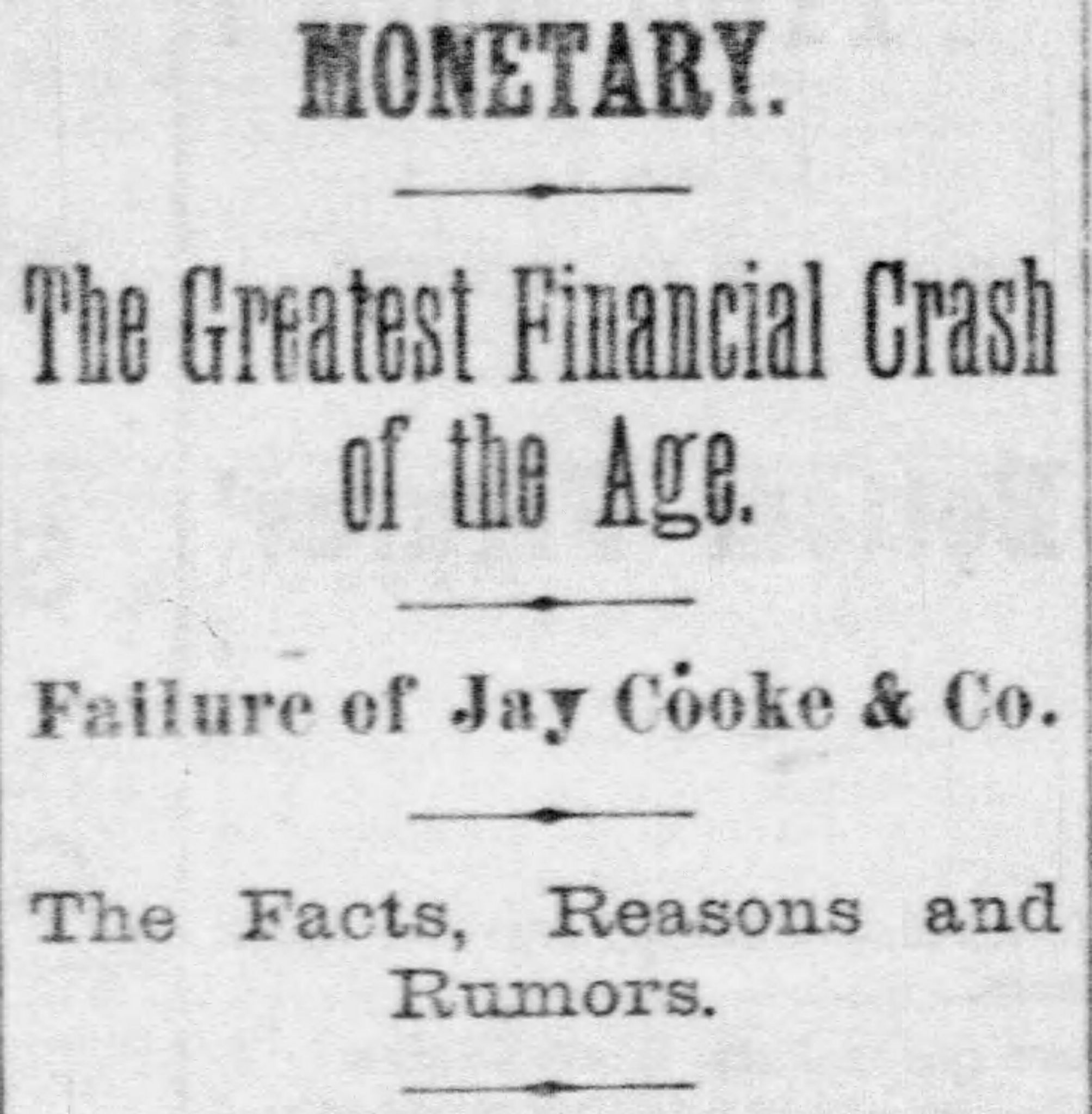
On a Thursday morning in September 1873, the largest bank in America failed.
Jay Cooke and Company was the bank that had sold the bonds that financed the Union side of the Civil War. Most Americans considered it as solid as the US government itself.
But Cooke had lately sunk enormous sums into building a second transcontinental railroad that wasn’t paying off.
When the money ran out, the bank had to shut its doors. The news set off a run on the banks.
Depositors rushed to pull their savings out of other banks, until those failed too. The stock exchange in New York closed its doors for ten whole days, something that had never happened before. It would become known as the Panic of 1873.
The panic became a depression that ground on for six long years. The price of crude oil sank to forty-eight cents a barrel, which in some towns made it cheaper than water.
For any of the remaining struggling oil refiners, the depression was the end.
For Standard Oil, it was a clearance sale. As Rockefeller would later say: “The strong feed during depressions.”
Standard had the largest cash reserves, lowest costs, and massive storage capacity to buyout his struggling competitors for pennies on the dollar. And seeing the news, Rockefeller even cut their dividend to pile up even more cash.
Refiners who had held out against him in the good times simply couldn’t in this slump. And when cash did grow scarce, Standard could simply pay with its own stock.
After the Cleveland massacre, the Standard Oil consolidation went national. And it went fast.
In the summer of 1874, Rockefeller invited two prominent oil refiners to meet him and Henry Flagler at Saratoga. The men were William Warden, from Philadelphia. And Charles Lockhart, from Pittsburgh. They had breakfast together. Then they talked for six hours in a pavilion while resort guests strolled outside.
Rockefeller laid out what he’d already done in Cleveland. In the last year alone, he told them, he’d shipped over 700,000 barrels and earned over a million dollars. He showed them his books and then he made his pitch.
Warden and Lockhart would transfer their Philadelphia and Pittsburgh refineries to him in exchange for Standard Oil stock. They would both come work for him. And they would in turn start absorbing their neighboring refiners, “as rapidly as persuasion or other means could bring it about.” They would keep the same names on all the doors. Nobody outside of that room would know.
Warden and Lockhart agreed.
Next, in October 1874, Standard brought in Charles Pratt & Company of New York, the New York Oil company. New York had the best market for oil and was the gateway to world exports. It was the last major piece of the puzzle.
Fully nine of every ten barrels of oil refined in the United States was now passing through Standard Oil.
And here is the part his enemies would never give him credit for. As Standard swallowed the chaos of the industry and squeezed the waste out of the trade, the price of kerosene fell, and kept falling, until light that had once been a luxury was something almost any family could afford.
And true to their name, the product had gotten safer. Kerosene had long been dangerously inconsistent, with bad, over-volatile batches turning lamps into bombs that could burn a house down. A barrel that carried the word Standard increasingly became a promise: this oil would burn clean and would not blow up the lamp.
On July 8, 1879, John D. Rockefeller turned forty. He was now one of the twenty richest men in America, and almost nobody in America knew it. That was just the way he liked it.
When a newspaper that year guessed at his fortune, it said five million dollars.
He didn’t correct them. He never did. But we know now that his Standard Oil stock alone was worth about eighteen million then.
The press had really only just discovered Rockefeller.
The year before, the New York Sun ended his obscurity with the first real profile of him ever printed. Exposing his monopoly, it called him one of the great commercial intellects of the country. But it also concluded that his success rested on some secret bargain with the railroads that people could sense but never quite prove. That double image, genius and suspect, would follow him to the grave.
The cost of building the machine was starting to show. He had been losing weight and was now lean to the point of gaunt, and his family had to remind him to buy a new suit when his old one got shiny. “I am eating celery,” he wrote to his mother in 1878, “which I understand to be very good for nervous difficulty.”
Decades later, as the richest man in the world, he admitted what those years had actually been like. “For years on end I never had a solid night’s sleep, worrying about how it was to come out… All the fortune that I have made has not served to compensate for the anxiety of that period.”
His wife Cettie was paying too. In 1876 the doctors diagnosed her as consumptive, and the family began organizing itself around her fragile health.
Which is part of how they came to buy an estate they called Forest Hill. Rockefeller had bought the land in 1873. It was seventy-nine wooded acres on a hill east of the city of Cleveland, with ravines and gullies and a view of Lake Erie.
Starting in 1877 the family began spending whole summers there, partly in hope the lake air would do Cettie good. It was a rambling house that had been built as a hotel, and critics would later mock it as “a monument of cheap ugliness.” Rockefeller didn’t care. “Oh, I like Forest Hill much better than any other home!” he remarked.
Forest Hill became his favorite place in the world. The place he started spending more and more time at. One summer he dammed a stream to make two lakes, one for boating and one for swimming. And on hot days he swam the mile-long circuit with a straw hat perched on his head to keep the sun off.
Then, in the winters, he flooded a pond for skating, and as many as fifty people, many of them strangers from the neighborhood, would skate on it. Since his faith would not allow the pond to be flooded on the Sabbath, he sometimes rose after midnight on Sunday night to direct the workmen in preparing the ice for Monday.
One of the richest men most Americans had never heard of, knee-deep in January, supervising a skating pond at one in the morning. That was Rockefeller at forty.
At Standard Oil, by the mid-1870s, the fight had moved out of the refineries and into the oil fields again. A new threat had emerged. It was a pipe.
The industry had evolved. Crude oil no longer traveled from a well to a railroad in barrels on a teamster’s wagon as it had 20 years before. Barrels were now barely even used. Crude oil now traveled through short pipelines to the trains where it was loaded onto tanker cars. Standard Oil had bought and built its way into control of nearly all these short pipes. When a driller struck oil, a Standard Oil crew would swoop in to connect the new well to their system immediately.
Almost all Pennsylvania crude now began its journey above-ground in a Rockefeller pipe and finished it on a railroad whose rates Rockefeller had carefully arranged.
In late 1877, the desperate remaining independent refiners crowded into Titusville, Pennsylvania for what they called a Petroleum Parliament. They were all hunting for a way out from under the Standard Oil machine.
The idea they landed on sounded close to impossible: a massive pipeline designed to move crude oil long distances of over a hundred miles. At the time, the longest pipeline ran just thirty miles, and nobody knew whether the crude oil could be pumped over a such a distance at all.
The independent refiners proposed to find out. They called it the Tidewater Pipeline.
The plan was audacious. It would be a six-inch pipe running from the Pennsylvania oil fields, up and over the Allegheny mountains, to a railhead owned by Philadelphia’s Reading Railroad. It was one of the few railroads not yet under Standard Oil’s thumb. It would carry the oil the rest of the way. If they could do it, they wouldn’t need to pay any rebates to Standard Oil.
If it worked, the freight advantages Standard Oil used to control the industry would be worth nothing.
Inside Standard Oil, the first reaction to hearing of this was laughter. One of Standard’s lieutenants wrote to Rockefeller that he was “greatly amused” by this pipeline scheme. Rockefeller wasn’t laughing though. He wrote back cautiously. “They are quite likely to have some disappointments yet,” he predicted, “before consummating all their plans in that direction.”
Then he set about manufacturing those disappointments himself.
Standard Oil fought it in every direction at once. They bought up massive strips of land running in straight lines across Pennsylvania. These became known as “dead lines” that the pipe would not be able to legally cross. Bewildered Pennsylvania farmers woke up rich as Standard Oil agents swept through their sleepy towns paying extravagant sums for farmland that had been worth just a fraction of that sum the week before.
Not being able to buy all the land though, Standard next planted stories in local papers warning farmers that a pipeline could leak and poison their crops.
Then, they started offering cut rates to any refiner that was tempted to become a Tidewater Pipeline customer. Then they went a step further and simply bought many of the refineries that were thinking of signing on. They also had help. The railroads, the other party greatly threatened by a pipeline, stepped in and refused the pipe permission to cross their tracks.
But the pipeline was being built anyway. When it was near completion, Rockefeller quietly offered three hundred thousand dollars just to buy his own stake in the project. He was refused.
In May 1879, the great pumps whirred to life and the oil started its journey east. Nobody yet actually knew if it could climb the mountains. For seven full days, the whole oil world tracked its slow crawl across Pennsylvania and up over the mountains. Then, finally, the first oil sputtered out at the far end, a hundred and nine miles away. The oil regions erupted in jubilation. The newspapers ranked the pipeline among the great engineering feats of the age.
The damn thing worked.
Inside Standard Oil: silence. One Standard Oil executive wrote to Rockefeller that “I feel extremely satisfied that the Tidewater Pipe Line can be stopped and torn up if it is thought best to do it. I also think that the sooner the Tidewater knows this the better.” Rockefeller vetoed this. He had something more elegant in mind.
He reached for his old playbook. Standard Oil cut its rates and the railroads cut theirs to levels one freight agent said barely covered the wheel grease of the railroads. This price war soon had the new pipeline running at half capacity. And then came a twist that says more about the era than any conspiracy could. The men behind the Tidewater pipeline had begun discussing how they might keep anyone else from building a pipeline like it.
The pipeline that was built to break the Standard Oil monopoly now wanted to protect their own monopoly.
Rockefeller did what he always did when he couldn’t kill a thing. He decided to absorb it as his own. If pipelines were the future, Standard Oil would own pipelines. But not just one. Standard Oil next laid four great lines of its own, from the oil fields to Cleveland, to New York, to Philadelphia and finally to Buffalo. By 1881, it had folded the whole web of pipelines into one single entity.
Standard now controlled the pipelines the same way it had once controlled the railroad rebates.
By 1881, Rockefeller had a problem almost no businessman in America had faced before. His company had outgrown the laws of the country it operated in.
Standard Oil was chartered as an Ohio corporation. But under the laws of that time, a corporation chartered in one state could not own property, or stock in other companies, in another state. Yet Standard Oil effectively controlled refineries in Pennsylvania, New York, New Jersey and Maryland, plus the pipelines, plus terminals and plants across the map.
Legally though, Standard Oil of Ohio wasn’t allowed to own almost any of it.
For years they had papered over this with improvisations. They had held most of their companies in secret. Properties in other states were parked in the names of various individuals from those states, men Rockefeller or Flagler trusted as caretakers. Then they used code names in the correspondence. It worked, barely, but the growing empire had become a coordination nightmare. Major decisions were now scattered between partners located in Cleveland, New York, Pittsburgh, Philadelphia and even Baltimore.
The empire had outgrown its disguises.
The solution, drafted with Henry Flagler’s help and signed on January 2, 1882, became known as the Standard Oil Trust.
The shareholders of Standard Oil of Ohio and roughly forty other companies handed over their stock to nine men, who became known as the trustees. Rockefeller was chief among them. In exchange, each shareholder received trust certificates, pieces of paper entitling them to their slice of the profits of everything, the whole combined machine.
The nine trustees now controlled all the companies, appointed every board, and could run them all as if they were one company, across every state line in the country. Technically, the trust itself didn’t exist anywhere. It couldn’t sign contracts. It kept no public books. And, most importantly, there was no law it violated because nothing like it had ever been done before.
A now seventy-million-dollar enterprise controlling nine of every ten barrels of oil, and the public still knew nothing about the arrangement.
Rockefeller held more than a third of it all, a block of shares worth about nineteen million dollars.
He was forty-two.
The trust did something else Rockefeller cared a great deal about. For the first time, Standard Oil existed as paper a person could own, and he urged every person he knew to buy it, especially Standard Oil employees.
He even made his own money available to help them do it. “I would have every man a capitalist, every man, woman and child,” he said. “I would have everyone save his earnings, not squander it; own the industries, own the railroads, own the telegraph lines.”
It worked better than any loyalty oath could have. The men, and families of Standard Oil, were now proper shareholders watching their certificates climb in value. As a result many of them closed ranks around the company like the faithful around a church.
As a result of it all, the word “trust” entered the American vocabulary because of Standard Oil. Because other industries soon copied the exact same form. Sugar. Whisky. Cotton oil.
Within a decade, the term “the trusts” would become shorthand for everything most Americans feared about big business, leading Congress to weaponize the legal system with a single landmark law aimed squarely at the form Standard Oil had invented.
They called it the Sherman Antitrust Act. The act was designed to prohibit monopolies and promote competitive markets.
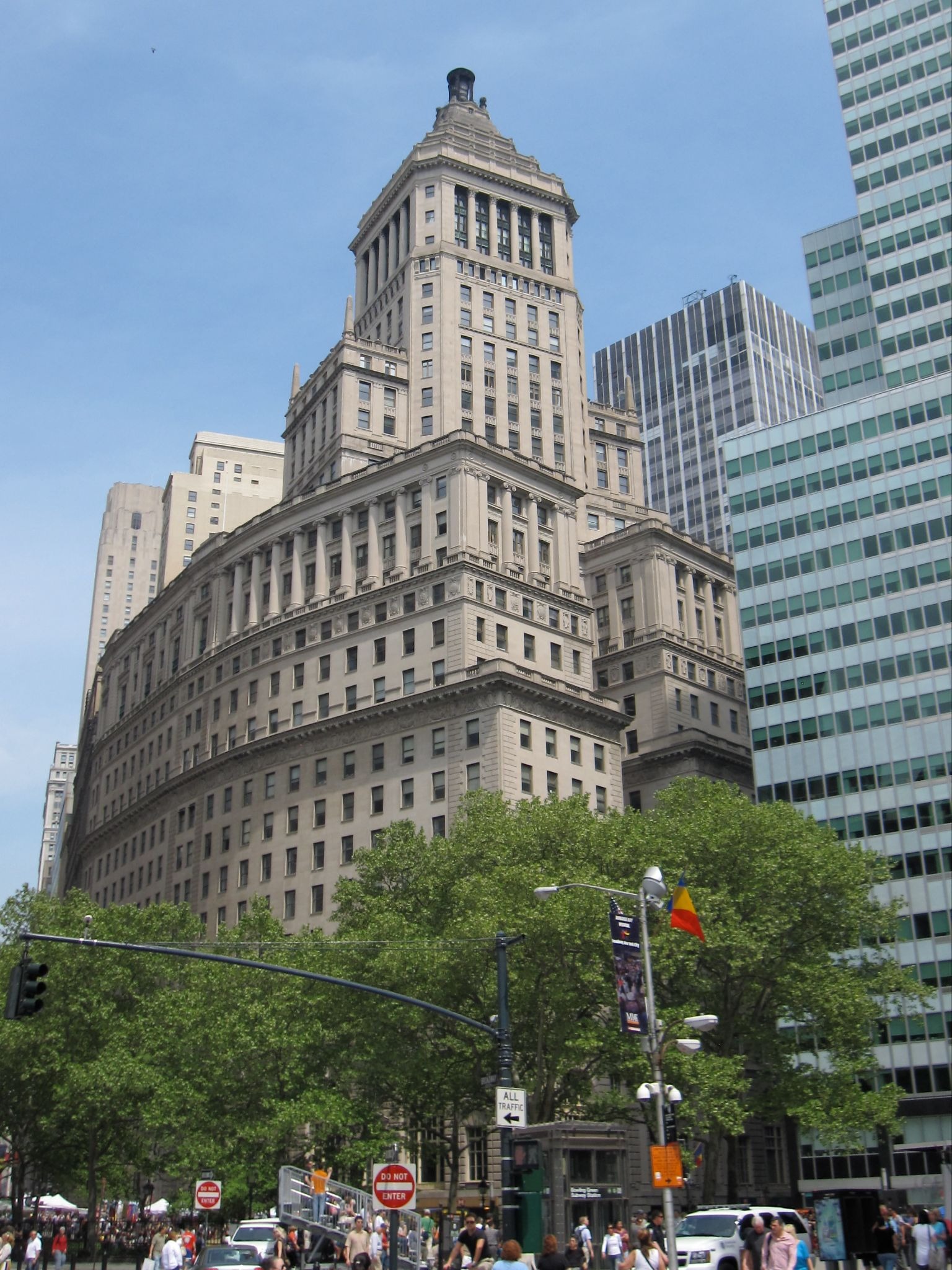
The trust had one more piece of unfinished business: geography. The oil trade now ran on exports, and the exports ran through the eastern seaboard, where Standard’s huge new refineries sat. One of Rockefeller’s partners put the problem to him bluntly. A two-headed calf, he said, belonged in a circus. “You can’t have one head in Cleveland and another in New York.”
New York won.
Henry Flagler had already moved to New York. In late 1883, Rockefeller himself followed, and then the rest of the Standard Oil men poured east after him. They settled into the same few blocks of midtown Manhattan, with Flagler taking a house on one corner of West Fifty-fourth Street and Rockefeller’s brother William on another.
The Rockefellers, with their instinct for invisibility, skipped Fifth Avenue, and bought a four-story brownstone on a quiet, shady side street.
At breakfast, after saying grace, Rockefeller sometimes read aloud to the family from the crank mail and threats that now swamped his office. Nobody quite knew why. Then he’d pull out a folder stuffed with begging letters and charity appeals from around the globe, and he assigned them to the children for further study.
His giving nearly doubled in those years, from sixty-one thousand dollars in 1881 to a hundred and nineteen thousand three years later. He was starting practicing for something far bigger, though nobody knew it yet. Including him.
On May 1, 1885, Standard Oil moved into its new headquarters: a nine-story granite fortress at the bottom of Broadway. The company’s name appeared nowhere on the outside. Just the street number. 26 Broadway. Within a few years that address would be shorthand, all over the world, for the oil trust itself. One reporter called the building “a cave for pirates, a den for the cutthroats of commerce.”
Inside, it was quiet. Deliberately quiet. Men moved through the halls like clerks in a counting house, not employees of a company that controlled the oil supply of a continent. People who entered instinctively spoke in hushed tones.
And Rockefeller sat in a back office facing the harbor.
The company was run by committees. Each department had one. Major decisions went to the Executive Committee, the nine trustees and their lieutenants, who gathered every day at noon for lunch at a long table on the top floor. The seating never changed. And Rockefeller deliberately did not sit at the head of the table. He gave that seat to the group’s oldest member and took a place along the side, among the others. It fooled no one and it didn’t need to. He didn’t dictate. He listened. Then he asked a few questions. And then he waited.
Sometimes he stretched out on a lounge after lunchtime and appeared to doze through the continuing arguments. “He might close his eyes now and then,” one executive remembered, “but he never missed a point.” Usually, the room came around to where he’d been all along, and the decision got made as if it had been everyone’s idea.
And what of Henry Flagler? He was still there every noon at the long table, one seat from the head. But something in him was beginning to wander. In the winter of 1883, he and Rockefeller had toured Florida together, looking over Jacksonville and a drowsy old Spanish town called Saint Augustine, listening to local men talk up the state’s prospects. Rockefeller saw a warm place to rest. Flagler saw something else.
Within a few years Flagler would start pouring his Standard Oil fortune into a second empire down there, railroads and grand hotels along the coast, the one that would put his name all over the map of Florida. The gilded streak his partner had always watched with quiet suspicion finally had somewhere to go. The parliament-of-two would keep meeting for years yet. But its great work was done.
By 1884 the company had outgrown Cleveland, its birthplace.
But Rockefeller kept coming back. Every summer to Forest Hill, his estate in East Cleveland.
The wide grounds. The trees he’d planted himself. The city where his father had dropped him off at a boarding house near the Erie Street Baptist Church, opened a small bank account, and left.
But, he was now a visitor in the city he’d first called home. The city whose refineries he had absorbed, one by one, until there was nothing left to absorb.
He was forty-five years old. He held more than a third of the largest industrial trust in the world. His kerosene now lit homes on four continents. His competitors had all been absorbed or broken. His name was on the letterhead at 26 Broadway, even if it wasn’t on the building.
But there was a writer who would one day aim to take all of it apart. Her name was Ida Tarbell. She was the daughter of a broken Pennsylvania oil man, and she had a score to settle.
She knew the trust’s greatest strength was its invisibility. As she later observed of Rockefeller’s maze of shell companies: “You could argue its existence from its effects, but you could not prove it.”
She thought she might be able to prove it now.
In May of 1887, one of the most senior men at Standard Oil sat down and wrote John D. Rockefeller a letter.
His name was William Warden. He was one of the Philadelphia refiners who had quietly folded his company into Standard Oil the decade before… He had grown richer than his wildest dreams for doing it. But he had gotten something else too. Something he hadn’t expected.
“We have met with a success unparalleled in commercial history,” Warden wrote in the letter. “Our name is known all over the world…” he continued, but “our public character is not one to be envied. We are quoted as the representative of all that is evil, hard hearted, oppressive, cruel.”
He begged John D. not to wave their dark public image away. “Don’t put this down or throw it to one side, think over it, talk with Mrs. Rockefeller about it. She is the salt of the earth.”
Near the end of his life, Rockefeller explained how he had decided to handle it. Suffice to say, he did not listen to William Warden.
“During all this time of outcry against us I determined it was useless to waste energy in denials and disputes with jealous or disappointed people. I persuaded our partners to keep silent, too. The more we progressed, yet kept on gaining success and keeping silent, the more we were abused. Mr. Flagler said to me, ‘Why, John, you must have a hide like a rhinoceros.’ We all said nothing and went on sawing wood.”
Sawing wood was what he meant by sticking to their business.
Doing so worked fine while nobody looked closely. The trouble started though, when somebody finally did.
His name was Henry Demarest Lloyd. He was a newspaperman who had married into the family that owned the Chicago Tribune, which left him rich and free to write what he wanted. He chose to write about Standard Oil. In March 1881 he ran an article called “The Story of a Great Monopoly”.
It was one of the first serious accounts of the Standard Oil Trust ever to appear in print. In it, he told forty million kerosene-burning Americans that the light in their homes was priced by a single company most of them had never heard of. He included a line built to be quoted: “America has the proud satisfaction of having furnished the world with the greatest, wisest, and meanest monopoly known to history.”
Lloyd also handed the company the nickname that stuck: The octopus. For decades after, Cartoonists would draw Standard Oil as a creature with tentacles around statehouses and railroads, with one arm even reaching for the dome of the Capitol.
As reporting goes, it was sloppy. Much of it rested on rumor and innuendo, and when Lloyd came back in 1894 with a whole book of it called Wealth Against Commonwealth, much of that was wrong too. It landed anyway, because underneath the ranting sat an idea many Americans were ready to believe: “Liberty produces wealth, and wealth destroys liberty.”
Rockefeller said he never read the book. His company, he said, “paid no more attention to all this nonsense than an elephant might be expected to pay to a tiny mosquito.”
Maybe so. But the mosquito had changed the weather. By 1888 the noise against the trusts had grown loud enough that both political parties were now condemning them and legislatures were opening investigations. That February, Rockefeller had to appear before a New York state senate committee, where he gave the performance that became his courtroom signature.
Sworn in, he kissed the Bible vehemently. Then, for hours, the man with the finest memory in American business turned into a vague and forgetful fellow wandering lost in the corridors of his own company.
The committee’s lawyer asked whether he had ever belonged to the Southern Improvement Company. Rockefeller caught the slip at once. The man had garbled the name. The real one was the South Improvement Company. Not “Southern.”
“There was such a company?” the lawyer asked.
“I have heard of such a company.”
“Were you not in it?”
“I was not.”
Every word of it was technically true. Years later he explained himself without a flicker of shame: “While they thought they were leading me into a trap, I let them go into the trap themselves.”
He won the battle that day, but lost the war.
The committee’s report delivered the sentence that trailed the company forever: “This is the original trust… It is the type of a system which has spread like a disease through the commercial system of this country.”
Here is the part that gets lost. By the time the country’s hatred of John D. Rockefeller reached full boil, he was barely going to work.
He had been fading out of 26 Broadway since the mid-1890s, and in 1897 at age fifty-eight, he stopped coming in at all.
Power passed to a man named John Archbold. He was small and quick, given to bounding down the corridors whistling “Onward Christian Soldiers,” but with a hard temper underneath the cheer. Under Archbold the prices crept up, the profits swelled, and the political methods got cruder.
But Rockefeller never announced he had left. His partners insisted he keep the title of president, and he agreed. But, he was president by name only. He no longer attended regular meetings or drew a salary. All the while though the public went on believing he was still the man giving the orders. For the next decade and a half he would answer personally for many decisions others were making. I suspect that because he was such a focal point for the public attention, the company was able to keep going for decades.
He kept declining the magazine profiles, almost weekly. One request came from a new magazine run by an editor named Samuel McClure, who was at that moment in Paris, recruiting an obscure young writer from Pennsylvania.
Her name was Ida Tarbell.
This one magazine writer did more damage to John D. Rockefeller than every senator, investigator, and ranting reporter combined. To understand why, it helps to start where she did, in the place where oil was first discovered in America, Northwestern Pennsylvania.
Her father built wooden tanks for the oil fields, and in the winter of 1872 the South Improvement Company arrived. The resulting fight turned the region inside out.
The talk of revolution thrilled her, she wrote later. Her father, who used to sing around the house and tell her funny stories from his day, was now silent and grim when he returned home. The oil region had been split in two: the many who fought the Standard Oil Monster, and the few who quietly sold out to it.
Franklin would point out the sellouts to his daughter on the street. “In those days,” she said, “I looked with more contempt on the man who had gone over to the Standard than on the one who had been in jail.”
Her route back to Standard Oil took twenty years. First she taught school, and then edited a small magazine. Then she went to Paris and wrote for American newspapers, a rarity among women of the time. It was there that she picked up Henry Demarest Lloyd’s book on Standard Oil ‘Wealth Against Commonwealth’ and rediscovered the company that had broken her father.
By then she was a rising star at McClure’s Magazine, one of the most read magazines in America. Its popularity came from its meticulously researched articles, tackling subjects near and dear to the public’s heart. Tarbell had spent a decade learning how to excavate a paper trail. And Standard Oil, after thirty plus years of business and investigations across numerous states had left one that no one had followed to the end yet.
As a young woman she had dreamed of writing the great American novel, with “the Standard Oil Company as a backbone.” Now, she got to write something better, her version of the story.
In September 1901, she sat down with her publisher and laid out a plan for a three-part series on the company. She privately doubted anyone would actually read such a long, story of a business. Nothing like it had ever been tried, even by McClure’s. Her father warned her off: “Don’t do it, Ida. They will ruin the magazine” he told her. She did it anyway.
And while she sharpened her tools, the man she was about to take apart was quietly starting to unravel himself.
For most of his life Rockefeller had paid no visible price for the way he worked or how the public was treating him and his company. But starting at the age of forty he had grown gaunt and was eating celery for what he called “nervous difficulty,” lying awake over a business that had never once failed him.
He had kept up that pace another decade. But, by 1891, at age fifty-one, with the public learning more and more about Standard Oil and the man behind it, it caught up with him.
Influenza put him down that winter, and then afterwards he had trouble breathing for weeks. Then came liver trouble, and then his digestive system stopped cooperating. He was soon a pale and haggard man who subsisted on milk and crackers. His doctor said it plainly: “A little more of that would have killed him. Mr. Rockefeller was close to the edge of a breakdown.”
It was the giving, as much as the empire, that broke him. While the country was learning to hate him as a money hoarder, his gifts to charity were actually doubling and doubling again, from $124,000 in 1889 to more than a million dollars three years later. But writing the checks wasn’t enough. Rockefeller took to giving the same way he ran his company: by knowing every detail. By his own account he “worked myself almost to a nervous breakdown in groping my way, without sufficient guide or chart, through the ever-widening field of philanthropic endeavor.”
So in March 1891, sick and stretched thin, he sent for a Baptist minister named Frederick T. Gates. Gates was an ex-preacher in his late thirties who had impressed Rockefeller during a recent campaign to build a Baptist university in Chicago.
“I am in trouble, Mr. Gates,” he told him. “The pressure of these appeals for gifts has become too great for endurance… These investigations are now taking more of my time and energy than the Standard Oil itself. Either I must shift part of the burden, or stop giving entirely. And I cannot do the latter.”
“Indeed you cannot, Mr. Rockefeller,” Gates replied.
“Well, I must have a helper. I have been watching you. I think you are the man.”
Gates took the job. For the moment he was a clearinghouse for all the begging letters Rockefeller received. Later he would become something much larger.
The ultimate cure for Rockefeller was just rest. Under the doctor’s orders he spent eight of the next twelve months at Forest Hill, and for the first time in twenty-one years, his mind cleared. He worked the fields beside his own laborers, rode around on his bicycle, and joked to all that would listen that he was training to be “a great concert singer.”
He recovered his body. He did not recover his hair.
The loss of hair had a name, alopecia, and in the end it took it all from him. It had started as an ordinary thinning in his late forties, but then sped up through the worst years of the 1890s, and finally left nothing at all behind. His wife Cettie kept the record in a memo book: “John’s moustache began to fall out, and all the hair on his body had followed by August.”
His head, his eyebrows, his eyelashes, every hair on his body vanished. Doctors then and now mostly shrug at the cause but severe stress sits on every list. And here was the cruelest part for him: the man who had spent his life controlling everything around him could not control or hide this. It was happening to his own face.
He met it with a kind of quiet, almost touching effort. He tried hair restoratives, and when they failed he bought a wig and tested it nervously at church one Sunday, and was relieved when the congregation approved. In time he kept a rotation of wigs cut to different lengths which he wore in sequence over the weeks so that his hair seemed to grow and then be freshly trimmed. He was an aging man going through gentle, elaborate lengths just to look ordinary.
The biggest cruelty of it was the timing. Because his enemies had taken to calling him a literal monster. His own estranged brother Frank used that exact word to describe him in one of Tarbell’s articles: Of course, it had been a figure of speech and taken out of context, but Tarbell never let that get in the way of her narrative.
The illness, as one biographer put it, made him look like “a hairless ogre, stripped of all youth, warmth, and attractiveness.” The illness had given him the physical face his accusers had always insisted he wore. And the worst use of it was still coming. In a few years, Ida Tarbell would point to this disease, this medical affliction, as the outward proof of the rot she said lay inside him.
The first installment of Ida Tarbell’s “The History of the Standard Oil Company” appeared in McClure’s Magazine in November 1902. Her original outline had three articles. But the public had other ideas, and the magazine’s rule was to keep printing as long as readers kept buying. It would in the end run nineteen installments over two and a half years.
What strengthened the series was that she had a man on the inside: Henry Rogers, who was a senior director of Standard Oil. Historians suggest that he was an arrogant man who reached out to her believing he could charm her and perhaps spin the story and settle some scores.
For two years she came to the Standard Oil office, whisked in one door and out another, while Rogers reviewed her findings and, she noticed, kept the light trained on the founder and off himself.
What made the series particularly lethal was its clinical calculation. Knowing that Standard Oil’s lawyers would pounce on any emotional outbursts, Tarbell weaponized a mountain of dry public records, footnotes, and court testimonies. By adopting the tone of a detached researcher, she masked her personal crusade, allowing the selected raw data to quietly dismantle the company’s reputation piece by piece.
And she gave the company its fair due with an entire chapter discussing its legitimate greatness. “There was not a lazy bone in the organization,” she wrote, “not an incompetent hand, nor a stupid head.” Having established that these were the best men in the world at what they did, she showed that despite all that, they had cheated anyway.
“Mr. Rockefeller has systematically played with loaded dice,” she concluded, “and it is doubtful if there has ever been a time since 1872 when he has run a race with a competitor and started fair.” To the old defense that everybody in the industry took rebates, she had a flat answer: “Everybody did not do it. In the nature of the offense everybody could not do it.”
Month after month, everything Rockefeller assumed was safely buried decades ago came back up in print. With the public crying for more, Tarbell delivered. The South Improvement Company. The Cleveland massacre. The drawbacks. She found one detail from a teenage office boy assigned to burn records at a Standard plant.
While doing so, he spotted in the furnace pile the name of his own Sunday-school teacher, a small independent refiner. The paper was from a railroad and it showed the man’s shipments from that week. Standard Oil was the largest refiner in the country but felt threatened enough by one man’s business to keep tabs on him.
The smallness of it was what shook Ida Tarbell the most. “There was a littleness about it that seemed utterly contemptible compared to the immense genius and ability that had gone into the organization,” she wrote.
And Rockefeller said nothing. As issue after issue was printed, associates begged him to answer, but he refused. “If she is right we will not gain anything by answering, and if she is wrong time will vindicate us,” was his response. Walking alongside him at his Forest Hill estate, a friend pressed him again to respond just as a worm crossed their path. “If I step on that worm I will call attention to it,” Rockefeller told him, motioning to it. “If I ignore it, it will disappear.”
The composure was a performance. On a train west, a companion read to him the most recent installment aloud, and he listened “with keen interest and no resentment.” Then he turned away any attempt to discuss it saying, “Not a word. Not a word about that misguided woman.”
Around the family he even started to call her “Miss Tarbarrel.” When an old Cleveland friend gently raised the subject, he shut that down too. “The world is full of socialists and anarchists. Whenever a man succeeds remarkably in any particular line of business, they jump on him and cry him down.” And “The crowd is always ready to help tear down a successful man.”
He believed it. In his head there was a complete, airtight story in which every critic was simply a sore loser. The old Cleveland refiners who had sold out to him in 1872 had taken his cash instead of his stock. They laughed at his folly. But soon their laughter died, replaced with regret and then jealousy as they watched the stock turn into fortunes for other men.
There was one place Rockefeller could almost always be found in Cleveland. And it had been that way for more than 30 years. At Church, teaching Sunday school. He had been the Church’s superintendent since 1872. He always came early in the morning to kindle the fire and stayed late to dim the gas lamps. “Boys, do you know why I never became a drunkard?” he liked to ask the room. “Because I never took the first drink.” He had been covering half the church’s budget out of his own pocket for decades. His faith was not a costume he put on. It was the oldest and steadiest thing within him.
Which was exactly why his pew had become a kind of attraction. The richest, most hunted man in the country sat in plain view in the ninth row every Sunday, and the church increasingly filled with people who had not come for the sermon. They were curiosity seekers, feature writers, panhandlers, and oil men angling to get near his money or pry loose a tip on Standard Oil stock. Instead, he gave them hymns and temperance lectures and nothing more.
He and Tarbell were in the same room exactly once, and he never knew it. In the fall of 1903, hearing that Rockefeller would give a special talk at his Cleveland Sunday school, Tarbell decided to attend. She got there first and watched as he entered the room. She watched him take off his coat and hat, and slide a black skullcap over his bald head, and sit down flush against the wall, where he could see the whole room.
“There was an awful age in his face,” she wrote afterwards of 64 year old Rockefeller, “the oldest man I had ever seen, I thought, but what power!”
She studied him for the two hour service, watching him crane his neck and scan the crowd, and decided for herself that he was afraid. She wrote: “I was sorry for him. I know no companion so terrible as fear.” It did not occur to her that she was maybe part of what he was scanning for. Nor did she know that he also searched congregations for another reason, to slip envelopes of cash to needy members after the service.
But her verdict was the one that stuck in the minds of the public. She wrote: “They had never played fair, and that ruined their greatness for me.”
Tarbell’s articles on Standard Oil were much more accurate than the Lloyd ones from earlier. Better researched and documented. But they also had their misses. One of the most famous stories in her whole series was called the Widow Backus affair. Mrs. Fred Backus was the widow of one of Rockefeller’s old Sunday-school friends. She had sold her late husband’s small lubricating works to Standard Oil in 1878 and then spent the rest of her life telling anyone who would listen that Rockefeller had robbed her blind.
Tarbell told this story as gospel.
But the records tell it very differently. The plant was obsolete. And she asked for as much as $200,000 for it. Standard’s appraisers came in and assessed it as worth far below that. But Rockefeller, out of personal regard for her, directed that $10,000 be added to the assessment. She was then paid $79,000. Then he offered, in writing, to undo the entire sale if she wished it.
She took the money and proceeded to put it into Cleveland real estate, dying years later worth more than $300,000. Her own brother-in-law later wrote to Rockefeller: “I know that you paid 3 times the value of the property, and I know that all that ever saved our company from ruin was the sale of its property to you.”
Rockefeller Biographer Ron Chernow, writing a century later with these papers in front of him, judged Tarbell’s series one of the great demonstrations of what a single journalist can do against seemingly invincible power. But he also concluded that it “does not, finally, stand up as an enduring piece of history.”
In 1905 Tarbell published a two-part character study of Rockefeller himself, but there the scalpel instead turned into a club. She described his alopecia as the outward sign of moral rot, the puffy flesh and thin lips of a “living mummy.” He could shrug off attacks on his business methods but this personal attack hit a nerve.
The same study dragged his father into the open. It revealed that the richest man on earth had a parent still alive out west, a traveling medicine man living under an assumed name. This was a secret Rockefeller had spent his whole life burying. Sixteen years earlier, in 1889, his mother Eliza had died at age seventy-six, never knowing that the husband who had drifted away from the family for decades was living as a bigamist under a false name. The day before her funeral, Rockefeller went to the minister who would deliver the eulogy and arranged for one detail to be added: that his mother had died a widow, faithful to the memory of her dead husband. The death certificate recorded the same fiction. At his mother’s funeral, Rockefeller, for the official record, had killed the old man off himself.
But now, Tarbell was digging the old man back up. As a result, for years, reporters hunted Big Bill Rockefeller. They were too late. He died in 1906 at ninety-six years old, buried under the name Levingston in an unmarked grave.
The family absorbed the rest. While the Tarbell series ran, his wife Cettie suffered a stroke that left her half-paralyzed for two years. Bessie, their eldest daughter, sank into a dementia she never came out of. And another daughter, Edith fled to Europe, depressed. Junior, gripped by migraines and insomnia, broke down entirely late in 1904 and spent most of a year recovering in France. All of this stayed hidden from the public. It was in these years that the father began confiding in the son.
“He used to talk to me about the criticisms,” Junior remembered, “and I think it eased his mind to do so… but he always ended up by saying: ‘Well, John, we have to be patient. We have been successful and these people haven’t.’”
Tarbell had set out to make him answer for all of it. But he never answered her. His focus always remained on staying out of the spotlight and concentrating on only what he could control. In July 1905, with Tarbell’s final installment on the stands, he wrote to Archbold, the man running Standard Oil now: “I never appreciated more than at present the importance of our taking care of our business, holding it and increasing it in every part of the world.”
The armor cracked once. In his late seventies Rockefeller sat for a long run of private interviews with a writer named William Hoster. Hoster had been a newspaperman, and one day he worked up the nerve to ask whether Mr. Rockefeller had ever considered that he might be partly responsible for how the papers had treated him.
Rockefeller was dumbfounded at such a suggestion. Then Hoster admitted that he himself had once written absurd stories about Rockefeller’s failing health. He explained that he had done so because when his editor sent him to check the facts, nobody would let him within a hundred feet of the man. The secrecy itself had become the story, because reporters like him had nothing else to go on.
Rockefeller stood in silence a full minute before murmuring, “So, it is all my fault.” Then, after another long pause, he went on: “I suppose there may be something in what you say, though I had never thought of it in that way before.”
The public verdict was one reckoning. The law was another, and it had been grinding toward Standard Oil for decades.
Congress had moved first. In 1890 the Sherman Antitrust Act became law, written in large part in response to what Standard Oil had built. But then, for a decade, almost nothing happened. The law was vague and barely enforced. It was so full of loopholes that people took to calling it the Swiss Cheese Act. Standard Oil lost no sleep or money over it.
The trust was simply very good at not being caught. Every time a court came close, the company would change shape. When Ohio’s courts ruled that their present arrangement was illegal, the partners dissolved it on paper into twenty separate companies but then continued to run all twenty from the same office. When the state next pressed for Standard Oil’s books, sixteen boxes of records turned up conveniently burned.
And in 1899 the empire slipped into its final and cleverest disguise. New Jersey had just made a new kind of company legal. It was termed a “holding company,” and its only job was to own other companies. So, the entire empire reorganized under a single entity: Standard Oil of New Jersey. It now held forty-one firms that operated from coast to coast.
If the government wanted to dismantle the machine now, it would have to sue a single, massive corporation and win. It would take a president willing to try.
In September 1901, an anarchist shot President McKinley, and a young man named Theodore Roosevelt took the oath of office. This new president drew a line between the good trusts and the bad ones and put Standard Oil at the top of the bad list. And in November 1906, his government sued under the Sherman Act to dissolve Standard Oil of New Jersey.
By the following summer, seven federal and six state suits were also opened and all running at once against Standard Oil.
The main case became the largest antitrust proceeding the country had ever seen. Over four hundred witnesses. Eleven million words of testimony. Twelve thousand pages. It would take almost five years.
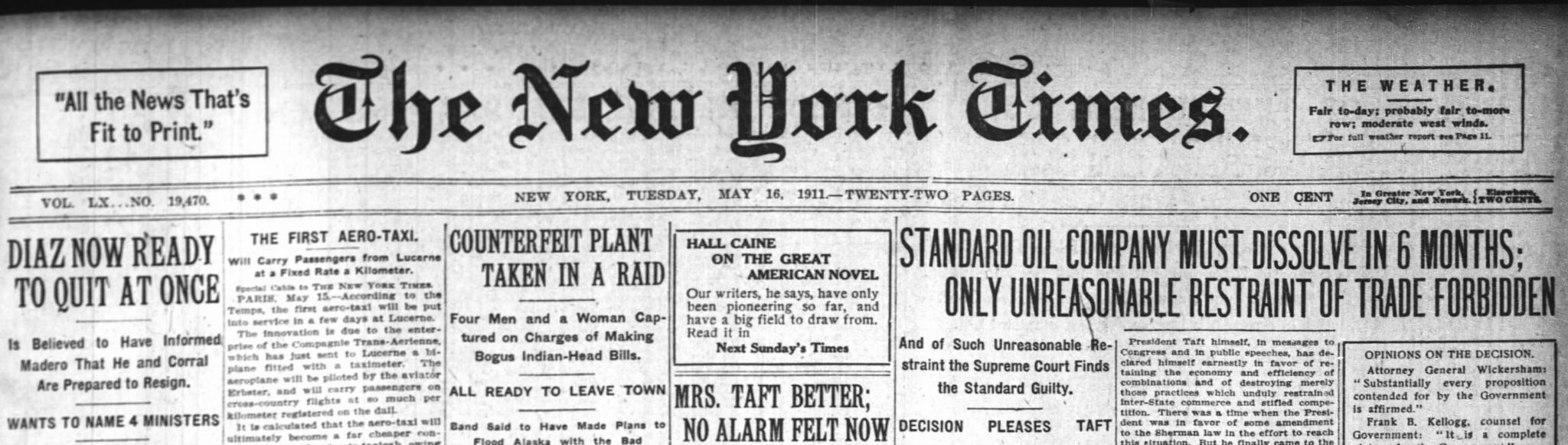
And on May 15th, 1911, the end finally arrived. In a sleepy Supreme Court chamber, Chief Justice Edward White read the opinion aloud, in a voice so low the other justices leaned over and asked him to speak up. The verdict inside the mumble: Standard Oil was deemed an unlawful monopoly. They gave it six months to break itself into thirty-four separate companies, forbidden ever to recombine.
Rockefeller was on the golf course that afternoon, playing with a Catholic priest from the nearby village, when the word arrived. He took the news in, then turned to his partner. “Father Lennon, have you some money?” The priest said no, then asked him why.
He responded with three words, “Buy Standard Oil.”
To his old partners he sent a wry note: “Dearly beloved, we must obey the Supreme Court. Our splendid, happy family must scatter.” The opinion itself, the one that broke up his life’s work, he refused to read.
Wall Street soon saw what the government had missed. J. P. Morgan asked the obvious question: “How the hell is any court going to compel a man to compete with himself?” When the thirty-four orphan companies began trading that December on the stock exchange, investors soon discovered that each one was stuffed with hidden assets.
The shares soon went vertical, propelled by each company being free to do what was in their best interest and the arrival of the automobile.
Just a year earlier, in 1910, gasoline-once a near-worthless byproduct routinely dumped into rivers-had outsold kerosene for the very first time. Now, every Ford Model T rolling off the assembly line was burning it, turning the thirty-four spun-off companies into a network of instant goldmines.
Rockefeller owned roughly a quarter of every new company. Worth about $300 million the day the court ruled, his fortune skyrocketed to nearly $900 million just two years later. It’s worth noting the entire federal budget of the United States was just $715 million at the time.
Roosevelt fumed from his retirement: “No wonder that Wall Street’s prayer now is: ‘Oh Merciful Providence, give us another dissolution.’ ”
The pieces took up names Americans would spend the next century buying gas from: Exxon, Mobil, Chevron. And the man who had preached for forty years had preached that corporate monopolies had come to stay, made more money from the dismemberment of his company than he ever made running it.
The government had finally won. But Rockefeller had not lost.
Strangely enough, the five plus years the government spent trying to take Standard Oil apart were the same years John D. Rockefeller really started trying to give it all away.
By the time he was sick in 1891, the checks alone had grown past a million dollars a year, and the appeals were starting to bury him, which is why he had hired Gates, the Baptist minister, in the first place.
For the first few years Gates was just a filter. He read the begging letters so Rockefeller didn’t have to. Then Gates began to do what Rockefeller had always done with a new business. He studied it. He went looking for the structure underneath.
In the summer of 1897, Gates sat down and read a dry medical textbook, Osler’s Principles and Practice of Medicine. He read it cover to cover, and came away unsettled. Most diseases, he realized, had no known cure, and almost no one in America was trying to find one. Here was a whole field nobody had organized, a great open territory of human suffering with no one organization on it yet. It was the chaotic oil regions again, and Gates knew exactly who to bring to it.
So, together they built a foundation the way Rockefeller had built an oil refinery. Hire the best people alive and then leave them alone. Build the system and then measure the results.
The first piece was a university. In 1889, even while Ohio’s lawyers had started circling, Rockefeller had begun pouring money into a new University in Chicago. It opened in October 1892, in the thick of the Standard Oil legal battle, with no ceremony. It did not have the Rockefeller name over the door. That was on purpose.
What it did have was a faculty so strong that the school entered the front rank of American universities on its very first morning. He would end up putting thirty-five million dollars into the University of Chicago over his lifetime. The students knew exactly who their silent founder was. They sang a song on campus that began, “There was a man sent from God whose name was John.”
The next piece was the body. In 1901 he founded the Rockefeller Institute for Medical Research in New York, the first American institution devoted purely to discovering the causes of disease. It was the answer to the open field Gates had found in that textbook.
The year after, more education. In 1902, came the General Education Board, founded with a million dollars of seed money and aimed at the wrecked schools of the American South. Within eight years its money had helped bring eight hundred Southern high schools into existence.
He also funded Spelman, the Atlanta school for Black women that carried his wife’s family name. He had started funding it in 1882, when it ran out of a leaky church basement, and he kept funding Black colleges for decades after.
Soon the giving machine would be running at full power. In 1902 a government scientist discovered that hookworm had infested the American South. Hookworm is a parasite that enters barefoot children through the soles of their feet and slowly drains them of energy. By some estimates two of every five Southern children at the time carried it. The cure, it was discovered, cost just fifty cents.
Rockefeller handed the problem a million dollars and an organization, and had Gates run it the way Standard Oil would have run a new territory. The money was leveraged to get state governments moving rather than to replace them. State health boards were the ones getting the credit. And the Rockefeller name was kept deliberately quiet. Young doctors were paid to fan out across rural counties, with public dispensaries expanding from two Southern counties to more than two hundred in three years.
In five years roughly half a million people were treated, and a regional curse fell to a minor infection. Some Southerners, sure there had to be an angle, decided that the wealthy Rockefeller was secretly getting into the shoe business.
The final and largest piece took the longest, and it was the purest version of the idea. It was designed to be a permanent, professionally managed fund so massive that its administration would be a public trust itself. In 1906 Gates wrote Rockefeller a letter that set the terms: “Your fortune is rolling up, rolling up like an avalanche! You must keep up with it! You must distribute it faster than it grows! If you do not, it will crush you and your children and your children’s children.”
Asking Congress to charter such a fund produced a national spectacle. Because the federal government was prosecuting Standard Oil as an illegal monopoly, a fearful Congress balked on the conundrum for three years until the Rockefeller family gave up. The Family finally bypassed Washington entirely. In 1913 New York State quietly chartered the Rockefeller Foundation with a deliberately limitless mandate designed to outlive its founders: “to promote the well-being of mankind throughout the world.”
Rockefeller endowed it with a hundred million dollars. This new foundation took the hookworm fight worldwide to fifty-two countries, bankrolled the campaign that all but eradicated yellow fever from the Americas, and built modern schools of public health from Baltimore to Calcutta.
By the time the dust settled, Rockefeller’s systemic giving eclipsed even the legendary lifetime benchmarks set by Andrew Carnegie.
None of it surprised the people who really knew him. “I do not believe a man has a right to hoard money,” he loved to say. He would repeatedly say he had been begging for good causes since boyhood, when he had first been tasked with raising money to clear the debt of the Erie Street Baptist Church.
A reporter once told him that he wanted to write about how the richest man in the world played, following orders from his newspaper. “Stop!” Rockefeller snapped at the man. “If we are to get along, you will have to find some other designation for me… Wealth isn’t a distinction. If I have no other achievement to my credit than the accumulation of wealth, then I have made a poor success of my life.”
To Rockefeller, philanthropy was never a late-career change of heart or a desperate washing of his family name, regardless of how it looked to a cynical public. He genuinely believed that the exact same God who had engineered his corporate fortune was now supervising him as he handed the keys back.
John D. Rockefeller and his son, John D. Rockefeller, Jr. are shown in 1915. Source: Cleveland Memory, Cleveland State University Library Special Collections Date: 1915
He passed the same philosophy onto his only son, John Junior, who reported for work at 26 Broadway on October 1, 1897, the same year his father quietly stopped coming in.
Junior was given no title and no instructions.“Father never said a word to me about what I was to do in the office before I began work there,” he remembered, “nor has he ever since.” So on that first day he filled inkwells and walked around trying to be useful.
Two years in came his first real test. A Wall Street con artist tricked the earnest young heir into a fraudulent stock deal, swallowing nearly a million dollars of his father’s money. Terrified, Junior went to report the disaster. The elder Rockefeller listened calmly, audited the figures without a single word of reproach, and said: “All right, John, I’ll take care of it.” The mistake was never mentioned again.
What Junior was never handed was the truth about how the massive fortune had been made. He had taken his parents’ morality entirely on faith, and his father left it that way. “Most of what my son knows of this situation,” Rockefeller once admitted of the South Improvement Company, “is his memory of what he has read in [Tarbell’s] book.”
Discovering his family’s history from a woman determined to destroy them half-broke the heir.
His migraines and the year he spent in France recuperating were the cost of defending a record he had never been allowed to really see, let alone understand.
In 1910 Junior made his decision. He resigned from the board of Standard Oil and stepped away from the business side for good. His real life’s work would be the other machine, the giving one. Over the next half century he moved more than a billion dollars of his father’s fortune out into the world. But even so, the weight of it never lifted; he carried the headaches for decades.
As Gates observed, Junior desperately wanted to escape his father’s shadow and forge an independent career, but he was “dedicated from his birth to overwhelming burdens, not to be evaded.”
He never stopped revering his father though. Years later, before a visit to his father, he wired ahead a single sentence that explains their whole relationship: “Am not coming because I think you need me but because I know I need you.”
Cettie’s health had been failing for years. By the time the worst of the Tarbell storm had passed she was confined to a wheelchair. She spent most of her time in bed, worn down by a list of ailments no doctor could quite name. Her husband cared for her with a tenderness that startled those who only knew one side of him.
At dinner he would slip a flower off the table, climb the stairs, and carry it up to her. On their fiftieth anniversary, in September 1914, he set a brass band on the lawn at their New York Estate and had her carried out to Mendelssohn’s wedding march. He had said the truest thing about her years earlier, from a pew in the old Cleveland church, looking up at her pale face: “The best thing I ever accomplished, and the thing that has given me the greatest happiness, was to win Cettie Spelman. I have had but one sweetheart and am thankful to say I still have her.”
She died in 1915. Unfortunately when she passed he was a thousand miles south from her, in Florida. When the two telegrams reached him, the first saying she was dying, the second that she was gone, he carried the news to the breakfast table, and his son and daughter-in-law watched him do the one thing they’d never seen him do. He wept, openly.
Then came the question of where to bury her, and the answer turned into one of the strangest episodes of his life.
For two years Rockefeller had been locked in a vicious tax fight with the state of Ohio. He had been a legal resident of New York since the 1880s when Standard Oil moved their office there. So he paid his taxes there, but Cettie’s long illness had stranded him at Forest Hill, his Cleveland estate, past the February date that decided who counted as an Ohioan for tax purposes. The County had kept tabs on him and pounced at his lapse, billing him a million and a half dollars. He refused to pay a cent of it. So, the governor of Ohio let it be known that if Rockefeller crossed the state line, he would be served with a subpoena on the spot.
Because the Spelman family plot was in Cleveland, the richest man in America could not bury his own wife without being ambushed at her gravesite.
So he didn’t go, not yet. He gave the newspapers a tender cover story, claiming he could not bear to let her go: “I want to keep her with me as long as I can.” What he actually did was park her casket for four and a half months in a granite mausoleum at Sleepy Hollow Cemetery in New York.
When he did finally move her to Cleveland, he did it as a heist.
On a day of pelting rain and hail, the mausoleum guards were sent down to the cemetery gate on a twenty-five-minute errand to fetch decorative plants.
While they were gone, an undertaker backed up to the vault. They peeled back the flower-covered pall, and lifted Cettie’s casket out and slid in an empty substitute container in its place.
Finally, they covered the fake box with the original flowers. The undertaker drove her out the front gate hidden inside a plain, rough, unmarked box, carried her to the railway station, and loaded her into a baggage car in the flashes of lightning. Nobody on the train knew there was even a body. She rode to Cleveland with the undertaker.
A man who helped arrange the smuggling remembered Rockefeller’s reaction: “To plan and carry out the removal of the body without the papers and the public discovering a thing until all was over, was a source of satisfaction to him.”
Running right alongside his genuine grief, was the satisfaction of a job well done.
He had beaten Ohio, outsmarted the press, and moved the person he loved most across a guarded state line and not a soul had laid a hand on it.
What waited in Cleveland was small, silent and secret. To ensure he wasn’t served by the Ohio courts, only a handful of people stood with him at the gravesite at Lake View Cemetery as Cettie was lowered. She would lay beside his mother Eliza, with a space left open between the two graves, so that one day he could lie there too, in the gap between his mother and his wife. “That was all so beautiful, so lovely,” he said. “It was just as mama would have wished.”
He never forgave the city for the insult: “Cleveland ought to be ashamed to look herself in the face when she thinks of how she treated us.” The town where he had built the whole machine, refinery by absorbed refinery, had chased his wife’s coffin to its grave.
When they inventoried Cettie’s wardrobe, it told its own story of their lifestyle. The wife of the richest man on earth had owned almost nothing of value. The costliest thing in her closet was a sealskin coat appraised at a hundred and fifty dollars.
By the mid-1910s the Standard Oil empire was scattered into 34 separate entities. And the money Rockefeller had made had built a giving machine that was running on rails he no longer had to touch. The public hatred had peaked and began, very slowly, to soften. What was left was the man himself: old, bald under a shifting rotation of wigs, and lighter than he had been in decades. Rockefeller turned his sights toward the one thing money could not buy, he decided he wanted to live to be a hundred years old.
Sometime around 1918, a small boy in Ormond Beach, Florida, called out to the old man walking past. “Hello, John D.!”
The old man was not offended. He just thought it could have been done better. “It would have been nicer,” he remarked afterward, “if he had said, ‘Hello, Neighbor John.’ ”
The town heard about this and began calling him Neighbor John. He cherished it. For many, he was the most hated man in America, builder of the octopus, the original trust. He was the living mummy of Ida Tarbell’s last installment, and a Florida resort town had now decided he was to be their idolized old neighbor. They thought of him as somewhere between a retired mayor and an old Sunday-school teacher.
Part of it was simply time. The so-called crimes Tarbell had documented belonged to the 1870s and 1880s. But 40 years later they had faded into a half-remembered era. Part of it was money: the country worshipped wealth in the roaring 1920s in a way it never had before, and John D. was its patron saint. And part of it was the company he now kept in the public mind. Ask an American in 1925 what the name Rockefeller meant and the answer was as likely to be a university, or hookworm, or yellow fever, as Standard Oil. The giving machine had done slow, quiet work on his reputation, and it had taken hold of the public.
And part of it was the dimes.
The dimes were his own idea. For years he had carried shiny coins to give out as he moved around, dimes for adults and nickels for children. Each one would be delivered with a small sermon: that the nickel was a year’s worth of interest on a dollar; save it, don’t spend it; work hard and be frugal and a fortune will come. He gave them to caddies on the golf course and to children on the street or to those who told him a good story at dinner. When somebody spilled something at his table, he would pour dimes over the stain as a tip for whoever mopped it up.
Then, a public-relations man Junior had hired, saw this the habit and let the newspapers and cameramen find it. By the end Rockefeller had handed out somewhere between twenty and thirty thousand dimes. People started to collect them. Molding them into amulets and framing them on walls. Old newsreels show him pressing dimes into palms, murmuring “Bless you, bless you” in a thin reedy voice, like a man giving communion.
A century later, visitors to his grave still leave dimes on the stone.
The famous soon came to meet him too. Henry Ford turned up one day at Ormond Beach without an appointment. He was told that Mr. Rockefeller appeared on the public golf course at exactly twelve minutes past twelve. He met him there at that precise instant. Ford studied the leathery face and the alert eyes and said afterward, “As soon as I saw his face I knew what had made the Standard Oil Company.”
The humorist Will Rogers came out for a golf game too. When Rockefeller handed him a souvenir dime, Rogers turned it over and said, “You know, after the company this little dime has been keepin’, I’m afraid it’s gonna be plumb lonesome in my pocket.” And when Rockefeller beat him on the golf course, Rogers said, “I’m glad you beat me, John. The last time you were beaten, I noticed the price of gasoline went up two cents a gallon.”
That Rogers dared to make the joke, and that Rockefeller threw back his head and laughed at it, said a lot. He had become a storybook character, a certified American original, and he knew it.
He was, by his own happy account, living his life backward. He had been a monument of self-control through more than sixty hard-working years, but as he reached his eighties, he entered a kind of late, mischievous boyhood.
He now owned sixty suits and several hundred ties and sometimes changed his clothes three times a day. He’d pick up hitchhikers to keep the conversation going on afternoon drives through the country. Pulling into a country filling station one day, low on gas, he leaned forward and told the woman at the pump, “My dear woman, we are on our way to heaven. And we’ll get there sooner or later.” She looked him up and down. “Yer may be on yer way to heaven, whoever you are,” she said, “but I warn yer you’ll never get there on five gallons o’ gas.”
It became one of his favorite stories.
What Rockefeller wanted now, more than money, which he had largely stopped being able to spend, was time. He had settled on a number. One hundred years old. And he treated the project the way he had treated everything else, as a problem of inputs and waste. He started eating a tablespoon of olive oil a day. He golfed each day in the open air. He’d have five rest periods a day on a fixed schedule.
His doctor had long prophesied that he would indeed reach a hundred, and the two of them shook hands on a pact to play a round of golf together on July 8, 1939, his hundredth birthday. Amazingly, his doctor did not make it, dying in the 1920s. But his patient soldiered on.
He cut waste till the very end. Studying the fire one evening at Ormond Beach, he asked the butler how long the sticks of firewood were. Fourteen inches, the butler told him. Would they do just as well at twelve? He asked. The butler supposed they would. Twelve inches gave enough heat and light but at less cost, and twelve inches it became. He was now in his nineties.
As his strength finally ebbed he negotiated with it the way he negotiated with everyone, by halves. He cut his golf from six holes a day to four, then to two, then, after a bad cold in 1932, finally gave it up for good.
He took off the silver wigs he’d been wearing daily for decades and never put them on again. He now mounted a stationary bicycle in his room to keep the muscle in his legs and pedaled slowly.
He was a wizened little man now under ninety pounds who had decided he was not done. When he turned ninety-six, his insurance company, honoring an old policy, had to pay him five million dollars. By the actuarial tables of the day, one out of a hundred thousand people lived as long as he had.
He did not reach one hundred. He missed it by a little over two years.
On May 22, 1937, Rockefeller ran through his usual comedy routine with Mrs. Evans, his housekeeper. She fished for a compliment. “Mr. Rockefeller, you haven’t said anything about how I look.” He made a small bow from his chair. “Mrs. Evans, that is because I am never able to do the subject justice.”
That same day he paid off the mortgage on the Euclid Avenue Baptist Church in Cleveland, the church whose congregation had approved of his very first wig. Before the day was over he had a heart attack. Soon after, he slipped into a coma and died in his sleep, just six weeks short of his ninety-eighth birthday.
His body went by private rail car to Cleveland, and was lowered into the ground between the two Baptist women who had believed in him without reservation his whole life: his mother Eliza and his wife Cettie.
So what to make of him.
Let’s start with the arithmetic, since he would have. By the time he and his son were done, his fortune had very largely been given away. He donated more than half a billion dollars in his own lifetime. Junior, spending the inheritance, moved more than a billion more. They funded a university, a medical institute that would help give the world vaccines, the campaigns that broke hookworm and yellow fever, schools of public health on three continents. A great deal of human suffering ended because he had decided that hoarding money was a sin and built a machine to get rid of it.
And the machine that made the money in the first place had run on rebates and spies and burned ledgers and the quiet ruin of men who had trusted his cash over his stock. Both of those things are true at the same time.
Tarbell got the second one mostly right, and his own papers, opened long after everyone involved was dead, showed it ran deeper than even she had proved. He went to his grave certain the critics were sore losers and that God was keeping the only books that mattered.
And yet history, in the end, has been kinder to the company than Tarbell was. Standard Oil rose out of an industry that was pure chaos, a frenzy of booms and busts and reckless overbuilding that ruined nearly everyone who touched it, and Rockefeller forced order onto it.
He drove the price of kerosene down so far and so steadily that ordinary families could afford to light their homes for the first time.
He brought science into the trade, a test laboratory in every refinery, and built the pipelines and tank cars, and worldwide distribution that became the template for the modern corporation.
Even the breakup made the point in its own backhanded way: the pieces turned out to be worth so much more apart than together that his own grandson, writing an economics thesis years later, sided with the court while still crediting Standard Oil for bringing order to the industry.
He had kept his own books from the start. Ledger A, the little volume where the boy clerk recorded his first wages and his first gifts in the same careful hand, telling the same story he would tell all his life: that the getting and the giving were one act, two columns in a single account, both of them done for the glory of God and the good of man.
He believed that completely.
The country never did settle the question. It went on doing with John D. Rockefeller what it had always done, lionizing him when it admired wealth and vandalizing him when it didn’t. He outlasted every verdict. He was the most hated man in America, and then he was Neighbor John pressing dimes into the hands of children, and the strangest part is that he had not changed all that much. The country had.
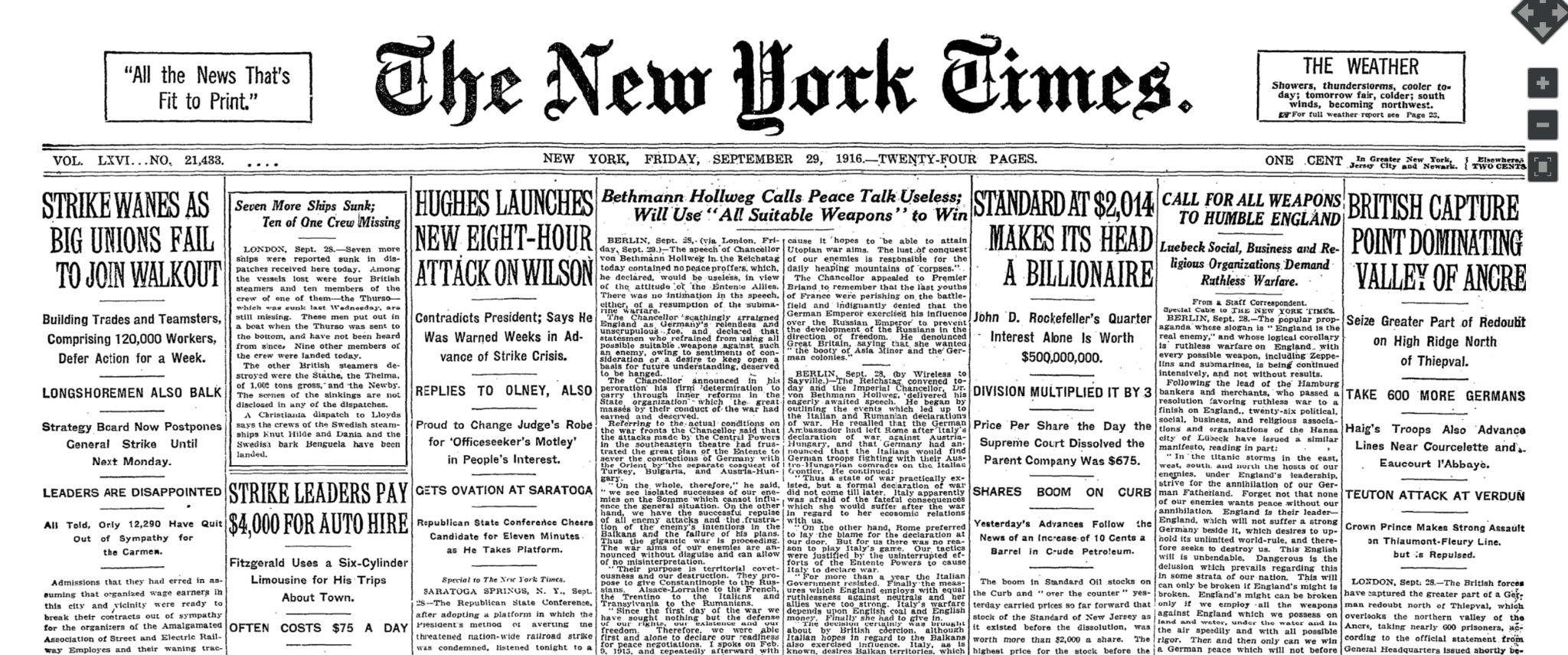
John D. Became the world’s first Billionaire, September 28th, 1916
Press cmd⌘ + p or ctrl + p to print this transcript. Sharing with one or two friends is ok. Posting on the internet is not.